
Pomegranate Juice vs. Grapefruit: Do You Need to Worry About Drug Interactions?
 May, 12 2026
Pomegranate vs. Grapefruit Interaction Checker
You probably know the drill with grapefruit juice. It’s the poster child for food-drug interactions, carrying warnings on labels for dozens of medications. But what about that ruby-red alternative sitting in your fridge? For years, a shadow of doubt hung over pomegranate juice, which has been studied for its potential to inhibit cytochrome P450 enzymes, specifically CYP3A4 and CYP2C9, critical for metabolizing many common drugs. Early lab tests suggested it might behave just like grapefruit, raising alarms among pharmacists and doctors. If you take blood thinners, statins, or immunosuppressants, you’ve likely wondered if you need to pour that glass down the sink.
The short answer is reassuring: current clinical evidence shows that pomegranate juice does not pose the same significant risk as grapefruit juice. While early laboratory studies raised red flags, human trials have largely debunked the fear. This distinction matters because it allows you to enjoy a nutritious beverage without unnecessary dietary restrictions, provided you stick to the juice itself rather than concentrated supplements.
The Lab vs. Reality: Why the Confusion Started
To understand why pomegranate got a bad reputation, we have to look at how drug interaction research works. Scientists often start with in vitro studies-experiments done in test tubes using human liver tissue. In 2005, researchers from Gifu Pharmaceutical University in Japan published findings that seemed alarming. They found that adding pomegranate juice to these liver samples almost completely blocked the activity of CYP3A4, an enzyme responsible for breaking down roughly half of all clinically used medications. The potency looked similar to grapefruit juice, which is known to cause dangerous spikes in drug levels.
This finding created a ripple effect. Animal studies followed, showing that rats given pomegranate juice before taking carbamazepine (an anti-seizure drug) had higher levels of the drug in their blood. On paper, the risk looked real. However, biology is messy, and what happens in a petri dish or a rat’s stomach doesn’t always translate to a human body. The concentration of compounds in the test tube was much higher than what you’d get from drinking a normal serving of juice. This gap between theoretical risk and actual patient experience became the central puzzle for pharmacologists.
Human Trials Set the Record Straight
Between 2007 and 2013, several rigorous human clinical trials were conducted to settle the debate. These studies are the gold standard because they involve actual people taking actual medications while consuming pomegranate juice. One pivotal study by Hanley et al., published in Clinical Pharmacology & Therapeutics in 2012, looked at flurbiprofen, a drug metabolized by the CYP2C9 enzyme. Participants drank pomegranate juice daily, and researchers measured drug levels in their blood. The result? No significant change. The geometric mean ratio for drug exposure was 0.98, essentially meaning the juice had no impact on how the body processed the medication.
Another key study by Farkas et al. in 2013 focused on midazolam, a sensitive marker for CYP3A4 activity. Again, participants consumed pomegranate juice alongside the drug. The data showed no alteration in bioavailability. The confidence intervals were tight, indicating a high level of certainty that pomegranate juice does not inhibit CYP3A4 in humans to a clinically relevant degree. These findings directly contradicted the earlier lab results and provided a solid foundation for updating medical advice.
| Feature | Grapefruit Juice | Pomegranate Juice |
|---|---|---|
| CYP3A4 Inhibition (In Vitro) | Strong | Moderate |
| Clinical Significance in Humans | High (Well-documented) | Negligible (No significant effects found) |
| FDA Warning Status | Required for 85+ drugs | No warnings issued |
| Evidence Rating (UW Database) | A (Strong evidence for interaction) | B (Moderate evidence against interaction) |
| Dietary Restriction Advice | Avoid with specific meds | Generally safe |
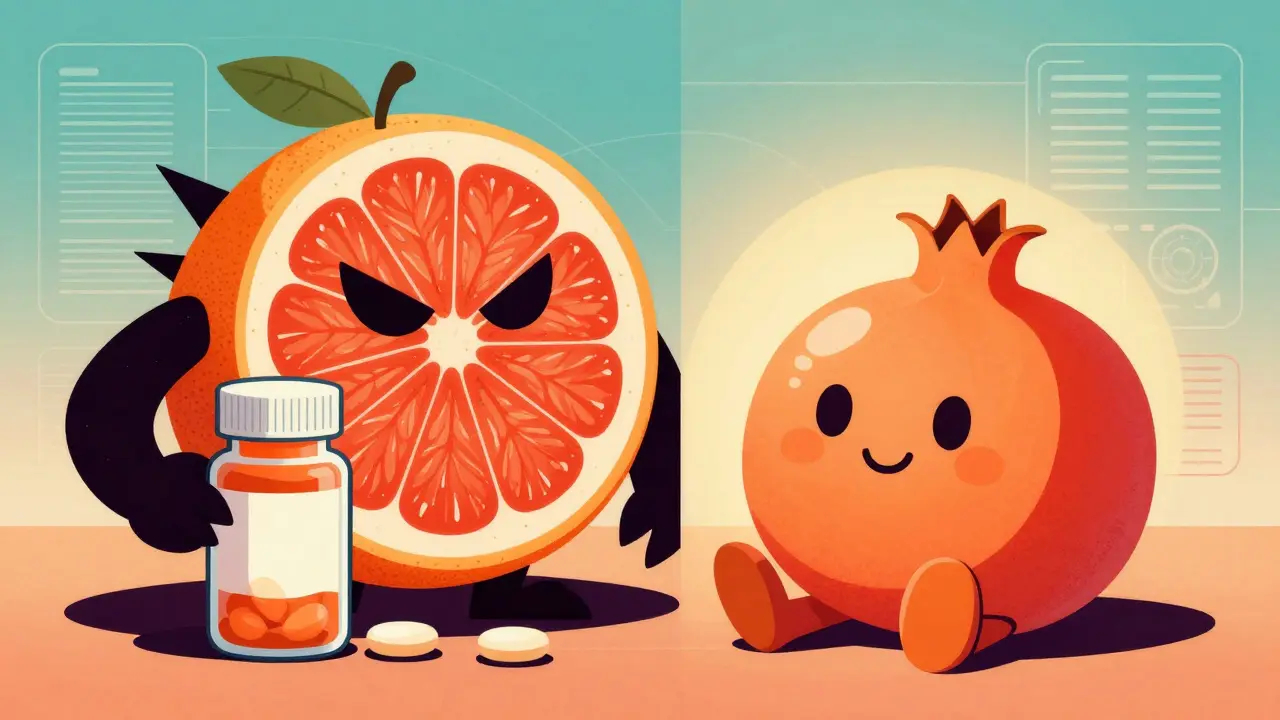
Why Grapefruit Is Different
If both juices contain compounds that can inhibit enzymes in a lab, why does grapefruit juice cause problems while pomegranate doesn’t? The difference lies in the concentration and stability of the active compounds. Grapefruit contains furanocoumarins, which irreversibly bind to CYP3A4 enzymes in the intestinal wall. When you drink grapefruit juice, these compounds destroy the enzymes right where the drug absorption happens. Your body can’t replace them fast enough, so the next dose of medication isn’t broken down properly, leading to toxic levels.
Pomegranate juice contains ellagitannins and other polyphenols, but they don’t seem to reach the intestinal wall in high enough concentrations to cause this irreversible damage in humans. Even though lab tests show inhibition, the human digestive system processes the juice differently. The compounds may be metabolized too quickly or bound to proteins before they can interact with the enzymes. This explains why the "theoretical risk" never materializes into "clinical reality" for most patients.
The Extract Exception: Supplements Are Not Juice
Here is where things get tricky. While pomegranate juice appears safe, pomegranate extract supplements tell a different story. Extracts are concentrated forms of the fruit, often containing much higher doses of the active compounds than you’d find in a glass of juice. A case report published in the Journal of Clinical Pharmacy and Therapeutics described a patient whose INR (a measure of blood clotting time) spiked from 2.4 to 4.1 after starting pomegranate extract while on warfarin. Warfarin is metabolized by CYP2C9, and a spike like this can lead to dangerous bleeding.
This highlights a crucial distinction: juice is a food; extract is a supplement. The regulatory oversight for supplements is less strict, and the variability in potency is high. If you are taking narrow therapeutic index drugs-medications where small changes in dose can cause harm-you should treat pomegranate extract with caution. Always clarify with your pharmacist whether you are discussing the fresh juice or a capsule.

What Experts Say Today
The medical consensus has shifted significantly since those early 2005 studies. Dr. Stephen M. Stahl, a prominent psychopharmacologist, emphasized in a 2014 editorial that clinicians should base their advice on human studies, not lab data. He noted that the risk of interaction with pomegranate juice is negligible for patients on CYP2C9 substrates. Similarly, the American Society for Clinical Pharmacology and Therapeutics issued a position statement clarifying that avoidance is not necessary based on current evidence.
Despite this, misinformation persists. A survey found that nearly 70% of physicians incorrectly believed pomegranate juice required the same restrictions as grapefruit. This educational gap puts patients at risk of unnecessary anxiety and restricted diets. As of 2024, major resources like the University of Washington’s Drug Interaction Database rate the evidence for pomegranate juice interactions as "B," meaning there is moderate evidence against an interaction. This is a strong endorsement of its safety compared to the "A" rating for grapefruit, which confirms strong evidence for interaction.
Practical Advice for Patients
So, what should you do at breakfast? If you are taking medications metabolized by CYP3A4 or CYP2C9-including statins, certain blood pressure meds, and some antidepressants-you can generally continue drinking pomegranate juice. There is no need to separate it from your medication by hours, unlike with grapefruit. However, moderation is always wise. Drinking liters of any juice can affect your blood sugar and overall nutrient balance, which indirectly impacts health.
Keep an eye out for confusion between juice and extract. If you buy a bottle labeled "pomegranate juice," you are likely safe. If you buy a pill or powder labeled "pomegranate extract" or "punicalagin concentrate," check with your doctor first. Also, remember that individual responses can vary. If you notice unusual side effects after starting pomegranate juice, mention it to your healthcare provider. While rare, personal physiology can sometimes defy general trends.
Can I drink pomegranate juice with warfarin?
Yes, you can generally drink pomegranate juice with warfarin. Human clinical trials have shown that pomegranate juice does not significantly alter the metabolism of warfarin, which is processed by the CYP2C9 enzyme. However, avoid pomegranate extract supplements, as concentrated forms may increase bleeding risk. Always monitor your INR levels regularly as directed by your doctor.
Is pomegranate juice safer than grapefruit juice with statins?
Yes, pomegranate juice is considered much safer than grapefruit juice when taking statins. Grapefruit juice strongly inhibits CYP3A4, leading to potentially toxic levels of statins in the blood. Current evidence indicates that pomegranate juice does not cause clinically significant inhibition of this enzyme in humans, making it a safer alternative for those who want to avoid grapefruit restrictions.
Why did early studies say pomegranate interacts with drugs?
Early studies were conducted in laboratories using human liver tissue (in vitro). These tests showed that compounds in pomegranate could block drug-metabolizing enzymes. However, these conditions didn't account for how the human digestive system processes the juice. Later human clinical trials proved that the concentration of active compounds reaching the intestines is too low to cause significant interactions.
Do I need to wait between taking my meds and drinking pomegranate juice?
No, you do not need to separate pomegranate juice from your medication. Unlike grapefruit juice, which causes long-lasting enzyme damage, pomegranate juice does not appear to interfere with drug absorption or metabolism in a way that requires timing adjustments. You can consume them together safely.
Are pomegranate supplements safe for everyone on medication?
Are pomegranate supplements safe for everyone on medication?
Not necessarily. Pomegranate extract supplements are highly concentrated and may contain higher levels of active compounds than juice. There are case reports of increased bleeding risk with warfarin when using extracts. If you take narrow therapeutic index drugs, consult your doctor before starting pomegranate extract supplements.