
Quality Assurance Units: Why Independent Oversight Is Non-Negotiable in Production
 Mar, 13 2026
When a batch of medicine goes out the door, someone has to say yes - and that someone must be free to say no. That’s the core idea behind quality assurance units (QUs). These aren’t just departments that check boxes. They’re the last line of defense between a flawed product and a patient’s body. And if they’re not truly independent, that defense crumbles.
What Exactly Is a Quality Assurance Unit?
A quality assurance unit is a formally recognized group within a manufacturing facility with one job: protect quality, no matter what. In pharmaceuticals, nuclear energy, and other high-risk industries, this isn’t optional. Regulatory agencies like the FDA and EMA require it. The unit doesn’t run production. It doesn’t meet production targets. It doesn’t answer to the plant manager. Its only loyalty is to the product’s safety and compliance.
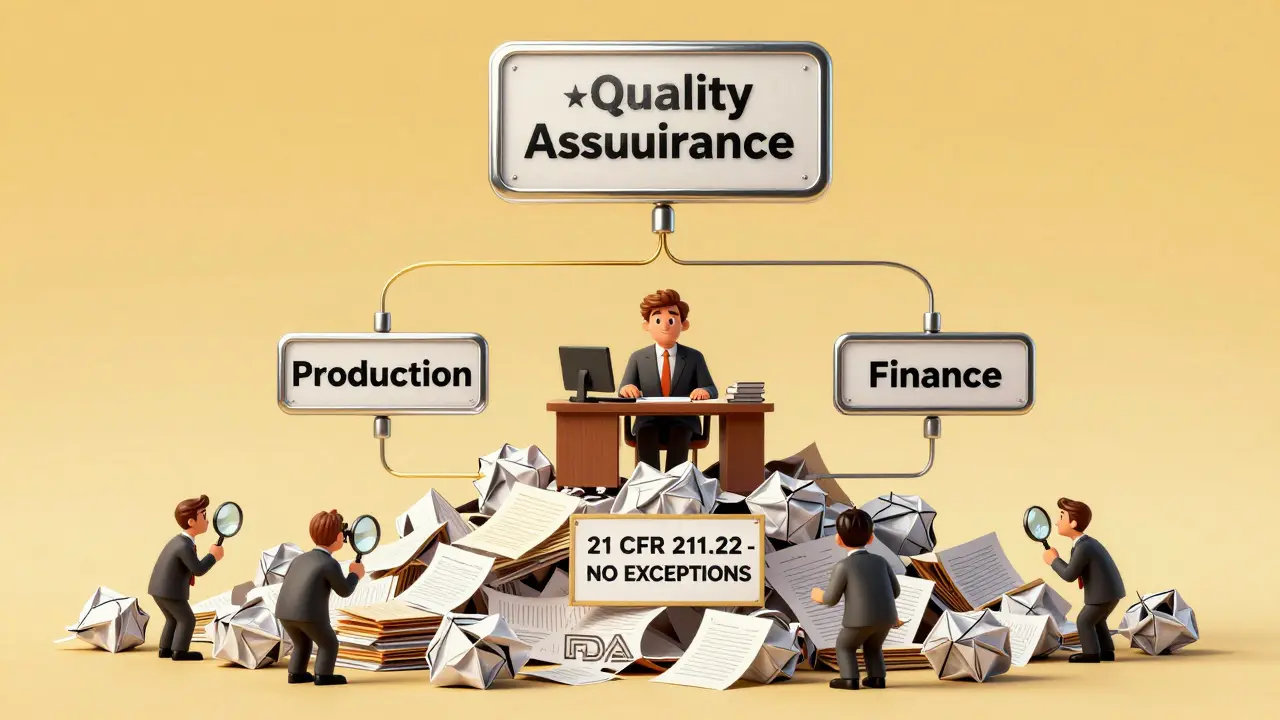
Under 21 CFR 211.22, the quality control unit must have the authority to approve or reject everything - from raw ingredients to finished vials. That means if a batch doesn’t meet specs, the QU can stop it. No negotiation. No exceptions. This isn’t advice. It’s a legal requirement.
The difference between quality control (QC) and quality assurance (QA) matters too. QC tests samples. QA sets the rules. QA reviews procedures, audits records, investigates deviations, and ensures systems work. QC says whether a batch passes. QA says whether the whole system is fit to make batches in the first place.
Why Independence Isn’t Just a Good Idea - It’s a Rule
Imagine a production manager who’s under pressure to hit monthly targets. Now imagine that same manager also runs the quality unit. What happens when a batch shows a minor deviation? Do they approve it to keep the line running? Or do they reject it, even if it means losing money?
The FDA made this clear in its 2006 guidance: “Quality decisions must remain objective and focused on product quality rather than production metrics.” If the QU reports to production, it’s not independent. It’s compromised.
Real-world data backs this up. In 2024, 68% of FDA warning letters cited failures in QU independence. That’s up from 29% in 2020. Facilities where the QU was buried under manufacturing leadership had 63% more data integrity violations. That’s not coincidence. It’s cause and effect.
One case from a mid-sized pharma plant in 2024 shows how quickly things go wrong. After restructuring, the production manager was also named QA lead. Within three months, two critical deviations went uninvestigated. The batches shipped. The FDA found out. The plant got a 483 observation. The CEO had to step in and rebuild the entire quality structure from scratch.
How Independence Works in Practice
True independence means three things:
- Direct reporting line - The QU reports to the CEO or Board, not to the head of manufacturing. In 87% of compliant organizations, QU leaders have direct access to top executives without going through production channels.
- Separate budget and resources - The QU can’t be starved for staff or tools. ISPE benchmarks show that QUs should make up 8-12% of total manufacturing staff. Facilities with fewer than 1 QU staff per 15 production workers see 3.2 times more repeat deviations.
- Clear authority to halt production - If a batch is questionable, the QU must be able to put it on hold. No approval needed from production. No “let’s wait until tomorrow.” That authority is written into FDA regulations. Yet, 33% of quality professionals surveyed in 2025 said they lacked this power - even though they were supposed to have it.
Documentation is just as critical. Warning letters in 2024 cited inadequate organizational charts 95% of the time. If you can’t show who reports to whom, regulators assume the worst.
Industry Differences: Pharma vs. Nuclear vs. ISO
Not all industries treat independence the same way.
In U.S. pharmaceutical manufacturing, the FDA demands complete separation. The QU can’t be part of production, even in small ways. The European Medicines Agency (EMA) is slightly more flexible - they allow integration as long as “effective mechanisms” ensure quality decisions stay independent. But even EMA requires that the QU never be organizationally subordinate to production.
Nuclear facilities take it further. The IAEA requires a four-layer oversight model: peer checks, senior manager reviews, independent oversight, and external audits. Independent oversight personnel must be free to raise concerns without fear of retaliation. This isn’t bureaucracy - it’s survival. After Three Mile Island, the nuclear industry learned that silence kills.
Compare that to ISO 9001-certified manufacturers. Many treat quality as an advisory function. Their QU can recommend changes, but can’t stop production. That’s fine for furniture or electronics. It’s dangerous for medicine.
The Cost of Getting It Wrong
Bad quality doesn’t just mean a recall. It means lives at risk.
Organizations with truly independent QUs have 37% fewer critical compliance failures during inspections. They resolve critical deviations 28% faster. And they’re 31% more likely to pass their first FDA inspection.
But the flip side is brutal. Small companies with fewer than 50 employees are 2.3 times more likely to fail on QU independence. Why? Resource constraints. They can’t afford a separate team. So they double up roles. And that’s where the cracks appear.
That’s why third-party quality oversight services are growing at 14.2% annually. Small manufacturers are outsourcing their QU functions to independent consultants who have no ties to production. It’s not ideal - but it’s safer than pretending to be compliant.
What Does a Good QU Look Like?
It’s not about titles. It’s about behavior.
Staff in a strong QU have:
- At least 8 years of industry experience on average
- 100% GMP training
- 78% trained in statistical process control
- 65% with formal conflict resolution skills
They don’t just review paperwork. They walk the floor. They ask hard questions. They sit in on shift handovers. They challenge assumptions. And they’re not afraid to say, “This batch doesn’t go out.”
One company, Eli Lilly, tried something new in 2024: “quality ambassadors.” They trained production staff in quality principles - but kept the QU completely separate. The result? A 40% improvement in quality culture. Workers started speaking up. Managers stopped ignoring red flags. The QU didn’t get bigger. But it became more effective.
The Future: AI, Digital Systems, and New Challenges
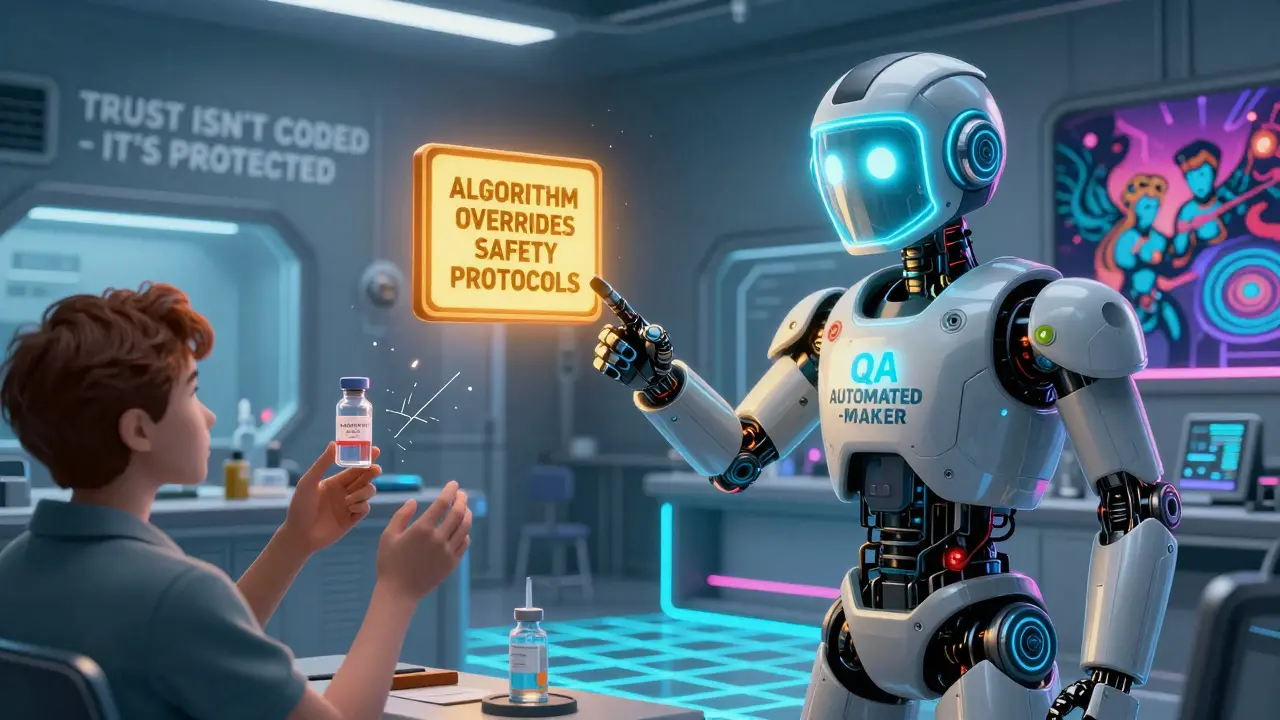
Now, factories are getting smarter. AI monitors temperature, pressure, and contamination in real time. Algorithms decide when to adjust a process. But who oversees the algorithm?
The FDA’s 2025 draft guidance warns that digital systems can blur the lines. If an AI makes a quality decision, is the QU still in control? Can it override the algorithm? Can it audit its logic?
MIT’s 2025 roadmap suggests the future won’t be about organizational charts - it’ll be about algorithmic separation. The system itself must be designed so that quality decisions can’t be overridden by production goals. That’s the next frontier.
But here’s the truth: no algorithm replaces human judgment. No code replaces accountability. The principle stays the same: someone must have the power to say no - and no pressure to say yes.
Final Thought: It’s Not About Control - It’s About Trust
Some managers think independence creates distance. They say it slows things down. But the real cost isn’t speed - it’s trust.
Patients trust that their medicine is safe. Regulators trust that companies are doing the right thing. Employees trust that their concerns won’t be ignored.
When a quality assurance unit is truly independent, it doesn’t stand between production and progress. It protects both. Because in the end, quality isn’t a department. It’s a promise.
Dylan Patrick
March 14, 2026 AT 18:46Elsa Rodriguez
March 15, 2026 AT 07:54Stephanie Paluch
March 17, 2026 AT 03:00Aaron Leib
March 17, 2026 AT 10:18tynece roberts
March 19, 2026 AT 08:40Hugh Breen
March 20, 2026 AT 05:39Lorna Brown
March 22, 2026 AT 01:13mir yasir
March 23, 2026 AT 03:51Rex Regum
March 24, 2026 AT 10:51Buddy Nataatmadja
March 25, 2026 AT 02:08Serena Petrie
March 26, 2026 AT 02:16Byron Boror
March 26, 2026 AT 06:10