
Presumed Consent in Pharmacy: When Pharmacists Can Switch Your Medication Without Asking
 Dec, 15 2025
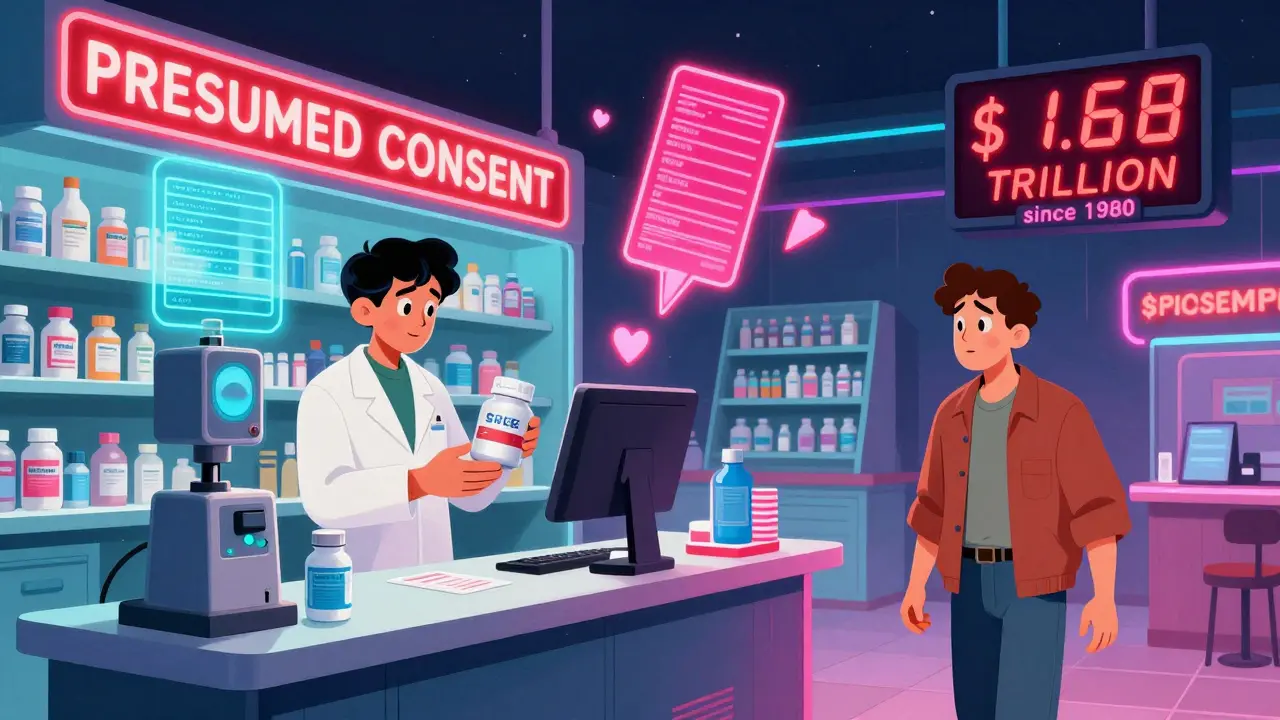
Every year, over 4 billion prescriptions are filled in the U.S. Most of them-nearly 9 in 10-are generic drugs. You probably didn’t even notice the switch. That’s because in 43 states, pharmacists are allowed to swap your brand-name drug for a cheaper generic version without asking you first. This is called presumed consent.
What Does Presumed Consent Actually Mean?
Presumed consent means the law assumes you’re okay with getting a generic drug instead of the brand-name one your doctor wrote on the prescription. You don’t have to say yes. You don’t even have to be asked. The pharmacist just does it-unless you’ve told them not to, or your state says they can’t for certain drugs. This system started in the 1980s after Congress passed the Hatch-Waxman Act, which made it easier for generic drug makers to get FDA approval. The goal? Save money. And it worked. Generic drugs now make up 90% of all prescriptions but cost only about 15% of what brand-name drugs do. Over the last decade, this has saved the U.S. healthcare system an estimated $1.68 trillion.How It Works: The Rules Vary by State
Not every state treats substitution the same way. There are five big differences that matter:- Do pharmacists have to substitute? In 19 states-including California, Texas, and Illinois-they’re required to switch to generics if available. In the other 31, they can choose to, but aren’t forced to.
- Do they need your permission? Only 7 states plus Washington, D.C. require explicit consent. That means in those places, the pharmacist has to ask you, “Want the generic?” The other 43 states operate under presumed consent.
- Do they have to tell you after? In 31 states plus D.C., pharmacists must give you some kind of notice after the switch-even if you didn’t say yes. That could be a printed slip, a note on the label, or a verbal reminder.
- Are they protected from lawsuits? In 26 states, pharmacists can’t be held more liable for substituting than if they’d given you the brand name. In the other 24, they’re on their own if something goes wrong.
- Are there exceptions? Yes. For drugs where small changes in dosage can cause big problems-like epilepsy meds, blood thinners, or thyroid drugs-many states block substitution unless you specifically agree.
Why Some Drugs Are Off-Limits
Not all medications are created equal. For drugs with a narrow therapeutic index-meaning the difference between a helpful dose and a dangerous one is tiny-substitution can be risky. The American Epilepsy Society recorded 178 cases of breakthrough seizures between 2018 and 2022 linked to generic switches in antiepileptic drugs. That’s why 15 states, including Tennessee and Hawaii, have special rules. In those places, pharmacists can’t swap your seizure medication unless you or your doctor says it’s okay. The same applies to warfarin (a blood thinner), levothyroxine (for thyroid), and some psychiatric drugs. The FDA says all A-rated generics are therapeutically equivalent. But doctors and patients have reported differences in how they feel after switching-even if lab tests show the levels are “the same.”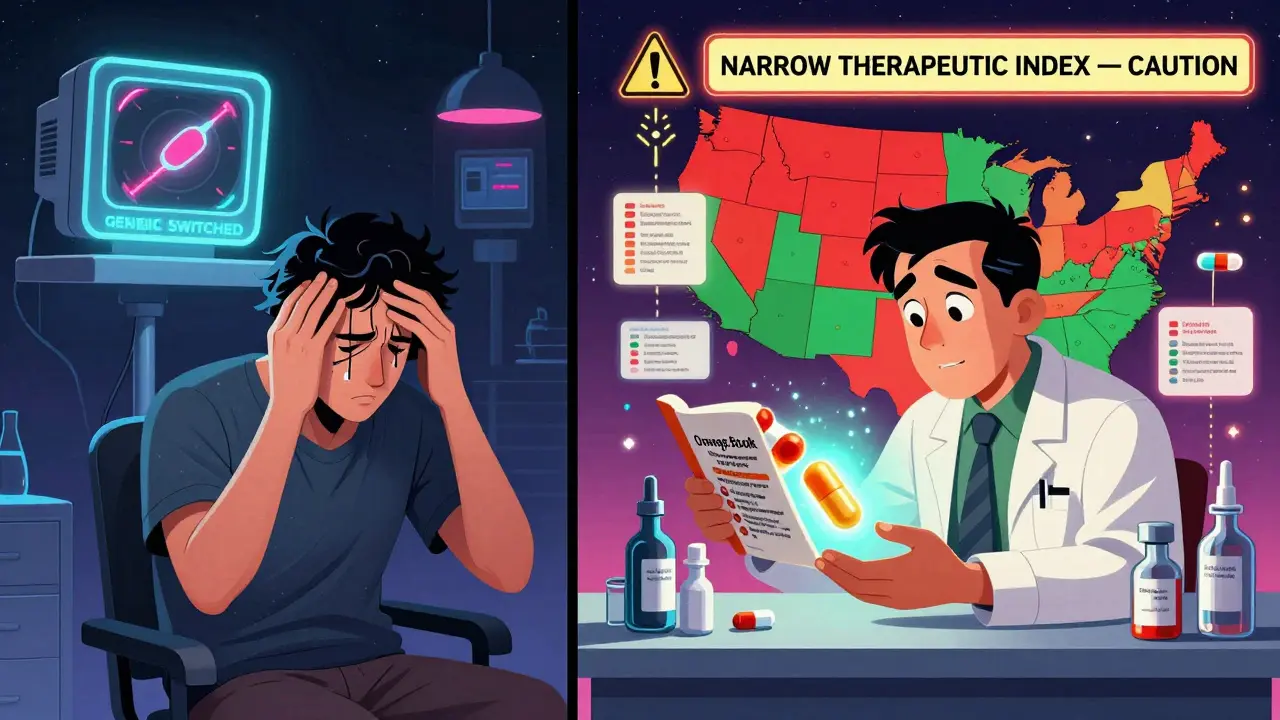
What Happens When You Don’t Know You Were Switched
Most people never notice. A 2023 Reddit post from a pharmacist in Ohio said 95% of patients don’t realize they got a generic unless they’re told. And for many, that’s a good thing: “Saved me $45 a month,” one patient wrote on Drugs.com. But for others, it’s a problem. “My seizure meds stopped working after they switched me,” another user said. That’s not rare. Patient advocacy groups logged 312 adverse events in 2022 tied to substitution, and 67% happened in states without extra protections for high-risk drugs. Pharmacists say the biggest challenge isn’t the law-it’s the confusion. One pharmacy technician reported that patients often come back angry, thinking the pharmacy made a mistake. “They think we’re cutting corners,” they said. “But we’re just following the rules.”How Pharmacists Keep Up
Managing substitution rules isn’t simple. Each state has its own list of which drugs can be swapped, which ones need extra steps, and how to document it. New pharmacists spend an average of 17 hours in their first year just learning state-specific laws. After that, they need 4+ hours every year to stay updated. That’s why most use tools like the FDA’s Orange Book (for small-molecule drugs) and the Purple Book (for biologics) to check therapeutic equivalence ratings. Chain pharmacies have automated systems that flag restrictions before the prescription is filled. Independent pharmacies? They rely more on memory and printed guides. A 2023 survey found chain pharmacies hit 96.7% compliance with state laws. Independent ones? Only 89.4%.Biosimilars: The New Wild West
The rules get even messier with biosimilars-generic versions of complex biologic drugs like Humira or Enbrel. Unlike small-molecule generics, biosimilars aren’t exact copies. They’re made from living cells, so tiny differences matter more. As of 2023, only 6 states let pharmacists automatically substitute interchangeable biosimilars without asking. Four states-North Carolina, Oklahoma, Pennsylvania, and Texas-ban automatic substitution entirely. Another 45 states have extra steps, like requiring the prescriber to write “dispense as written” or getting the patient’s signature. The FDA says biosimilars are safe. But doctors and patients are cautious. A 2022 survey found that 61% of rheumatologists would never switch a patient to a biosimilar without their input.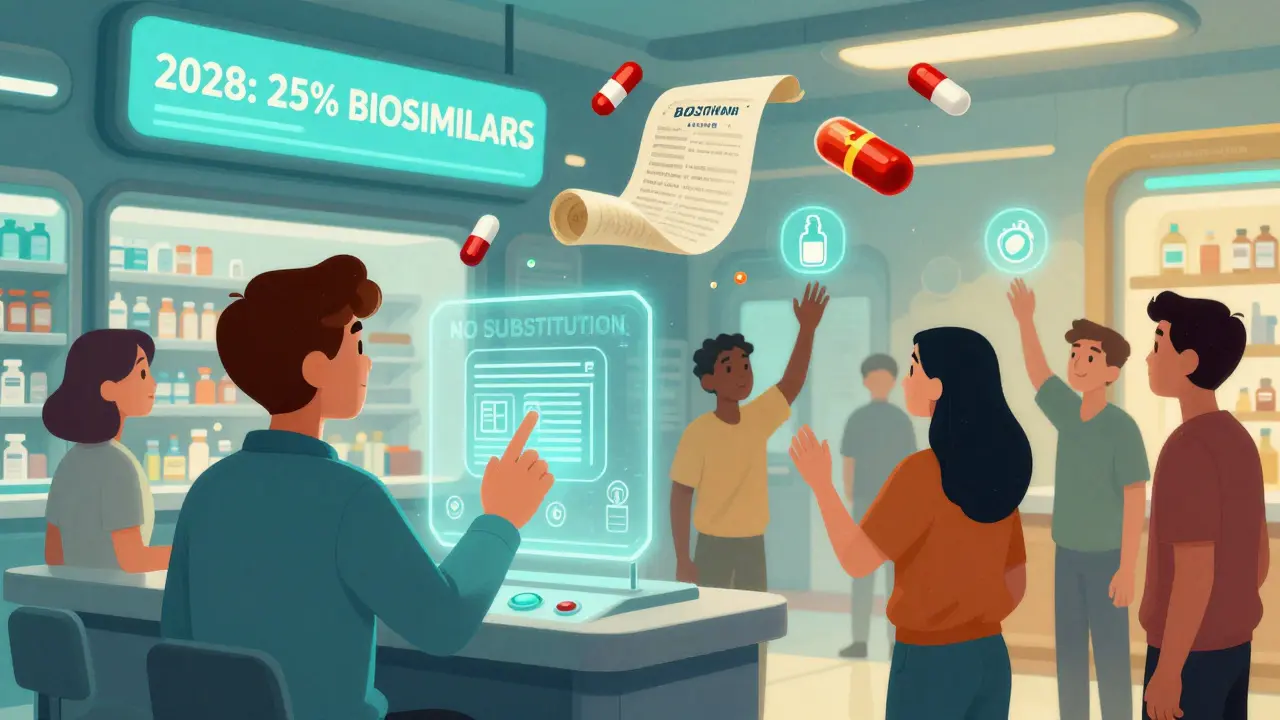
Who Benefits? Who Gets Left Behind?
The biggest winners? Medicare Part D patients. Nearly 95% of all generic substitutions happen in this group. On average, each beneficiary saves $627 a year. That’s huge for people on fixed incomes. But the system isn’t perfect. People with chronic conditions who need stable, predictable meds are at higher risk. And if you move from one state to another, your rules change. A drug you could switch in Ohio might be locked down in New York. Pharmacists say the real issue isn’t substitution-it’s lack of standardization. “We have 51 different rulebooks,” one pharmacist told a national conference. “It’s impossible to keep up unless you’re doing it full-time.”What You Can Do
You don’t have to accept substitution without a say. Here’s how to take control:- Ask your doctor to write “dispense as written” or “no substitution” on your prescription. That overrides state law.
- Check your label. If the drug name changed, call the pharmacy. Ask why.
- Know your meds. If you’re on a drug for epilepsy, thyroid, or blood thinning, assume substitution is restricted-unless you’re told otherwise.
- Use your pharmacy’s app or portal. Many now show substitution alerts before you pick up your prescription.
- Speak up. If you feel different after a switch, tell your pharmacist and doctor. It’s not just in your head.
The Future: Will This Change?
The pressure to cut costs won’t go away. Experts predict generic drugs will keep saving the system $227 billion a year through 2028. But as biosimilars grow-expected to hit 25% of the biologics market by 2028-states will have to update their laws. Some states are already moving toward a “tiered consent” model: presumed consent for most drugs, but explicit consent for high-risk ones. The Uniform Law Commission is pushing a model law that could bring consistency across states. Right now, 17 legislatures are considering it. For now, the system works-mostly. But it’s built on assumptions. And assumptions can break when lives are on the line.Can my pharmacist switch my medication without telling me?
In 43 states and Washington, D.C., yes-pharmacists can substitute a generic drug without asking you first. But in 31 of those states, they’re required to notify you after the switch, either on the label, with a printed notice, or verbally. In the remaining 12 states, they must get your permission before switching.
Are generic drugs really the same as brand-name ones?
The FDA says yes-generic drugs must contain the same active ingredient, strength, dosage form, and route of administration as the brand name. They must also meet the same strict manufacturing standards. However, inactive ingredients (like fillers or dyes) can differ, and for certain drugs-especially those with a narrow therapeutic index-those small differences can affect how your body responds.
Which drugs are most likely to cause problems after substitution?
Drugs with a narrow therapeutic index are the biggest concern. These include antiepileptic drugs (like phenytoin or carbamazepine), blood thinners (warfarin), thyroid medications (levothyroxine), and some psychiatric drugs (like lithium or valproic acid). Even small changes in blood levels can lead to serious side effects or loss of effectiveness.
Can I stop my pharmacist from substituting my drugs?
Yes. Ask your doctor to write “dispense as written” or “no substitution” on your prescription. That legally blocks the pharmacist from switching, no matter what your state’s presumed consent law says. You can also tell the pharmacist directly when you drop off your prescription.
Why do some states require consent and others don’t?
It comes down to balancing cost savings with patient safety. States with presumed consent prioritize efficiency and lower drug costs. States requiring explicit consent prioritize patient autonomy and control. There’s no national standard, so the rules vary based on political priorities, lobbying from drug companies, and public opinion.
Dave Alponvyr
December 15, 2025 AT 14:45So my pharmacist switched my blood pressure med last month and I didn’t notice until my legs started swelling. Now I know to always check the label. Thanks for the heads up, I guess.
Cassandra Collins
December 15, 2025 AT 22:10THIS IS A GOVERNMENT PLOT TO MAKE US DEPENDENT ON CHEAP DRUGS SO WE’LL STOP QUESTIONING EVERYTHING. THEY’RE TESTING ON US AND THE PHARMACISTS ARE IN ON IT. I SAW A GUY IN THE STORE WITH A TATTOO THAT SAID ‘FDA APPROVED’ AND HE WASN’T EVEN A DOCTOR. THEY’RE WATCHING US THROUGH OUR PILL BOTTLES.
Tiffany Machelski
December 17, 2025 AT 19:11i never knew pharmacists could do this without asking… i just thought they gave me what the doc wrote. kinda scary when you think about it. i’ll be checking my labels from now on.
Hadi Santoso
December 19, 2025 AT 00:59As someone who grew up in Indonesia where meds are sold over the counter like candy, this feels wild. In the U.S., you need a prescription for aspirin sometimes. But here, you can swap life-changing meds without a word? I get the cost savings, but man - trust matters. Maybe a simple ‘your med was switched’ text would go a long way. Just a heads up, not a lecture.
Arun ana
December 19, 2025 AT 09:34Interesting! In India, we don’t have this system - you get exactly what the doctor writes. But I’ve seen people switch generics themselves to save money. Maybe a middle ground? Like a checkbox on the receipt: ‘You got the generic. OK?’ Just something small.
Kayleigh Campbell
December 21, 2025 AT 06:38My grandma’s thyroid med got swapped and she started nodding off in the middle of her crossword puzzles. She thought she was just getting old. Turns out, her body didn’t like the new filler. Now she carries a laminated card in her wallet that says ‘NO SUBSTITUTION - I’M NOT A LAB RAT.’ I love her. She’s basically a superhero with a walker.
Andrew Sychev
December 23, 2025 AT 05:42This is why America is crumbling. You can’t even trust your pharmacist anymore. They’re just corporate drones handing out pills like candy from a vending machine. And now you’re supposed to be grateful? No. No. No. This isn’t efficiency - it’s negligence dressed up in a white coat.
Dan Padgett
December 23, 2025 AT 10:42It’s funny how we treat medicine like a car part - swap it out, same thing, right? But your body ain’t a Toyota. It remembers. It feels. I’ve seen people get sick after switches and just blame themselves. ‘Maybe I’m not sleeping right.’ Nah. Maybe your pill changed color and nobody told you.
Elizabeth Bauman
December 25, 2025 AT 08:28Why are we letting big pharma dictate our health? This is why we need to stop importing foreign generics and make all meds in America. This system is a joke. Our soldiers fight for freedom but can’t even get the exact same pill their doctor prescribed? Unacceptable.
Dylan Smith
December 25, 2025 AT 14:43so i just found out my anxiety med got swapped and i felt like i was drowning for a week. i thought i was losing it. turns out it was the filler. why dont they just say something? i mean come on. its not that hard to type a note
sue spark
December 26, 2025 AT 10:01my mom’s on levothyroxine and she’s been fine for years. i never thought to ask if she got generics. now i’m terrified. i’m calling her pharmacist tomorrow. thank you for making me look closer at something i took for granted
Josias Ariel Mahlangu
December 26, 2025 AT 22:43People who don’t check their prescriptions are asking for trouble. This isn’t rocket science. You want safety? You take responsibility. Don’t blame the pharmacist. Blame yourself for not reading the label.
anthony epps
December 27, 2025 AT 20:14so if my doctor writes ‘brand only’ does that override everything? i’ve got epilepsy and i don’t want to risk it. just wanna make sure i’m doing this right
Kim Hines
December 28, 2025 AT 13:20My pharmacy sent me a text last week saying my pill changed. I didn’t even know they could do that. Kinda cool they bothered to tell me. Maybe more should.
Joanna Ebizie
December 28, 2025 AT 17:01you people are acting like this is some secret conspiracy. it’s just business. if you want the expensive version pay for it. stop being dramatic. your meds aren’t magic.