
Osteoporosis Medications: How Bisphosphonates and Calcium Work Together (and When They Clash)
 Dec, 7 2025
Osteoporosis Medication Timing Calculator
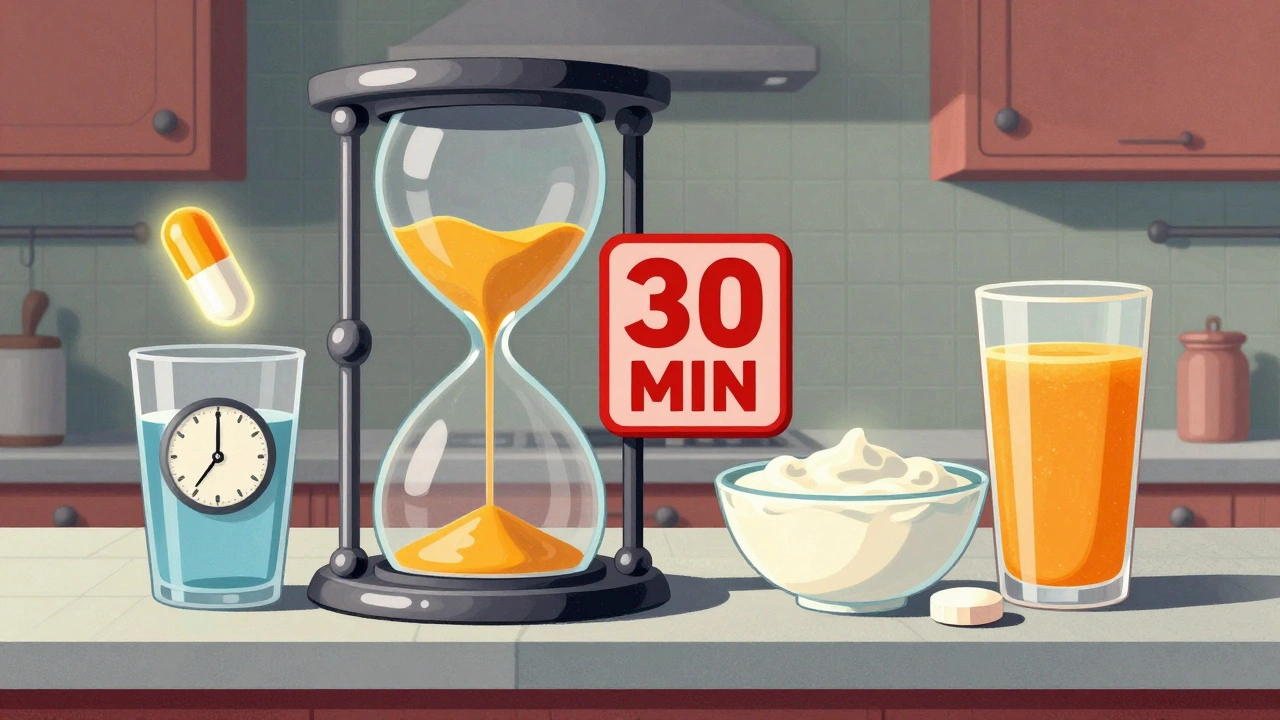
Take your osteoporosis pill on an empty stomach. Wait 30 minutes. Then take your calcium. Sounds simple, right? But if you’re one of the 40% of people who mix them together, you’re wasting your medication-and putting yourself at higher risk for a fracture.
Why Bisphosphonates Are Your Bone’s Best Friend
Bisphosphonates like alendronate, risedronate, and zoledronic acid are the most common pills prescribed for osteoporosis. They don’t build new bone. Instead, they stop your body from breaking it down too fast. Think of them as a brake pedal for bone loss. These drugs latch onto areas of bone where old cells are being removed. They sneak into the bone-resorbing cells-osteoclasts-and shut down their energy supply. Without energy, these cells can’t do their job. Over time, your bones get denser, stronger, and less likely to snap from a fall or even a cough. Studies show bisphosphonates cut vertebral fractures by 40-50% and hip fractures by 20-25%. That’s not small. A hip fracture in someone over 65 has a 1 in 5 chance of being deadly within a year. Bisphosphonates change those odds. But here’s the catch: they only work if your body can actually absorb them. And that’s where calcium comes in.The Calcium Problem: When the Supplement Becomes the Saboteur
Calcium is essential. Your bones need it. Your muscles need it. Your nerves need it. Most doctors recommend 500-1,000 mg of extra calcium per day on top of what you get from food-especially if you’re on a bisphosphonate. But calcium and bisphosphonates don’t get along in your gut. When they meet, they form a hard, insoluble lump. It’s like mixing milk and vinegar. The calcium binds to the drug, and your body can’t absorb either one properly. Research shows this drops bisphosphonate absorption by up to 90%. That means if you take your pill with your morning calcium tablet, you might as well have tossed the pill in the trash. This isn’t a theory. It’s been proven in lab tests, clinical trials, and real-world patient surveys. A 2006 study by Procter & Gamble found nearly half of patients were taking calcium at the same time as their bisphosphonate. The result? Poor bone density gains. Higher fracture rates. And wasted money.The Right Way to Take Them: Timing Is Everything
There’s only one safe way to take bisphosphonates with calcium: separate them by at least 30 to 60 minutes. Here’s the exact routine:- First thing in the morning, before eating or drinking anything (not even coffee), take your bisphosphonate with a full glass of plain water.
- Stay upright-no lying down-for at least 30 minutes. This keeps the pill from irritating your esophagus.
- Wait 30-60 minutes.
- Now you can eat breakfast, drink tea, and take your calcium supplement.
Why People Mess It Up (And How to Fix It)
You’d think this would be easy to remember. But it’s not. On Reddit’s osteoporosis community, 67% of users said they were confused at first. Some took calcium with breakfast, then remembered they hadn’t taken their pill yet. Others took the pill after coffee, or with a multivitamin. All of those mistakes kill absorption. A 2022 survey by the National Osteoporosis Foundation found that difficulty managing multiple timed medications was the third most common reason people quit their bisphosphonate within the first year. The good news? There are fixes. One is Actonel with Calcium-a combo pack that includes one risedronate tablet and six calcium tablets in a blister pack. Each blister is labeled with the day and time. You take the bisphosphonate on Monday, Wednesday, Friday, Sunday. The calcium goes on Tuesday, Thursday, Saturday. The packaging itself acts as a reminder. Users gave it a 4.2 out of 5 rating, with many saying, “I finally stopped forgetting.” Another fix? Use a phone alarm. Set one for 7 a.m. for the pill. Set another for 8 a.m. for calcium. Put the supplements in different spots-bathroom sink for the pill, kitchen counter for calcium. Out of sight, out of mind doesn’t work here. Out of sight, out of effect does.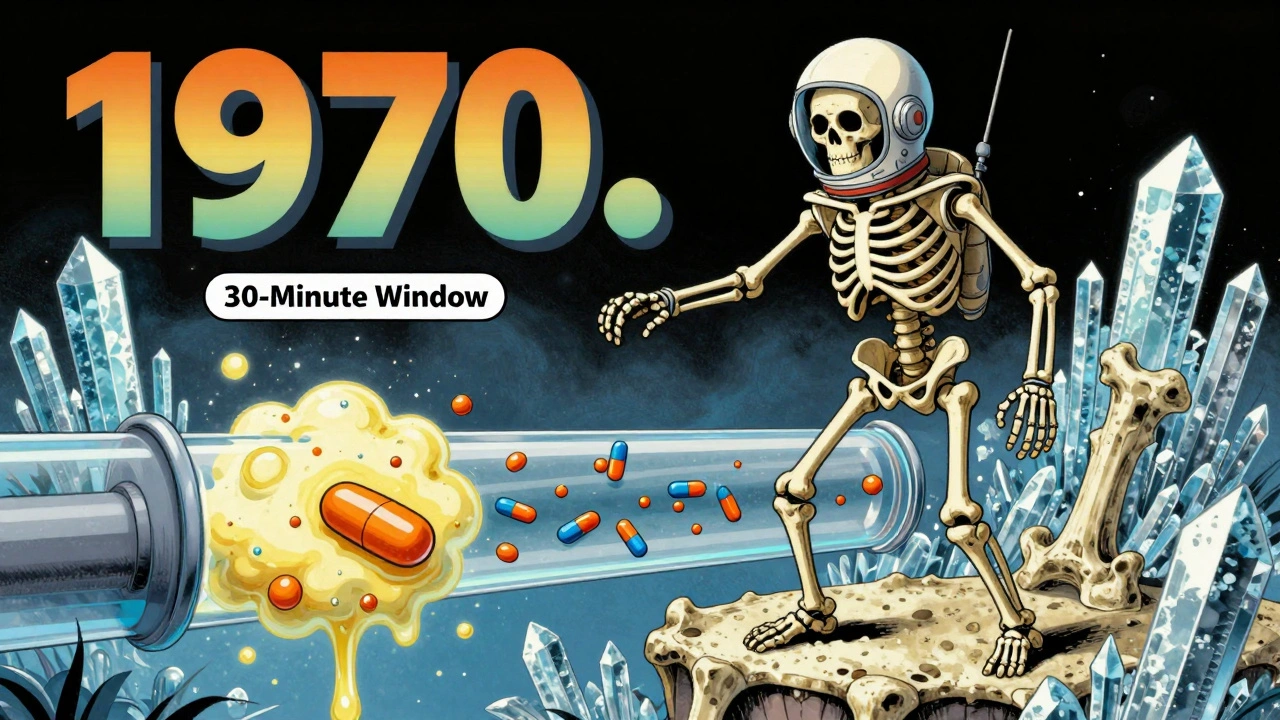
Vitamin D: The Hidden Partner
Calcium won’t do much without vitamin D. Your body needs vitamin D to absorb calcium from your gut. Without enough D, even perfect timing won’t help. Most guidelines recommend 800-1,000 IU of vitamin D daily. That’s often not enough from diet alone. Sunlight helps-but in the UK, especially from October to March, you’re not getting enough UVB rays to make vitamin D naturally. Many people on bisphosphonates also take a vitamin D supplement. But here’s the rule: take it with your calcium, not with your bisphosphonate. Vitamin D doesn’t interfere with bisphosphonate absorption. So if you’re taking calcium at breakfast, that’s the perfect time to take your D too.How Much Calcium Is Too Much?
More isn’t always better. The recommended daily total (diet + supplement) is 1,000-1,200 mg. Go beyond that, and you might be risking more than you’re helping. Some studies suggest excess calcium supplementation-especially over 1,200 mg/day from pills-could raise the risk of heart problems. It’s not proven, but it’s a signal to be cautious. Don’t double up. If your multivitamin has 500 mg of calcium, and your separate supplement has another 600 mg, you’re at 1,100 mg. Add milk, yogurt, and leafy greens? You might be hitting 1,500 mg. That’s too much. Check the label. Look for “elemental calcium.” That’s the actual amount your body can use. Calcium carbonate is 40% elemental calcium. Calcium citrate is 21%. So a 1,250 mg calcium carbonate tablet gives you 500 mg of usable calcium. A 1,000 mg calcium citrate tablet gives you only 210 mg.When to Stop Taking Bisphosphonates
Bisphosphonates stay in your bones for years-even decades. That’s why doctors don’t recommend taking them forever. After 3-5 years, if your fracture risk is low and your bone density is stable, you might be a candidate for a “drug holiday.” You stop taking the pill for 1-3 years. Your bone stays protected because the drug is still there, slowly releasing. But here’s the catch: you still need calcium and vitamin D during the break. Stopping the bisphosphonate doesn’t mean stopping bone care. Your doctor will monitor you with bone scans every 1-2 years during the break. If your bone density drops or you have a fracture, you’ll restart the medication.
Katie Harrison
December 7, 2025 AT 19:39Okay, but can we talk about how the 30-minute rule feels like a full-time job? I’m 68, have arthritis, and sometimes forget if I’ve taken my pill or just stared at it for 10 minutes. I swear, my bones are judging me.
Mona Schmidt
December 8, 2025 AT 05:39It’s worth noting that calcium citrate is better absorbed with food and doesn’t interfere with bisphosphonates as severely as carbonate-so if you’re struggling with timing, switching formulations might be a viable workaround. Always consult your pharmacist before changing supplements.
Guylaine Lapointe
December 8, 2025 AT 17:26Wow. So people are still mixing calcium with their bisphosphonates? Like, in 2024? I get that memory fades with age, but this isn’t rocket science. It’s literally written on the bottle. If you can’t follow basic instructions, maybe you shouldn’t be taking meds at all.
Christian Landry
December 9, 2025 AT 22:54lol i just take my pill with coffee and call it a day 🤷♀️ my bones are probs like ‘we’re fine, we’ve seen worse’
Taya Rtichsheva
December 10, 2025 AT 23:4930 minutes? More like 30 minutes of existential dread while I wait for my oatmeal to cool down
Asset Finance Komrade
December 11, 2025 AT 05:00One might argue that the entire pharmacological paradigm of osteoporosis management is a construct of pharmaceutical marketing. Bone density is not a proxy for strength. Evolution did not design humans to ingest synthetic bisphosphonates. Perhaps the real solution is ancestral movement, not chemical intervention.
Ruth Witte
December 12, 2025 AT 05:15YESSSS this is the info I needed!!! 🙌 I’ve been taking calcium with my pill for 2 years 😭 I’m switching my routine TODAY and I’m telling everyone. You’re a lifesaver 💪🩵
Noah Raines
December 13, 2025 AT 09:07My grandma uses a pill organizer with alarms. She’s 82 and still outlives all of us. If she can do it, you can too. No excuses.
Katherine Rodgers
December 14, 2025 AT 21:53‘Wasting your medication’? More like wasting your time listening to a 2006 Procter & Gamble study. Where’s the recent meta-analysis? Where’s the long-term RCT? This reads like a brochure from a rep who got paid in free pens.
Lauren Dare
December 15, 2025 AT 21:40Let’s not conflate bioavailability with clinical efficacy. Absorption rates ≠ fracture reduction. The 90% absorption drop cited is in vitro. Real-world pharmacokinetics are far more complex. Also, vitamin D status is a confounder in 78% of these studies. The real villain here is poor study design, not patient noncompliance.