
Night vs Morning Statin Dosing: Side Effects and Efficacy
 Jul, 12 2026
Statin Dosing Timing Advisor
You take your pill. You swallow it with water. But do you actually know if taking it at breakfast or before bed changes how well it works? For decades, doctors told patients to take their statins, specifically medications used to lower cholesterol and reduce cardiovascular risk, at night. The logic was simple: your body makes most of its cholesterol while you sleep. So, the drug should be in your system when that production peaks. But science moves fast, and that old rule doesn't fit every patient anymore.
If you are wondering whether you need to set an alarm for midnight or just grab your pill with your morning coffee, the answer depends entirely on which specific medication you are taking. It’s not a one-size-fits-all situation. Some statins have short half-lives and vanish from your bloodstream quickly. Others stay active for nearly a full day. Understanding this difference is the key to getting the best results without unnecessary hassle.
The Biology Behind Cholesterol Production
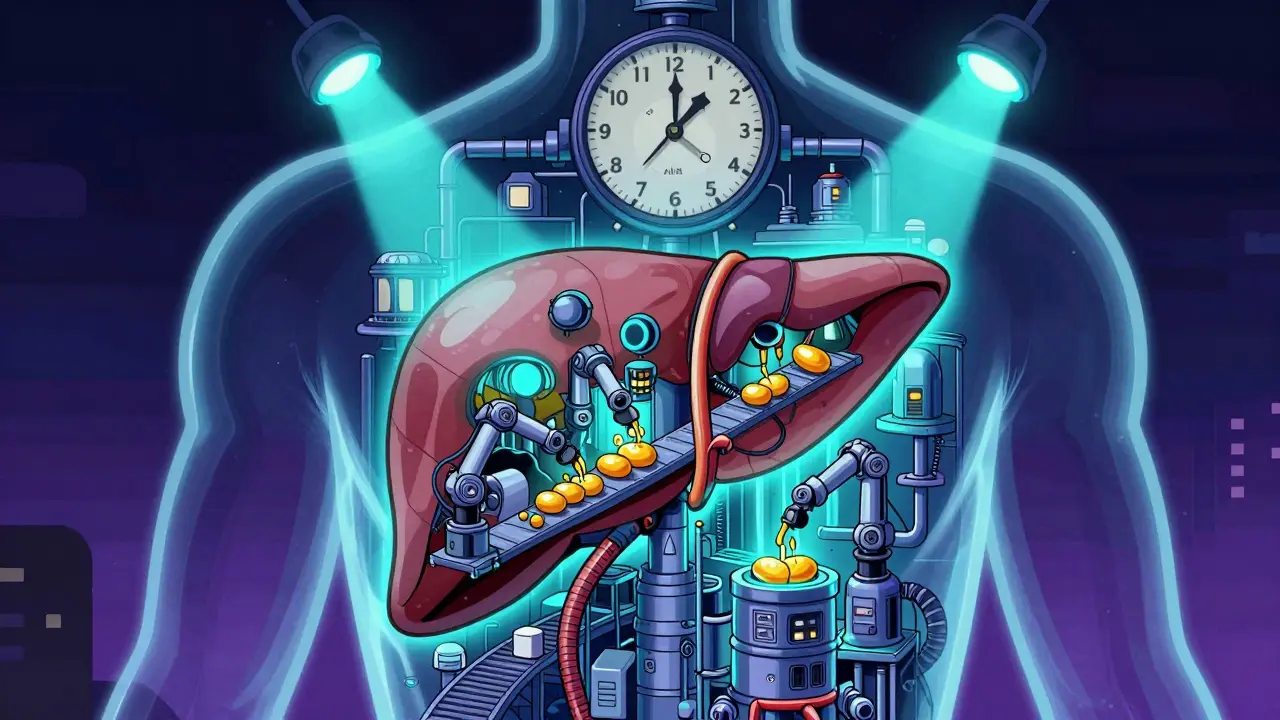
To understand why timing ever mattered, we have to look at how your liver works. Your body produces cholesterol naturally, but it doesn’t do so evenly throughout the day. Research dating back to the 1970s by Dietschy and Wilson showed that endogenous cholesterol synthesis follows a circadian rhythm. In simple terms, your liver is most busy making cholesterol between midnight and 4:00 AM.
This biological fact drove early clinical guidelines. If the enzyme responsible for making cholesterol-HMG-CoA reductase-is most active at night, then blocking it at night seemed like the smartest move. This led to the widespread recommendation for evening dosing. However, this physiological pattern only creates a strict timing requirement for certain types of drugs. For others, the clock is less relevant than consistency.
Short-Acting vs. Long-Acting Statins
The crucial distinction lies in pharmacokinetics, specifically the "half-life" of the drug. The half-life is the time it takes for the concentration of the drug in your blood to reduce by half. Think of it as how long the medicine stays "awake" and working in your body.
Older statins like simvastatin, lovastatin, and fluvastatin are short-acting. Simvastatin has a half-life of roughly 1.9 to 3 hours. Lovastatin lasts about 1 to 3 hours. Because they clear out of your system so quickly, they need to be present exactly when cholesterol production peaks. A 2017 meta-analysis by Awad et al. found that taking these short-acting statins in the evening resulted in 7.3% to 15% greater reduction in LDL cholesterol compared to morning dosing. That is a clinically meaningful difference.
In contrast, newer statins like atorvastatin (Lipitor) and rosuvastatin (Crestor) are long-acting. Atorvastatin has a half-life of 14 to 20 hours. Rosuvastatin lasts around 19 hours. These drugs maintain therapeutic levels in your blood for the entire 24-hour cycle. Whether you take them at 8 AM or 8 PM, they are still working hard at 2 AM. The same Awad study showed that for these long-acting drugs, the difference in LDL reduction between morning and evening dosing was negligible-less than 3%. Most experts consider any difference under 5% to be clinically irrelevant.
| Statin Type | Examples | Half-Life | Optimal Timing | Efficacy Difference (Night vs. Morning) |
|---|---|---|---|---|
| Short-Acting | Simvastatin, Lovastatin, Fluvastatin | 0.5 - 3 hours | Evening / Bedtime | 7.3% - 15% better LDL reduction at night |
| Long-Acting | Atorvastatin, Rosuvastatin, Pitavastatin | 12 - 19 hours | Any time (consistent) | < 3% difference (clinically insignificant) |

Does Timing Affect Side Effects?
A common fear among patients is that taking statins at night might cause insomnia or nightmares, while morning doses might lead to daytime fatigue. Let’s look at the data. The FDA Adverse Event Reporting System (FAERS) analyzed over 4 million prescriptions and found no significant difference in side effect profiles based on dosing time. Rates of myalgia (muscle pain), liver enzyme elevations, and new-onset diabetes were virtually identical: 8.7% for evening dosers versus 8.9% for morning dosers.
So, if you are experiencing muscle aches or brain fog, switching from night to morning likely won’t fix it. Those side effects are related to how your individual body metabolizes the drug, not the clock on the wall. However, there is a psychological component. Some people report feeling more alert after taking their meds, while others feel groggy. If you notice a pattern, talk to your doctor. But statistically, the time of day is not the culprit for adverse events.
The Adherence Factor: Consistency Beats Perfection
Here is where the rubber meets the road. Medical guidelines emphasize adherence above all else. Why? Because a perfectly timed dose that you forget half the time is useless. A slightly suboptimal dose that you take every single day is highly effective.
Data from a 2019 Mayo Clinic Proceedings study involving 12,498 users revealed a stark reality. Patients instructed to take statins at night had significantly lower medication possession ratios (MPR 0.87) compared to those taking morning doses (MPR 0.98). That translates to roughly two extra missed doses per month for the nighttime group. Why? Life happens at night. Dinner plans run late. Sleep schedules vary. Morning routines, however, are often more rigid and predictable.
Dr. Steven Nissen of the Cleveland Clinic argues that the modest 2-3% LDL benefit seen with evening dosing of long-acting statins is "clinically irrelevant" when weighed against the 20-30% adherence gap caused by complex scheduling. If you are on atorvastatin or rosuvastatin, forcing yourself to take it at night adds friction to your routine. Removing that friction by taking it in the morning can actually improve your overall health outcomes because you are more likely to remember it.

Practical Recommendations for Patients
So, what should you do? Here is a straightforward decision tree based on current evidence:
- If you take Simvastatin, Lovastatin, or Fluvastatin: Try to take these in the evening. The pharmacokinetic advantage is real. If you consistently forget, ask your doctor about switching to a long-acting alternative rather than sticking to a morning schedule that reduces efficacy.
- If you take Atorvastatin, Rosuvastatin, or Pitavastatin: Take them whenever you remember best. For most people, this means morning. Pair it with brushing your teeth or drinking coffee. Make it automatic.
- If you are already on a stable routine: Don’t change it unless you have a problem. The American College of Cardiology states that timing should be individualized. If you’ve been taking your pill at 6 PM for five years and your labs are good, keep doing it. Stability is valuable.
Technology can also help. A 2020 study in the Journal of Managed Care & Specialty Pharmacy showed that using a smartphone alarm for morning dosing achieved comparable LDL reduction to unassisted evening dosing for short-acting statins, simply because adherence jumped from 76% to 92%. Use tools that work for your life.
Future Directions in Statin Therapy
The landscape of cholesterol management is shifting. According to IQVIA data from 2023, 82% of new statin prescriptions are for long-acting formulations. This trend reduces the relevance of the "night vs. morning" debate for the majority of new patients. We are moving toward a model where adherence strategies dominate over pharmacokinetic nuances.
Research is also exploring innovative delivery methods. Pfizer filed a patent application in 2022 for a circadian-timed release simvastatin formulation. Imagine a pill that releases the drug automatically at 2 AM regardless of when you swallow it. While this technology isn’t mainstream yet, it highlights the industry’s focus on removing patient burden. Until then, the best advice remains simple: know your drug, pick a time, stick to it, and let consistency drive your results.
Should I take my statin with food?
For most modern statins like atorvastatin and rosuvastatin, it does not matter whether you take them with food or on an empty stomach. However, older statins like lovastatin may be absorbed better with food. Always check your specific prescription label or ask your pharmacist, but generally, consistency with your meal routine helps with adherence.
Can I switch from night to morning dosing?
Yes, you can usually switch times without issue. If you are on a long-acting statin, there is no clinical penalty. If you are on a short-acting statin like simvastatin, switching to morning may slightly reduce efficacy (by about 10%), but if it improves your adherence, it might still be worth it. Consult your doctor before making changes to ensure it aligns with your treatment plan.
Why did my doctor tell me to take it at night?
Your doctor may be following traditional guidelines or prescribing a short-acting statin like simvastatin, where evening dosing offers a measurable benefit. Alternatively, they may assume a bedtime routine is easier for you to remember. It is always okay to ask your doctor to explain the reasoning behind their specific instructions.
Do statins cause insomnia?
Insomnia is a rare side effect of statins, but it has been reported by some patients. If you suspect your medication is affecting your sleep, try switching to morning dosing. Since side effect rates are similar regardless of time, this change might help you identify if the drug is the cause or if other factors are at play.
What happens if I miss a dose?
If you miss a dose, take it as soon as you remember. However, if it is almost time for your next dose, skip the missed one. Do not double up. Occasional missed doses are not catastrophic, but frequent misses will raise your LDL levels. Setting a daily alarm is the best way to prevent this.