
Muscle Cramps on Statins: How to Tell If It’s Myopathy or Neuropathy
 Jan, 21 2026
Many people on statins start noticing muscle cramps, aches, or tingling and immediately worry: is this statin myopathy, or could it be something else? The truth is, not all muscle discomfort from statins comes from the same place. Some symptoms come from the muscle itself - that’s myopathy. Others come from damaged nerves - that’s neuropathy. And mixing them up can lead to the wrong treatment, or worse, stopping a life-saving medication unnecessarily.
What Statin Myopathy Actually Feels Like
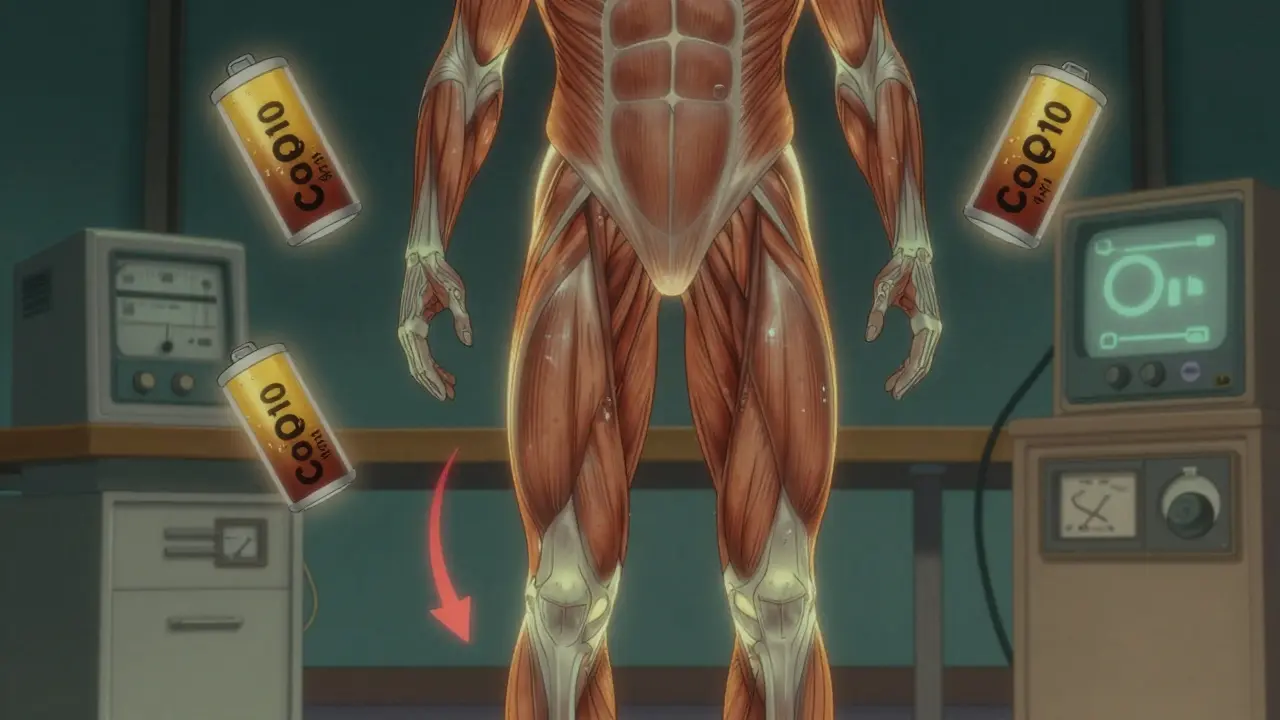
Statin-associated myopathy isn’t just soreness after a workout. It’s a deep, dull ache or weakness that builds slowly, usually in your thighs, hips, or shoulders. You might find yourself struggling to get up from a chair, climbing stairs feels harder, or your arms feel heavy when lifting groceries. Unlike a pulled muscle, there’s no sharp pain or swelling. It’s more like your body is slowly losing power. The key sign? Bilateral symptoms - both sides of your body are affected equally. And it’s not just about pain. Many patients don’t even realize they’re weaker because the decline is gradual. They blame it on aging, until they trip more often or can’t hold onto their shopping bags. A 2014 study from the NIH found that doctors often miss this because patients don’t report it, and clinicians don’t always test muscle strength during routine visits. Creatine kinase (CK) levels are the lab marker doctors check. In true myopathy, CK rises above four times the normal limit. But here’s the twist: most people with statin-related muscle symptoms have normal or only slightly elevated CK. That doesn’t mean it’s not myopathy. It just means the damage is happening at a cellular level - mitochondria in your muscle cells are struggling because statins cut coenzyme Q10 production by up to 40% within a month. Your muscles are running on low battery.What Statin-Related Neuropathy Might Look Like
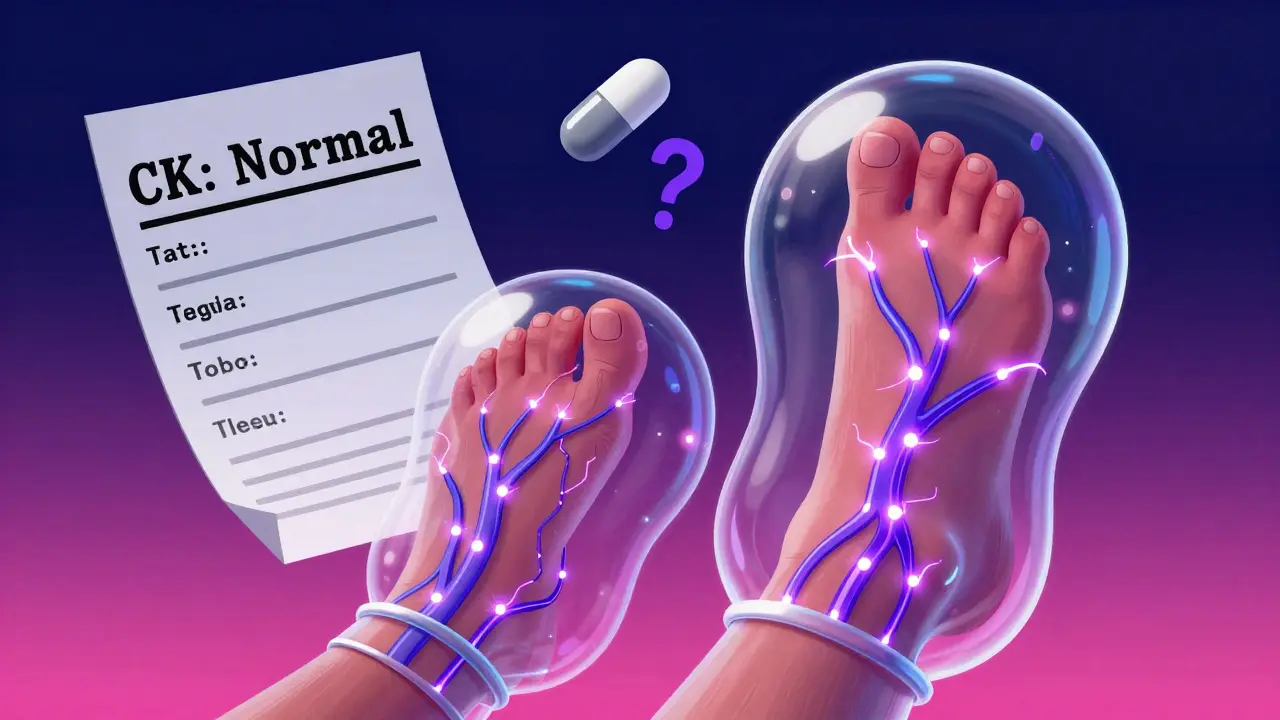
If your cramps feel more like burning, tingling, or numbness in your feet or hands - like walking on pins and needles or wearing invisible gloves - that’s a red flag for neuropathy. This isn’t muscle weakness. It’s nerve misfiring. Symptoms usually start in your toes and creep upward, following what doctors call a “stocking-glove” pattern. You might drop things more often, or feel like your feet are asleep even when you’re not sitting. But here’s where it gets confusing: the evidence linking statins to neuropathy is messy. Some studies say statins increase the risk. Others, like a 2019 case-control study of over 600 patients, found statin users had lower odds of developing peripheral neuropathy. One theory is that statins lower LDL cholesterol, which carries vitamin E - a key antioxidant for nerves. Less vitamin E could mean more nerve damage. Another idea is that reduced coenzyme Q10 affects nerve energy. But none of this is proven. The most reliable way to tell if it’s neuropathy? Nerve conduction studies. These tests measure how fast electrical signals travel through your nerves. If sensory nerves are slow or weak, it points to axonal neuropathy. If your CK levels are normal and you have these nerve changes, it’s likely not myopathy.How to Tell the Difference - A Simple Checklist
You don’t need a doctor to spot the difference - but you do need to pay attention to details. Here’s what to look for:- Location: Myopathy = thighs, hips, shoulders. Neuropathy = feet, hands, fingers, toes.
- Sensation: Myopathy = dull ache, heaviness, weakness. Neuropathy = burning, tingling, numbness, electric shocks.
- Strength: Myopathy = trouble standing, climbing stairs, lifting arms. Neuropathy = grip weakness, dropping things, balance issues from foot numbness.
- Lab test: Myopathy = CK elevated (often >4x normal). Neuropathy = CK normal.
- Response to stopping statins: Myopathy = symptoms improve within weeks. Neuropathy = symptoms may persist or worsen.
Why Getting It Wrong Matters
If you assume it’s myopathy and stop your statin, you might be risking a heart attack or stroke. Statins reduce your risk of major cardiovascular events by about 25% for every 1 mmol/L drop in LDL cholesterol. That’s not small. On the other hand, if you ignore real neuropathy because you think it’s just muscle cramps, you could end up with permanent nerve damage. Some patients are told to “just tough it out” - but that’s dangerous. A 2023 case report in Cureus described a patient whose statin-induced myopathy mimicked Guillain-Barré syndrome - a serious autoimmune nerve disorder. He was misdiagnosed for weeks until a neurologist spotted the muscle weakness pattern and ordered the right tests.What to Do If You Have Symptoms
Don’t panic. Don’t stop your statin on your own. Do this instead:- Track your symptoms: Write down when they started, where they are, what makes them better or worse. Note any new numbness, balance issues, or weakness.
- Get your CK checked: A simple blood test. If it’s above 4x normal, myopathy is likely. If normal, move to the next step.
- Rule out other causes: Thyroid problems, diabetes, vitamin B12 deficiency, alcohol use - all can cause similar symptoms. Your doctor should check these before blaming statins.
- Ask for nerve testing: If symptoms are distal (feet/hands) and CK is normal, ask about electromyography (EMG) or nerve conduction studies.
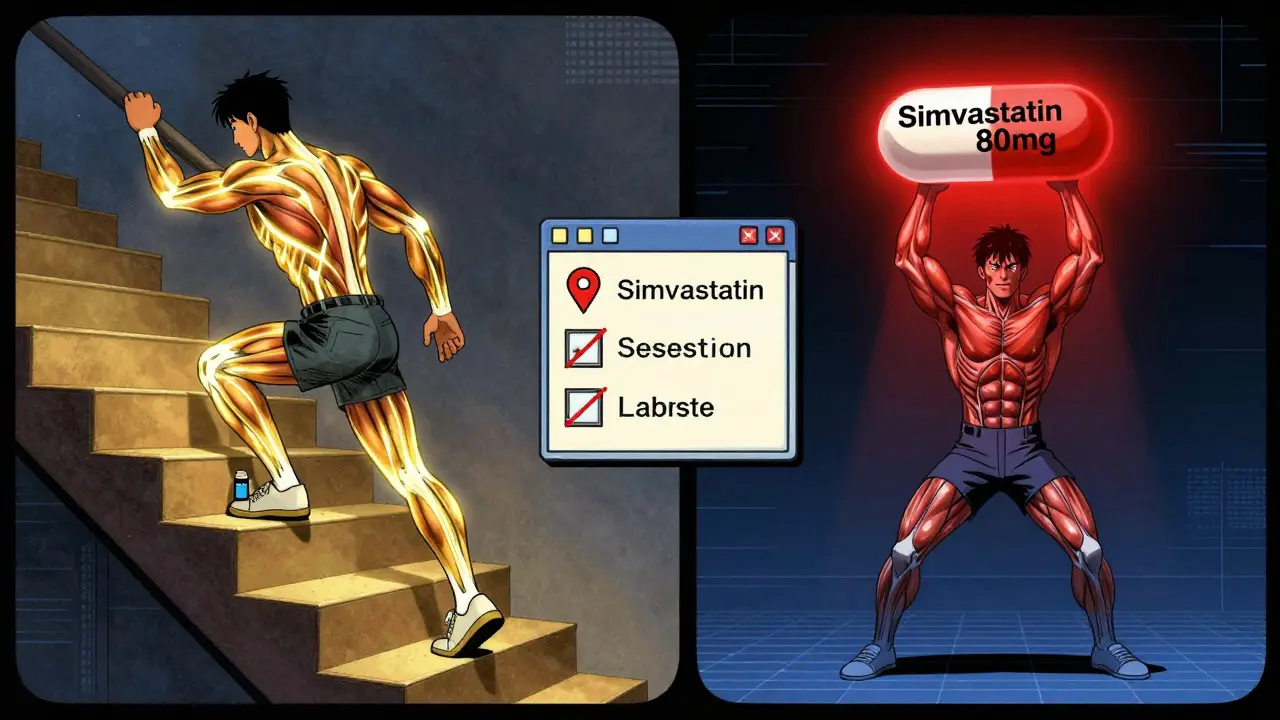
- Try a statin switch: If it’s myopathy, switching to a hydrophilic statin like pravastatin or rosuvastatin works for about 60% of people. Avoid simvastatin at high doses - it’s the worst offender.
- Don’t skip lipid-lowering therapy: If you can’t tolerate statins, ezetimibe or PCSK9 inhibitors are proven alternatives that don’t cause muscle issues.
What Doesn’t Work
Coenzyme Q10 supplements? A 2015 JAMA study gave them to 44 people with statin-related muscle pain. Half got the supplement, half got a placebo. No difference in pain relief. So don’t waste your money. Stretching, massage, or heat packs might help with general soreness, but they won’t fix the root cause. And if your symptoms persist beyond 2-3 months after stopping statins, see a neurologist. Something else might be going on - and it’s not your statin.The Bottom Line
Muscle cramps on statins are common. But they’re not always caused by statins - and when they are, they’re rarely the same thing. Myopathy affects your muscles. Neuropathy affects your nerves. One is common, treatable, and reversible. The other is rare, poorly understood, and needs careful evaluation. The goal isn’t to scare you off statins. It’s to help you figure out what’s really happening so you can keep your heart safe - without unnecessary pain or nerve damage.Can statins cause both muscle pain and nerve tingling at the same time?
Yes, but it’s rare. Most patients experience one or the other. If you have both muscle weakness and burning numbness, it could mean two separate issues - one triggered by statins (myopathy) and another unrelated (like diabetes or spinal stenosis). A neurologist can sort this out with blood tests, nerve studies, and a full exam.
How long does it take for muscle cramps to go away after stopping statins?
For statin myopathy, most people feel better within 2 to 8 weeks after stopping. Some take up to 3 months, especially if symptoms were severe or went unnoticed for a while. If pain or weakness lasts longer than that, it’s unlikely to be statin-related - see a specialist.
Is it safe to restart statins after stopping them for muscle cramps?
It depends. If your symptoms were mild and CK was only slightly high, switching to a different statin - like rosuvastatin or pravastatin - works for about 60% of people. Start at the lowest dose and increase slowly. Never restart the same statin at the same dose. If you had severe myopathy or rhabdomyolysis, avoid statins entirely and use non-statin options like ezetimibe or PCSK9 inhibitors.
Can statin-induced neuropathy be reversed?
If it’s truly caused by statins and caught early, stopping the drug may help. But because the evidence linking statins to neuropathy is weak, doctors usually look for other causes first - like diabetes or vitamin B12 deficiency. If those are ruled out and symptoms improve after stopping statins, it’s likely related. Recovery can take months and isn’t guaranteed, especially if nerve damage is advanced.
Are some statins safer for muscles than others?
Yes. Hydrophilic statins - like pravastatin and rosuvastatin - are less likely to cause muscle problems because they don’t penetrate muscle cells as easily. Lipophilic statins like simvastatin and atorvastatin enter muscle tissue more readily and carry higher risk. Simvastatin at 80mg is especially risky - avoid it unless absolutely necessary.
Should I take CoQ10 supplements to prevent statin muscle pain?
No. A major 2015 study in JAMA found CoQ10 supplements didn’t reduce muscle pain any more than a placebo in people with statin-related symptoms. While the theory makes sense - statins lower CoQ10, so supplementing might help - the science doesn’t back it up. Save your money and focus on proven strategies: switching statins, checking for other causes, or using non-statin therapies.
Chiraghuddin Qureshi
January 21, 2026 AT 20:59Bro i got statin cramps like last month 🤯 thought it was just aging but then i read this and boom - it’s myopathy. Started pravastatin last week and my thighs feel like they’re not my own anymore 😅
Kenji Gaerlan
January 23, 2026 AT 09:16statins are just overprescribed. my uncle took them for 10 years and ended up with neuropathy. now he can’t feel his toes. thanks big pharma 🤡
Oren Prettyman
January 24, 2026 AT 14:55While I appreciate the attempt at demystifying statin-related myopathy and neuropathy, I must emphasize that the conflation of correlation with causation remains a persistent and perilous fallacy in contemporary medical discourse. The notion that elevated creatine kinase levels are diagnostic of statin-induced myopathy, for instance, is not only statistically tenuous but clinically misleading, given the considerable inter-individual variability in baseline CK concentrations, the influence of physical exertion, and the documented presence of subclinical myopathies in the elderly population unrelated to pharmacological intervention. Furthermore, the assertion that CoQ10 supplementation lacks efficacy is based upon a single, underpowered trial from 2015 - a study that, by its own admission, failed to control for baseline nutritional status, genetic polymorphisms in coenzyme biosynthesis pathways, and adherence to dosing regimens. To dismiss a plausible biological mechanism - namely, the depletion of mitochondrial coenzyme Q10 due to HMG-CoA reductase inhibition - on the basis of one negative RCT is emblematic of a broader trend toward evidentiary reductionism in clinical practice.
Liberty C
January 25, 2026 AT 21:17Oh please. Another ‘here’s how to not die on statins’ guide written by someone who thinks ‘muscle weakness’ is a symptom and not a cry for help. You’re telling people to ‘track symptoms’ like they’re journaling for a wellness app. Meanwhile, real people are losing mobility because their doctors don’t listen. And CoQ10? Of course it doesn’t work - because no one takes enough of it. 100mg? Pathetic. Try 400mg daily for 3 months. But sure, let’s keep pretending supplements are snake oil while the pharmaceutical industry sells billion-dollar PCSK9 inhibitors like miracle cures.
Neil Ellis
January 26, 2026 AT 23:51This is the kind of post that gives me hope. So many people are scared to talk about statin side effects, but you laid it out so clearly - no fearmongering, no jargon overload. Just facts with heart. If you’re reading this and feeling weird in your legs? You’re not crazy. Get the CK test. Ask for nerve studies. And if your doc brushes you off? Find a new one. Your body deserves better than ‘it’s probably just aging.’ You’ve got this 💪
Lana Kabulova
January 27, 2026 AT 07:59Wait - so if CK is normal but you have tingling in your feet - it’s neuropathy? But then you say statins don’t reliably cause neuropathy? So what’s the point of even testing? And why does everyone keep saying ‘rule out diabetes’ - what if you’re 28 and not overweight? And why does no one ever mention B12 deficiency? I had both - and my doctor didn’t test until I begged. And now I’m on injections. Statins? I stopped them. And my feet? Still tingling. So what now?
Rob Sims
January 28, 2026 AT 16:01Oh wow. Someone actually wrote a post that doesn’t say ‘just take CoQ10’ and ‘eat more kale.’ Revolutionary. I’m crying. But seriously - this is the most balanced thing I’ve read on statins in years. Most people either freak out and quit or blindly take them like candy. You actually explained the difference between myopathy and neuropathy without sounding like a textbook. Props. I’m sharing this with my mom.
Tatiana Bandurina
January 28, 2026 AT 21:14Interesting how you mention ‘reversible’ myopathy but say neuropathy might not be. So what’s the real message? That muscle damage is fixable but nerve damage is a life sentence? That’s terrifying. And you say ‘don’t stop statins on your own’ - but what if your doctor won’t listen? What if they say ‘it’s all in your head’? Then what? You’re left to choose between a heart attack and numb feet. No one talks about that choice.
Alec Amiri
January 29, 2026 AT 05:20My cousin had this. Thought it was just cramps. Ended up in the ER with rhabdo. Now she’s on ezetimibe. No more muscle pain. No more fear. Just a little pill and she’s hiking again. You’re not weak for needing help. You’re smart for asking questions.
Patrick Roth
January 29, 2026 AT 12:52Statins don’t cause neuropathy. The real cause? Your phone. You’re scrolling all night, neck bent, compressing your cervical nerves. That’s why your hands tingle. Not statins. It’s posture. I’ve seen it. I’m a physio. Stop blaming drugs. Fix your damn posture.
Ryan Riesterer
January 31, 2026 AT 05:06Per the 2023 Cureus case report referenced, the diagnostic challenge lies in distinguishing statin-induced myopathy from autoimmune-mediated inflammatory myopathies with secondary neurological involvement. The absence of CK elevation does not preclude myopathic etiology, particularly in the context of non-necrotizing myopathies, which are increasingly recognized in statin-exposed cohorts. EMG findings of small-amplitude, short-duration motor unit potentials, coupled with distal sensory neuropathy on NCS, suggest a dual pathology - one pharmacological, one idiopathic. Clinical correlation remains paramount.