
Medication Safety Statistics: What Patients Need to Know About Risks and How to Protect Themselves
 Jan, 31 2026
Every year, medication safety issues hurt millions of people-not because of bad luck, but because of preventable mistakes. You might think your doctor or pharmacist has it all under control, but the numbers tell a different story. Globally, about 1 in 20 patients experience harm from their medications. That’s not a rare accident. It’s a systemic problem-and you’re not powerless against it.
How Common Are Medication Errors?
More than 1.5 million Americans are injured by medications each year. That’s more than the number of people who get hurt in car crashes. In hospitals alone, these errors lead to about 7,000 deaths annually. One death every day. And these aren’t just mistakes in big cities or fancy hospitals-they happen everywhere, from rural clinics to urgent care centers.
It’s not just about getting the wrong pill. It’s about the wrong dose, the wrong timing, or mixing drugs that shouldn’t be taken together. Antibiotics cause about 20% of all medication-related harm. Antipsychotics and heart medications aren’t far behind. Intravenous (IV) drugs are especially dangerous-nearly half of all medication errors happen with IV infusions. And here’s the scary part: most of these errors are avoidable.
Who’s Most at Risk?
Older adults are hit hardest. People over 65 take, on average, five or more medications daily. The more pills you take, the higher the chance of a mistake. In Australia, doctors cut inappropriate antipsychotic use in seniors by 11% between 2016 and 2021-proof that change is possible when systems improve.
But it’s not just seniors. Young adults are at risk too. Nearly 9 million Americans misused prescription painkillers in 2021. Fentanyl-laced counterfeit pills are now the leading cause of death for people aged 18 to 45. These aren’t street drugs bought in alleys-they’re sold online, disguised as legitimate prescriptions. The DEA seized over 80 million fake fentanyl tablets in 2023 alone.
Even kids aren’t safe. Parents give the wrong dose because they misread instructions. Teens skip doses because they don’t understand why they’re taking the medicine. A Reddit survey of 1,247 medication-related posts found that 68% of users were confused about dosage. Another 22% didn’t know what side effects to expect.
Where Do Errors Happen?
You might assume hospitals are the most dangerous place-but the truth is, most medication errors happen at home. Between 2% and 33% of patients make mistakes with their prescriptions after leaving the clinic. That’s a huge range, but even the lowest number means hundreds of thousands of people are taking pills wrong every day.
Common mistakes include:
- Taking two pills instead of one because the bottle looks similar
- Skipping doses because they feel fine
- Stopping antibiotics early because the symptoms are gone
- Mixing alcohol with painkillers or sedatives
- Using old prescriptions for new symptoms
Pharmacies make mistakes too. Nurses in some countries have error rates between 16% and 44%. Even with electronic systems, miscommunication still happens. A patient gets a new drug, but the pharmacy doesn’t update their list. Or the doctor writes a prescription, but the pharmacist misreads the handwriting-or the digital version glitches.
What’s Being Done About It?
Some countries are making real progress. Australia launched 16 targeted actions to cut medication harm by 50% by 2025. So far, they’ve seen a 37% drop in opioid deaths since 2018 thanks to real-time prescription tracking. They’ve also reduced hospital visits for insulin-related emergencies by 10%.
In the U.S., the Centers for Medicare & Medicaid Services (CMS) is tracking 16 new safety metrics in 2025, including how well patients take their blood pressure, cholesterol, and diabetes meds. They’re also watching for dangerous opioid use and antipsychotic prescriptions in dementia patients.
The European Union now requires safety features on prescription drug packaging-like unique codes that can be scanned to verify authenticity. The U.S. FDA uses a program called REMS to monitor high-risk drugs, forcing manufacturers to provide extra warnings and training.
But technology alone won’t fix this. A 2024 study found that 80% of medication errors are caused by system failures-not individual mistakes. That means blaming a nurse or pharmacist misses the point. The problem is in how prescriptions are written, how drugs are labeled, how information is shared between doctors, and how patients are educated.
What You Can Do to Protect Yourself
You don’t have to wait for the system to fix itself. Here’s what works:
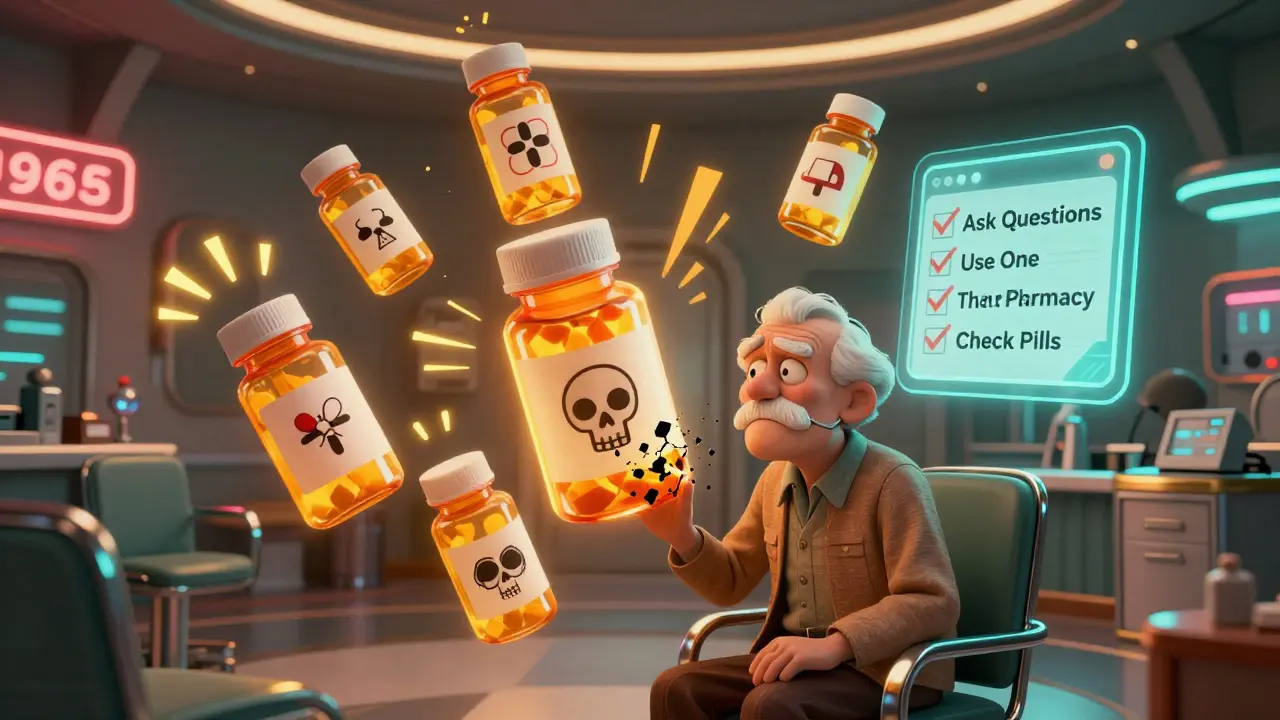
- Keep a live medication list. Write down every pill, patch, injection, and supplement you take-including the dose and why you take it. Update it every time something changes. Bring it to every appointment.
- Use one pharmacy. If you use multiple pharmacies, no one has the full picture. One pharmacy can check for dangerous interactions.
- Ask the three questions. Every time you get a new prescription, ask: What is this for? How do I take it? What side effects should I watch for? If the answer is vague, ask again.
- Check your pills. If your new prescription looks different from the last one-color, shape, markings-ask the pharmacist. Counterfeit drugs are real, and they’re getting better at looking real.
- Don’t share or reuse prescriptions. A pill that helped your friend’s headache might be dangerous for you. Never take someone else’s medicine, even if their symptoms sound the same.
- Use pill organizers. Especially if you take multiple meds daily. A weekly organizer with alarms can prevent missed or double doses.
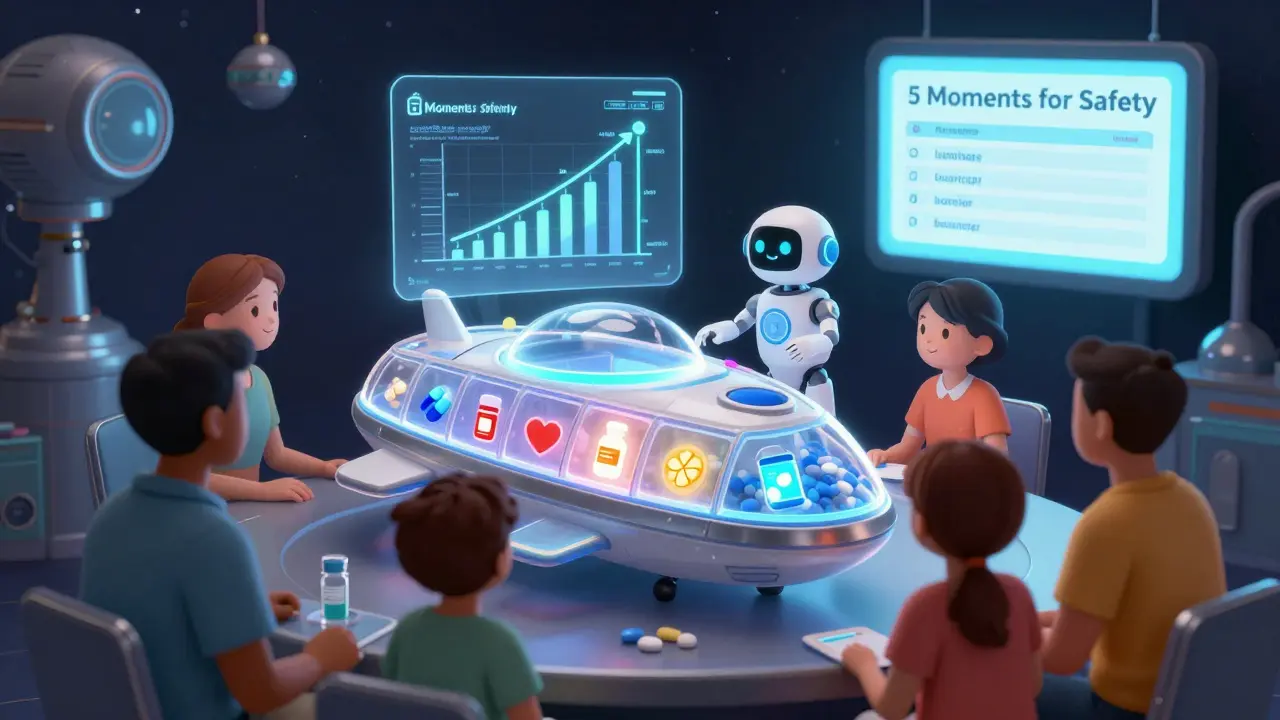
The Australian Commission on Safety and Quality in Health Care calls this the 5 Moments for Medication Safety: when you start a new drug, when you add one, when you move between care settings (like from hospital to home), when you’re on high-risk meds, and when you review everything regularly.
The Hidden Danger: Fake Drugs Online
More than one-third of all counterfeit drugs seized in the world are found in North America. You can buy fake Adderall, Xanax, or oxycodone on Instagram, TikTok, or shady websites. They’re often laced with fentanyl-sometimes in doses strong enough to kill you with one pill.
The DEA says more than 55% of overdose deaths between 2019 and 2021 involved fake oxycodone. These aren’t street drugs. They’re sold as real prescriptions. People think they’re buying safe medicine-and they die because they trusted the wrong source.
Only buy from licensed pharmacies. If a deal seems too good to be true, it is. Look for the VIPPS seal (Verified Internet Pharmacy Practice Sites) in the U.S. or the equivalent in your country.
What’s Next?
The global market for patient safety tools is growing fast-projected to hit $14.3 billion by 2029. Artificial intelligence could cut medication errors by up to 30% by 2027, helping doctors catch interactions before they happen. But tools won’t help if patients aren’t involved.
Medication safety isn’t just about doctors and hospitals. It’s about you. You’re the last line of defense. You hold the pills. You take them. You notice if something feels off.
Don’t assume someone else is watching out for you. Ask questions. Write things down. Speak up when something doesn’t feel right. Because in the end, the most effective safety system isn’t the one with the most technology-it’s the one where patients are informed, involved, and empowered.
How many people are harmed by medication errors each year?
Globally, about 5% of patients-1 in 20-experience harm from medication errors each year. In the U.S. alone, more than 1.5 million people are injured annually, and around 7,000 die in hospitals due to preventable mistakes.
What are the most dangerous types of medications?
Antibiotics cause the most medication-related harm (about 20%), followed by antipsychotics (19%), central nervous system drugs (16%), and cardiovascular medications (15%). Intravenous (IV) drugs also have the highest error rates, with nearly half of all hospital errors involving them.
Are online pharmacies safe?
Only licensed, verified pharmacies are safe. About one-third of counterfeit drugs seized in North America are sold online. Fake pills-often laced with deadly fentanyl-are sold as real prescriptions on social media and unregulated websites. Always look for the VIPPS seal in the U.S. or equivalent certification in your country.
Why do older adults have more medication errors?
Older adults often take five or more medications daily, increasing the risk of interactions, dosing mistakes, and confusion. They may also have trouble reading labels, remembering schedules, or recognizing side effects. Programs that reduce unnecessary prescriptions-like cutting antipsychotic use in seniors-have shown measurable success.
Can medication errors be prevented?
Yes. Most errors are system failures, not individual mistakes. Simple steps like keeping an updated medication list, using one pharmacy, asking questions about new prescriptions, and checking pill appearance can cut your risk significantly. Tools like pill organizers and real-time prescription monitoring also help.
What should I do if I think I’ve had a medication error?
Stop taking the medication immediately and contact your doctor or pharmacist. If you have serious symptoms like trouble breathing, chest pain, or extreme dizziness, go to the emergency room. Report the incident to your provider and consider filing a report with your country’s health safety agency. Document everything: what you took, when, and what happened.
Aditya Gupta
February 1, 2026 AT 13:11Man, I never realized how many people get hurt by meds until I saw my grandma almost die from mixing her blood pressure pill with that herbal tea she swears by. We need better labeling, like actual pictures on bottles, not just tiny text.
Chris & Kara Cutler
February 2, 2026 AT 19:28THIS. 🙌 I work in a pharmacy and see the same mistakes daily. People take 2 pills because they ‘forgot’ they already took one. A simple pill organizer with alarms saves lives. Seriously, get one.
Donna Macaranas
February 3, 2026 AT 19:49I’m the quiet type but I read this whole thing and just… nodded. So much of this hits home. My mom’s on 7 meds and I’ve started printing out her list and reviewing it with her every Sunday. Small thing, but it helps.
Rachel Liew
February 5, 2026 AT 07:10just wanted to say thank you for writing this. i was so confused after my last doctor visit and didn’t know what to ask. now i’m gonna print the 3 questions and take them with me. you’re right-patients need to speak up.
Nicki Aries
February 7, 2026 AT 02:18Let’s be real: if your pharmacist doesn’t ask you if you’re taking anything else, they’re not doing their job. And if your doctor writes ‘q.d.’ instead of ‘daily’? That’s negligence. We need standardized language-no abbreviations, no guessing. Period.
Melissa Melville
February 8, 2026 AT 20:35So you’re telling me I can’t trust my Instagram friend who sells ‘Adderall’ for $5 a pill? Shocking. 🤡 Next they’ll tell me the moon landing was fake.
Naresh L
February 9, 2026 AT 01:18It’s fascinating how we treat medication like magic beans-take it, feel better, stop. But biology doesn’t work that way. We’ve outsourced responsibility to systems that were never designed to handle human complexity. Maybe the real problem isn’t the pills-it’s our relationship with them.
franklin hillary
February 10, 2026 AT 10:32Look, I’ve been in emergency medicine for 20 years. The #1 thing that saves lives? Patients who bring a written list. Not a photo. Not a memory. A LIST. Handwritten. Updated. Brought to every visit. Do this and you cut your risk in half. Seriously. Do it now.
Bob Cohen
February 11, 2026 AT 23:15Yeah, but let’s not pretend the system isn’t broken. I’ve had prescriptions filled wrong three times. Three times. And every time I complained, they acted like I was being difficult. It’s not me. It’s the whole damn pipeline. We need accountability-not just ‘be more careful’.
Ishmael brown
February 12, 2026 AT 23:35Actually, I think we’re overblowing this. Most people are fine. If you’re dumb enough to buy pills off TikTok, you deserve what you get. Maybe the real solution is less education and more Darwinism.