
MAOIs and Other Antidepressants: Combination Dangers and Safer Alternatives
 Dec, 28 2025
MAOI Combination Safety Checker
This tool helps you determine if your current or planned antidepressant combination is safe when using MAOIs. Based on clinical guidelines and the latest research, it checks for dangerous interactions that could cause serotonin syndrome or other complications.
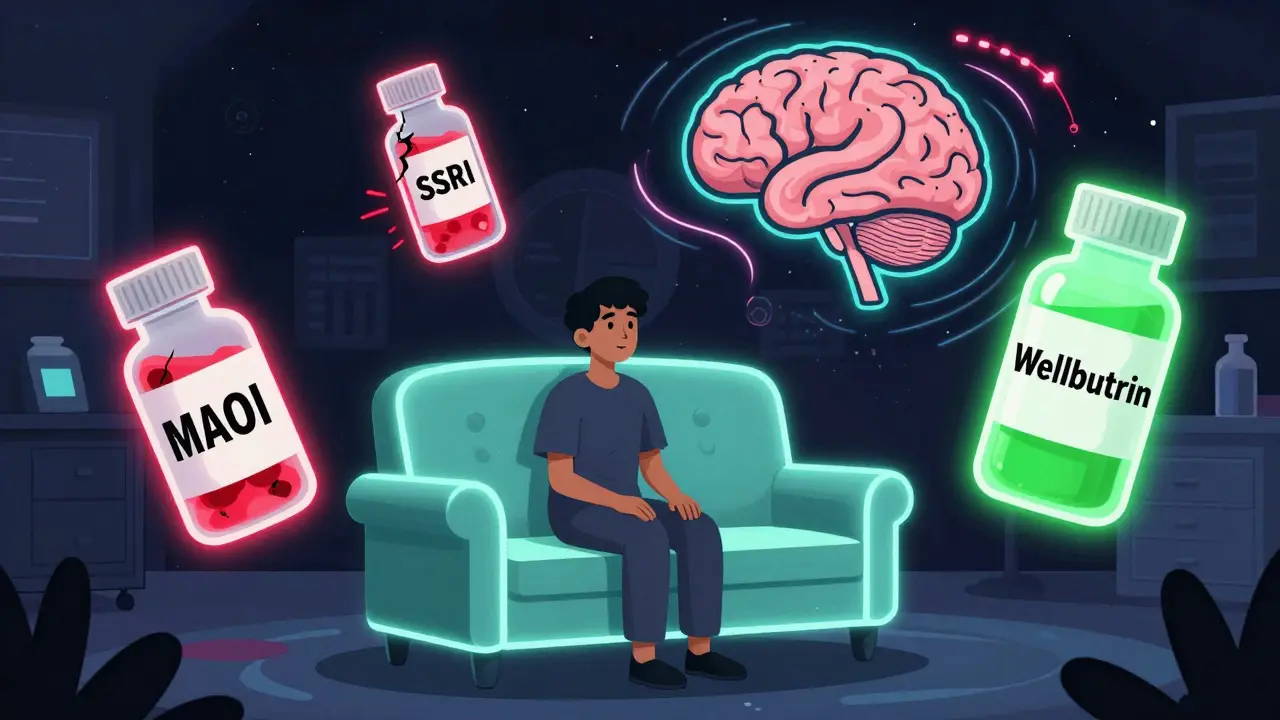
When you’ve tried multiple antidepressants and nothing works, it’s easy to feel like there’s no hope left. That’s where MAOIs come in - but they come with serious risks if used the wrong way. Monoamine oxidase inhibitors, or MAOIs, are some of the oldest antidepressants still in use today. Drugs like phenelzine (Nardil), tranylcypromine (Parnate), and the selegiline patch (Emsam) can help people with treatment-resistant depression - especially those with atypical symptoms like extreme fatigue, oversleeping, or intense sensitivity to rejection. But mixing them with other antidepressants can be deadly if you don’t know the rules.
Why MAOIs Are Different
Most antidepressants work by increasing serotonin, norepinephrine, or dopamine in the brain. But MAOIs do it differently. They block the enzyme that breaks down these chemicals, letting them build up naturally. That’s why they can work when SSRIs and SNRIs fail. About 40 to 60% of people with treatment-resistant depression respond to MAOIs, according to clinical studies. But that power comes with a price: MAOIs interact dangerously with many common medications and even some foods.The Deadly Mix: MAOIs and SSRIs/SNRIs
Combining MAOIs with SSRIs like fluoxetine (Prozac), sertraline (Zoloft), or SNRIs like venlafaxine (Effexor) is one of the most dangerous mistakes in psychiatry. Together, they can trigger serotonin syndrome - a life-threatening surge in serotonin that causes high fever, muscle rigidity, fast heartbeat, confusion, and seizures. In some cases, it’s fatal. A 1995 study in the Journal of Clinical Psychiatry found that seven out of eight cases where fluoxetine was followed by an MAOI ended in death. The FDA now requires a boxed warning on all MAOI labels: never combine with SSRIs or SNRIs. The timing matters too. If you stop an SSRI, you must wait at least 14 days before starting an MAOI. For fluoxetine, the wait is longer - five weeks - because it and its active metabolite stick around in your system much longer than other SSRIs.What About Tricyclic Antidepressants (TCAs)?
The rules around TCAs like amitriptyline or nortriptyline are less clear-cut. For decades, doctors were told to avoid combining TCAs with MAOIs. But recent research challenges that. A 2022 review in PMC9680847 found that some patients with severe depression did well on a combination of phenelzine and nortriptyline, with no serious side effects - if the TCA was started first or at the same time as the MAOI. Here’s the catch: if you start the MAOI first, the risk of serotonin syndrome jumps. And clomipramine - a TCA with strong serotonin effects - should never be mixed with MAOIs under any circumstances. Experts like Dr. J. David Amsterdam have shown that when done carefully, this combination can work for people who’ve tried everything else. But it’s not something to try without close monitoring by a psychiatrist who’s experienced with MAOIs.Safer Alternatives to Combine with MAOIs
You don’t have to give up on combination therapy. Some antidepressants are safe to use with MAOIs because they don’t significantly boost serotonin. These include:- Bupropion (Wellbutrin) - works on dopamine and norepinephrine, not serotonin. Often used to treat low energy and lack of motivation.
- Mirtazapine (Remeron) - helps with sleep and appetite, with minimal serotonin impact. Several case reports show it works well with MAOIs for treatment-resistant cases.
- Trazodone - commonly used off-label for sleep, it’s low-risk when paired with MAOIs.
- Nortriptyline - a TCA with lower serotonin activity than others. Preferred by some specialists for combination therapy.
Dr. Kenneth Heilman and others have noted that these options can be added safely, especially when you’re trying to target specific symptoms like insomnia, low energy, or poor appetite. The key is to change one medication at a time and go slow. Start low, monitor closely, and never rush.
Other Safe Add-Ons
You don’t need to rely only on antidepressants. Many non-antidepressant medications are safe to use alongside MAOIs:- Benzodiazepines like lorazepam or clonazepam for anxiety - no dangerous interactions.
- Non-benzodiazepine sleep aids like zolpidem (Ambien) or eszopiclone (Lunesta) - generally safe.
- Pramipexole - a dopamine agonist used for Parkinson’s, sometimes added to MAOIs for severe anhedonia or apathy. Requires slow dosing to avoid nausea and impulse control issues.
These options give you more tools to manage symptoms without increasing the risk of serotonin syndrome. They’re often the smarter way forward than pushing for risky combinations.
Dietary Restrictions Still Matter
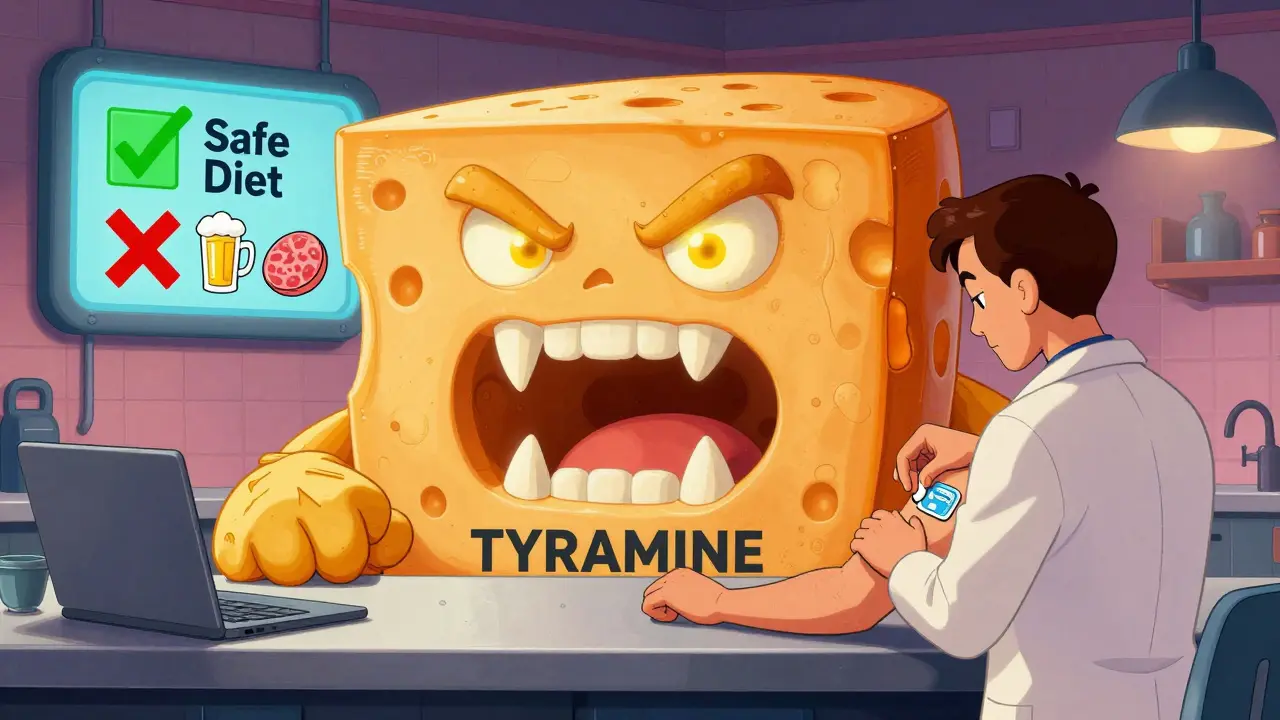
Even if you’re not mixing drugs, MAOIs require dietary changes. Tyramine - found in aged cheeses, fermented meats, tap beer, and soy sauce - can cause a sudden, dangerous spike in blood pressure when MAOIs are active. This isn’t just a theory. In the 1950s, patients on early MAOIs had strokes from eating blue cheese. Today, the risk is lower with the selegiline patch (Emsam) at doses of 6 mg/24hr or less - most people on this form don’t need to change their diet. But if you’re on oral MAOIs like phenelzine or tranylcypromine, you still need to avoid:- Aged cheeses (like cheddar, parmesan, blue cheese) - over 20mg tyramine per 100g
- Tap beer and home-brewed beer - over 10mg per 100ml
- Salami, pepperoni, and other fermented sausages - over 100mg per 100g
And you must keep these restrictions for two weeks after stopping the MAOI. The enzyme doesn’t bounce back instantly.
Stopping MAOIs Isn’t Simple
Abruptly quitting MAOIs can cause withdrawal symptoms that feel like the flu - but worse. A 2004 study found that 71% of people who stopped suddenly had sleep problems, 68% got headaches, 62% felt restless, and 55% had flu-like symptoms. Some even reported tingling or burning sensations. The fix? Taper slowly. Most experts recommend reducing the dose over 2 to 4 weeks. Don’t just stop because you feel better. Your brain needs time to adjust.
Why Aren’t More People Using MAOIs?
Despite their effectiveness, MAOIs are underused. Only 5 to 10% of depression specialists regularly prescribe them. Why? Fear. Lack of training. Outdated guidelines. A 2019 study found only 32% of psychiatry residents felt confident managing MAOIs. Many doctors still think they’re too dangerous - even though newer forms like the Emsam patch have reduced dietary risks. The truth? For the 15 to 20% of people with truly treatment-resistant depression, MAOIs are often the most effective option available.What’s Next for MAOIs?
Research is moving forward. Scientists are testing MAOI derivatives that target only one type of enzyme (MAO-B), which could reduce side effects. Early trials at Yale are exploring combinations with ketamine for rapid relief in severe cases. But until then, the best path is still careful, informed use.Final Takeaway
MAOIs aren’t the first-line treatment for depression - and they shouldn’t be. But for people who’ve tried everything else and still struggle, they can be life-changing. The key isn’t avoiding them entirely. It’s knowing exactly when, how, and with what to use them. Never mix them with SSRIs or SNRIs. Be cautious with TCAs. Stick to safer partners like bupropion or mirtazapine. Follow dietary rules. Taper slowly. And always work with a psychiatrist who understands the risks.If you’re on an MAOI and feel like you’re stuck, don’t give up. There are ways to make it work - safely. You just need the right information and the right team.
Can I take an SSRI after stopping an MAOI?
Yes, but you must wait at least 14 days after stopping the MAOI before starting an SSRI. If the MAOI you took was phenelzine, tranylcypromine, or isocarboxazid, wait 14 days. If you were on fluoxetine (Prozac), you need to wait five weeks after stopping it before starting an MAOI - and then another 14 days after stopping the MAOI before restarting fluoxetine or any other SSRI. The long half-life of fluoxetine and its active metabolite, norfluoxetine, means it stays in your system much longer than other SSRIs.
Is it safe to combine MAOIs with Wellbutrin?
Yes, bupropion (Wellbutrin) is considered safe to combine with MAOIs. Unlike SSRIs and SNRIs, bupropion doesn’t significantly affect serotonin. It works on dopamine and norepinephrine, which makes it a good choice for people who need help with low energy, lack of motivation, or fatigue - common symptoms in treatment-resistant depression. Many clinicians use this combination when other antidepressants have failed. Still, start low and go slow, and monitor for any unusual side effects.
Can I drink alcohol while on an MAOI?
It’s not recommended. Alcohol can interact with MAOIs in unpredictable ways. It may increase drowsiness, lower blood pressure too much, or trigger a hypertensive reaction - especially if it’s beer, wine, or liquor that contains tyramine. Even small amounts can be risky. Most guidelines advise avoiding alcohol entirely while on an MAOI and for two weeks after stopping. If you’re unsure, talk to your doctor. Safety comes first.
What happens if I accidentally eat cheese while on an MAOI?
If you eat a small amount of aged cheese or other high-tyramine food, you might not have any reaction. But if you eat a large portion - like a whole block of blue cheese - you could experience a sudden spike in blood pressure. Symptoms include severe headache, chest pain, rapid heartbeat, nausea, or blurred vision. If this happens, seek medical help immediately. Keep a blood pressure monitor at home if you’re on an oral MAOI, and know the warning signs. The risk is real, but manageable with awareness.
Are MAOIs still used today, or are they outdated?
MAOIs are not outdated - they’re underused. While newer antidepressants are prescribed more often, MAOIs remain the most effective option for about 15 to 20% of people with treatment-resistant depression. The transdermal selegiline patch (Emsam) has made them easier to use, with fewer dietary restrictions at lower doses. Many psychiatrists reserve them for cases where at least two other antidepressants failed. They’re not first-choice drugs, but for the right patient, they can be life-saving.
Janette Martens
December 29, 2025 AT 15:00so i tried phenelzine after 3 years of SSRIs failing and holy shit it was like someone turned on the lights in my brain. but then i ate a slice of blue cheese and thought i was gonna die. blood pressure through the roof. 911 called. worth it though.
Marie-Pierre Gonzalez
December 29, 2025 AT 18:12Thank you for sharing this deeply informative and compassionate overview. As a mental health advocate, I am profoundly grateful for the clarity and care with which you've outlined the nuanced risks and benefits of MAOIs. Such knowledge saves lives. 🙏
Louis Paré
December 29, 2025 AT 18:48Let’s be real-MAOIs are a relic. The fact that we’re still using drugs from the 1950s because Big Pharma doesn’t want to fund better ones says everything about how broken psychiatry is. You want real innovation? Stop playing Russian roulette with tyramine and serotonin. Get off the antiquated bandwagon.
Sydney Lee
December 31, 2025 AT 13:49It's astonishing how casually people treat MAOIs as if they're just another SSRI. The pharmacology is not just complex-it's *sacred*. You don't casually mix neurotransmitter systems like cocktail ingredients. The fact that some clinicians still prescribe these combinations without rigorous monitoring speaks to a systemic erosion of clinical discipline. This isn't medicine-it's gambling with lives.
oluwarotimi w alaka
January 1, 2026 AT 19:30MAOIs are a CIA mind control experiment disguised as medicine. They want you dependent. They want you scared of cheese. They want you to forget your culture, your food, your freedom. The FDA? Just a puppet. Wake up. They’re poisoning the global south with these drugs while banning traditional healing. Why? Because profit > people.
Debra Cagwin
January 3, 2026 AT 04:01Thank you for writing this with such clarity and heart. I’ve seen patients who’ve been told there’s nothing left-and then MAOIs give them back their lives. It’s not magic, it’s science. And yes, it takes care, patience, and a good team. You’re not alone. Keep going.
Hakim Bachiri
January 3, 2026 AT 22:03So… bupropion + MAOI is ‘safe’? LOL. You’re telling me dopamine + monoamine overload is ‘fine’? That’s like saying ‘I’m gonna drive drunk but only on Tuesdays.’ And why is everyone ignoring the fact that MAOIs suppress REM sleep? That’s not a feature-it’s a neurological wrecking ball. You want ‘life-changing’? Try TMS. Or ketamine. Or, I don’t know, therapy?
Celia McTighe
January 5, 2026 AT 10:20My cousin was on phenelzine for 8 years. She started eating cheese again after 3 weeks off and didn’t think twice. Got a migraine, went to the ER, turned out it was a hypertensive crisis. She’s fine now, but wow. This stuff is powerful. I’m so glad you laid out the safe combos. Bupropion + mirtazapine saved her sleep and energy. 💙
Ryan Touhill
January 5, 2026 AT 17:35Let’s not romanticize MAOIs. They’re a last resort for people who’ve given up. And yes, they work-but at what cost? The dietary restrictions are a form of psychological control. You’re not just treating depression-you’re policing your grocery cart. Is that healing? Or is it just another way to make people feel broken?
Teresa Marzo Lostalé
January 7, 2026 AT 10:42I’m from Mexico, and my abuela used to say depression is ‘el peso del alma’-the weight of the soul. MAOIs don’t fix that. But for some, they take the weight off long enough to learn how to carry it. That’s enough. 🌿
ANA MARIE VALENZUELA
January 8, 2026 AT 00:44Anyone who says MAOIs are ‘safe’ with bupropion is either lying or hasn’t read the case reports. I’ve seen two patients with severe agitation and akathisia from that combo. ‘Safe’ is a marketing word, not a medical one. Stop giving false hope.
sonam gupta
January 8, 2026 AT 05:09MAOIs work but no one talks about the shame. You can’t go to weddings. You can’t eat at restaurants. You’re a ghost at the dinner table. And still, they call it treatment. I’d rather be sad and free.
Julius Hader
January 9, 2026 AT 19:13Just stopped my MAOI cold turkey. Felt like I got hit by a truck for three days. Headache, shaking, crying for no reason. Never again. Taper. Taper. Taper. Don’t be stupid.
Vu L
January 11, 2026 AT 17:16Wait so you’re telling me the only reason MAOIs aren’t used more is because doctors are lazy? That’s it? No other reason? I call BS. There’s a reason SSRIs are everywhere. They’re easy. MAOIs are a pain in the ass. And honestly? So am I. Let’s be real.
James Hilton
January 11, 2026 AT 21:28MAOIs are the only reason I’m alive. Tried 11 meds. Got fired. Lost my girlfriend. Then phenelzine. 3 months later, I cooked my first real meal in 5 years. No cheese. No beer. Just me. And my damn eggs. 🍳