
Lab Monitoring Calendars: Staying Ahead of Side Effects
 Jan, 8 2026
Lab Monitoring Calendar Calculator
Calculate Your Next Lab Test
Next Test Date
Why This Matters
When you start a new medication, especially one with serious side effects, the real work doesn’t begin when you swallow the pill. It begins with lab monitoring. Skipping a blood test or missing a checkup isn’t just an oversight-it can lead to hospitalization, permanent damage, or worse. That’s why smart patients and providers use lab monitoring calendars: simple, structured schedules that turn guesswork into safety.
Why Lab Monitoring Isn’t Optional
Not all meds need blood tests. But for some, they’re life-or-death. Take clozapine, an antipsychotic used for treatment-resistant schizophrenia. It can wipe out your white blood cells without warning. If you don’t track your absolute neutrophil count (ANC), you could develop agranulocytosis-a condition that leaves you defenseless against infection. The rule? Weekly blood draws for the first four weeks after your ANC hits 1,500/μL. Then, if you stay stable, it drops to monthly. Miss one test, and you risk losing that safety net. Lithium, used for bipolar disorder, is another example. Too little? Your mood swings return. Too much? You get tremors, confusion, kidney damage, even seizures. Your lithium level must be checked 5-7 days after starting it, then weekly until it’s stable. After that? At least every six months. But if you change your salt intake, start a new diuretic, or get dehydrated? You need a test sooner. Without a calendar, these triggers slip through the cracks. Even common drugs like warfarin need strict monitoring. INR levels tell you if your blood is clotting too slowly-or too fast. A single missed test during a dosage change can mean internal bleeding. Monthly checks are standard. But if your dose shifts, or you start a new antibiotic? You need a test within 3-5 days. No exceptions.How Different Drugs Need Different Tracking
There’s no one-size-fits-all lab calendar. What works for cancer drugs doesn’t help with mood stabilizers. Cancer therapies like LONSURF (trifluridine/tipiracil) require weekly blood counts to catch low platelets or neutrophils before they turn dangerous. Patients also track nausea, vomiting, and fatigue daily. The treatment calendar for LONSURF includes space to log symptoms, missed doses, and temperature spikes-because fever during chemo can mean infection. Psychotropic drugs like olanzapine or risperidone need metabolic panels every 3-6 months. Why? These drugs can spike blood sugar, cholesterol, and weight. Left unchecked, they lead to type 2 diabetes or heart disease. Some patients gain 20 pounds in six months without realizing it’s the med, not their diet. Corticosteroids like prednisone, taken for more than two weeks straight, suppress your adrenal glands. When you stop, your body can’t make cortisol fast enough. That’s an adrenal crisis-low blood pressure, vomiting, collapse. Morning cortisol tests before stopping are mandatory. Many patients don’t know this until they’re in the ER. Glaucoma eye drops like dorzolamide/timolol? You need an annual eye exam to check for corneal damage or pressure changes. It’s not about vision-it’s about preventing permanent nerve damage.Printable Calendars vs. Digital Tools
You can use a paper calendar. Many clinics still hand them out. CBH Philly’s printable template, for example, lists dates for ANC, liver enzymes, and kidney function. You fill in the results by hand. Simple. But it doesn’t remind you. It doesn’t flag when your last test was 47 days ago. And if you lose it? You start over. Digital tools are changing this. Blood Cancer United’s Health Manager app lets you log lab results, side effects, meals, sleep, and even hydration. It shows patterns: “Your nausea spiked every time you took LONSURF after dinner.” Or, “Your INR dropped after you started eating more kale.” These connections are impossible to spot on paper. Ulta Lab Tests lets you order your own blood work without a doctor’s note-but it doesn’t schedule it. You still have to remember when to test, and you still need a provider to interpret the numbers. It’s a tool, not a system. The best approach? Combine both. Use a digital app to track trends and set reminders. Print a copy to bring to your appointments. That way, your doctor sees not just one number, but a story.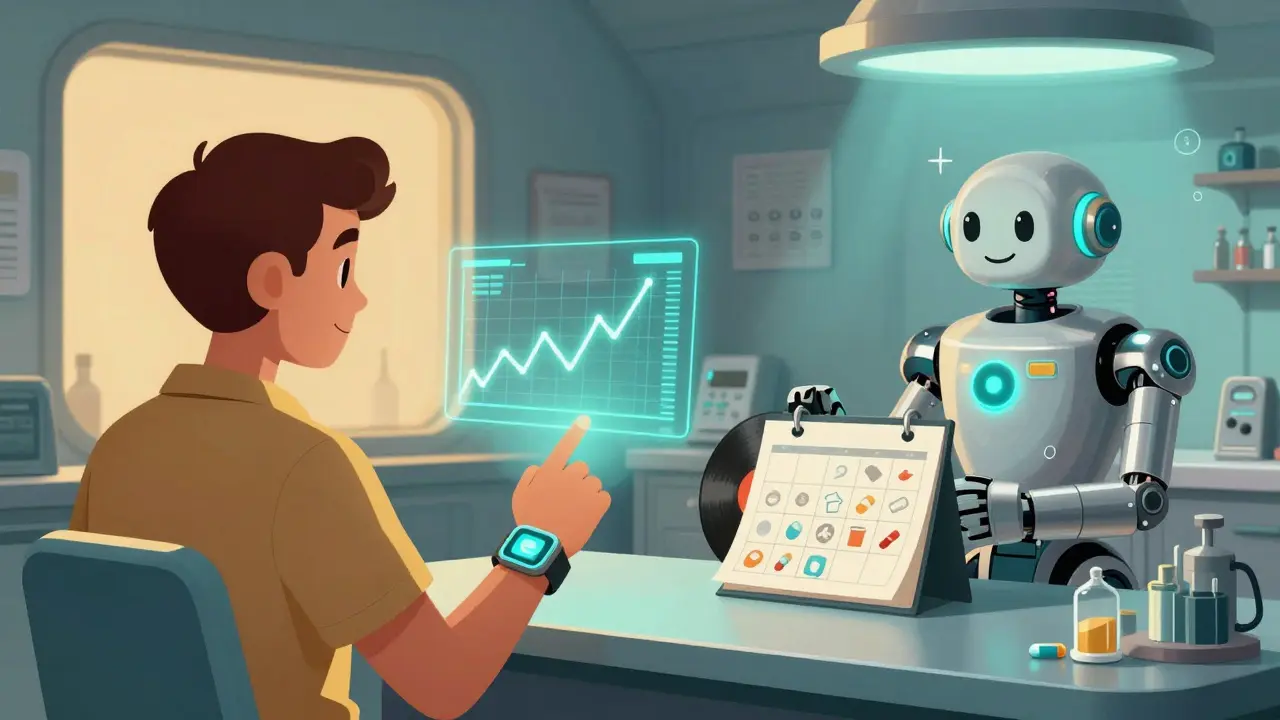
When to Update Your Calendar
Your lab calendar isn’t set in stone. It changes with your treatment. If your dose goes up or down? Update the calendar immediately. Add a note: “Dose increased to 300mg on 1/3/2026. ANC due weekly for next 4 weeks.” If you start a new medication? Check if it interacts with your current one. Antibiotics can raise lithium levels. Statins can worsen muscle damage from statins. Add a line: “New med: amoxicillin. Monitor for diarrhea, rash, or muscle pain.” Even small changes matter. Switching from tap water to bottled water? That can alter your sodium intake and throw off your lithium levels. Write it down. The key is consistency. Don’t wait for your next appointment to update your calendar. Do it the same day you get the news. That way, when you walk into the clinic, your provider sees the full picture-not just a blank space where a test should’ve been.Common Mistakes and How to Avoid Them
People make the same errors over and over:- “I felt fine, so I skipped the test.” Feeling good doesn’t mean your blood counts are safe. Clozapine can drop your neutrophils while you feel perfectly normal.
- “I forgot to test at the right time.” Lithium levels need to be drawn 12 hours after your last dose. If you test at 8 a.m. one week and 4 p.m. the next, the numbers won’t match. Set two alarms: one for the test, one for your last dose.
- “I didn’t tell my doctor about my symptoms.” Nausea, dizziness, or a rash? Log it. Don’t wait for your doctor to ask. They’re busy. You’re the expert on your body.
- “I lost my calendar.” Take a photo of it. Save it in your phone’s notes. Email a copy to a family member.
What Happens When Monitoring Fails
The cost of skipping tests isn’t theoretical. In 2024, a UK study found that 37% of hospital admissions linked to lithium toxicity were preventable-because patients hadn’t had a blood test in over 9 months. Another study showed that 42% of warfarin-related bleeds happened in people who missed at least two INR checks in the past year. These aren’t rare cases. They’re predictable. And they’re avoidable. One patient in Brighton, 68, was on clozapine for 12 years. She missed two ANC tests because her clinic was closed for holidays. She developed a fever, was rushed to the hospital, and spent 11 days in isolation. Her ANC had dropped to 320/μL. She survived-but her recovery took months. Her calendar? A crumpled piece of paper in a drawer.How to Build Your Own Lab Monitoring Calendar
Start simple. Here’s how:- Ask your doctor: “What labs do I need, and how often?” Get it in writing.
- Find your medication’s official monitoring guidelines. For clozapine, check the FDA REMS program. For lithium, use the British National Formulary (BNF) recommendations.
- Choose your tool: Use the Health Manager app, or download a printable template from Community Behavioral Health (2025).
- Mark your calendar: Add blood draw dates, symptom check-ins, and doctor appointments.
- Set phone reminders: Two days before each test. One day before. Morning of.
- Bring your calendar to every appointment-even if it’s just for a refill.
What’s Next for Lab Monitoring
The future is smarter. Apps are starting to sync with wearables-tracking heart rate, sleep, and activity to predict when side effects might spike. AI models are being tested to flag risky lab trends before they become problems. One trial in the U.S. used machine learning to predict lithium toxicity 72 hours before it happened, based on past levels and hydration data. But for now, the best tool is still the one you use consistently. No app, no algorithm, no fancy tech replaces a calendar you update every week. If you’re on a high-risk medication, your lab calendar isn’t just a reminder. It’s your shield. Treat it like one.Do I need a lab monitoring calendar if I feel fine?
Yes. Many dangerous side effects-like low white blood cell counts from clozapine or rising lithium levels-happen without symptoms. Feeling fine doesn’t mean your labs are safe. Monitoring catches problems before you feel them.
Can I order my own blood tests without a doctor?
Yes, through services like Ulta Lab Tests. But you still need a provider to interpret the results and adjust your treatment. Ordering tests without a plan can lead to confusion or unnecessary worry. Always discuss results with your doctor.
How often should I update my lab calendar?
Update it immediately after any change: new medication, dose change, side effect, or illness. Even small changes-like switching water brands or starting a new vitamin-can affect your lab results. Keep your calendar current so it stays useful.
What if I miss a lab test?
Call your doctor right away. Don’t wait. Some meds, like clozapine or warfarin, require immediate retesting. Missing one test might mean pausing your medication until it’s done. It’s better to reschedule than risk serious harm.
Are digital apps better than paper calendars?
Digital apps like Health Manager offer reminders, trend tracking, and symptom correlation-things paper can’t do. But paper is reliable if you lose power or forget your phone. The best system uses both: digital for daily tracking, paper for appointments and backups.
Can my pharmacist help with lab monitoring?
Yes. Pharmacists at pharmacies like Pharmerica are trained to review your meds and flag monitoring needs. They can remind you when tests are due and help you understand your results. Don’t hesitate to ask them.
What if my doctor doesn’t mention lab monitoring?
Ask. Say: “I’ve read that [medication name] requires regular blood tests. Can you tell me what’s needed and how often?” If they’re unsure, ask for a referral to a pharmacist or specialist. Your safety is your responsibility too.
Kiruthiga Udayakumar
January 8, 2026 AT 16:06Let me get this straight-you skip a blood test because you 'felt fine'? Oh honey, your body isn't a TikTok trend. Clozapine doesn't care how 'vibes' you're on. I've seen people end up in ICU because they trusted their 'gut feeling' over science. If you're on high-risk meds, your calendar isn't a suggestion-it's your lifeline. Stop treating it like a suggestion on a sticky note.
Patty Walters
January 9, 2026 AT 07:47i just started lithium last month and honestly didn't know about the 12hr rule for blood draws. i was testing at like 7pm one week and 9am the next. my doc just looked at me like i'd grown a second head. now i have alarms set for my dose AND the lab. also, i took a pic of my paper cal and saved it in notes. dumb but it works. thanks for the reminder 🙏
Phil Kemling
January 10, 2026 AT 04:22There's something profoundly human about the idea that we must outsource our bodily vigilance to a calendar. We are biological creatures, yet we've built systems that demand mechanical precision from fragile, distracted minds. The calendar becomes a proxy for our own mortality-each checkmark a tiny rebellion against entropy. We don't just track labs-we track the thin, trembling line between autonomy and dependence. And yet, isn't it beautiful that we bother? That we, knowing how easily we forget, still carve out space for the ritual of the needle, the vial, the date?
tali murah
January 10, 2026 AT 05:04Oh. My. GOD. People are still using *paper calendars*? In 2026? With the app ecosystem we have? I swear, if I see one more person with a crumpled printout in their purse like it's a holy relic, I'm going to scream. Digital tools don't just remind you-they analyze trends, correlate symptoms with meals, and send alerts to your caregiver if you miss a test. If you're not using Health Manager or something similar, you're not being careful-you're being performative. This isn't mindfulness. It's negligence dressed up as tradition.
Diana Stoyanova
January 10, 2026 AT 16:45Okay but real talk-this post saved my life. I was on olanzapine for 8 months and gained 30 pounds, felt like a zombie, and thought it was just 'me being lazy.' Turns out my fasting glucose was 187 and my triglycerides were through the roof. My doctor never mentioned metabolic panels. I didn't even know they existed for psych meds. I started tracking everything-sleep, meals, mood, labs-and now I'm down 18 pounds, my numbers are normal, and I actually feel like myself again. If you're on ANY med that changes your body chemistry, DO THIS. Don't wait until you're in the ER. Your future self will cry happy tears. You got this. 💪❤️
Gregory Clayton
January 10, 2026 AT 16:58USA has the best medical tech in the world and people are still using paper? That's why we're falling behind. In Germany they have AI that auto-schedules your labs based on your meds and syncs with your smartwatch. Here? People forget because they're too busy scrolling. Wake up. This isn't just about health-it's about national competence. If you can't manage your own blood tests, how are you supposed to run a country? Get with the program. America doesn't lose to paper calendars.
Ashley Kronenwetter
January 12, 2026 AT 10:42While I appreciate the intent behind this post, I must emphasize that the responsibility for adherence to lab monitoring protocols ultimately rests with the patient. Clinicians provide guidelines, but without consistent patient engagement, even the most sophisticated digital tools are rendered ineffective. The ethical imperative to maintain accurate records is not merely a clinical recommendation-it is a fundamental component of informed consent and autonomous healthcare decision-making.
Lindsey Wellmann
January 14, 2026 AT 02:05😭 I missed my ANC test because my clinic was closed for Thanksgiving. I didn’t think it was a big deal… until I got a fever at 3 a.m. and my husband had to drag me to the ER. I spent 11 days in isolation. My ANC was 290. I cried every night. I now have a digital calendar, a printed copy taped to my fridge, AND a notification that says ‘DO NOT SKIP THIS’ in big red letters. I’m alive because I got scared. Don’t wait to get scared. Do it now. 🙏💉