
How to Use Blister Packs and Pill Organizers to Prevent Medication Mistakes
 Dec, 10 2025
Every year, millions of people take the wrong pill at the wrong time-sometimes with life-threatening results. It’s not always because someone forgot. Often, it’s because the system is broken. A pile of bottles, unclear labels, multiple doses per day, and the simple fact that humans make mistakes. For older adults managing five, six, or even ten different medications, the risk of overdose or missed doses is real. But there’s a proven way to fix this: blister packs and pill organizers.
Why Medication Mistakes Happen
Think about your own routine. You’ve got a morning pill for blood pressure, an afternoon one for cholesterol, an evening one for pain, and maybe a bedtime pill for sleep. Now add in vitamins, supplements, and antibiotics. You’re juggling up to 20 pills a day. Without help, even the most careful person can mix things up. Did you take the blue pill this morning? Or was it yesterday? Did you double up because you thought you missed one? Studies show that about half of people with chronic conditions don’t take their meds as prescribed. That’s not laziness-it’s confusion. And the cost? Over $100 billion a year in avoidable hospital visits, ER trips, and complications in the U.S. alone. Many of these errors happen because pills are stored in unlabeled bottles, counted by hand, or sorted into simple weekly boxes that don’t match the actual schedule.What Are Blister Packs?
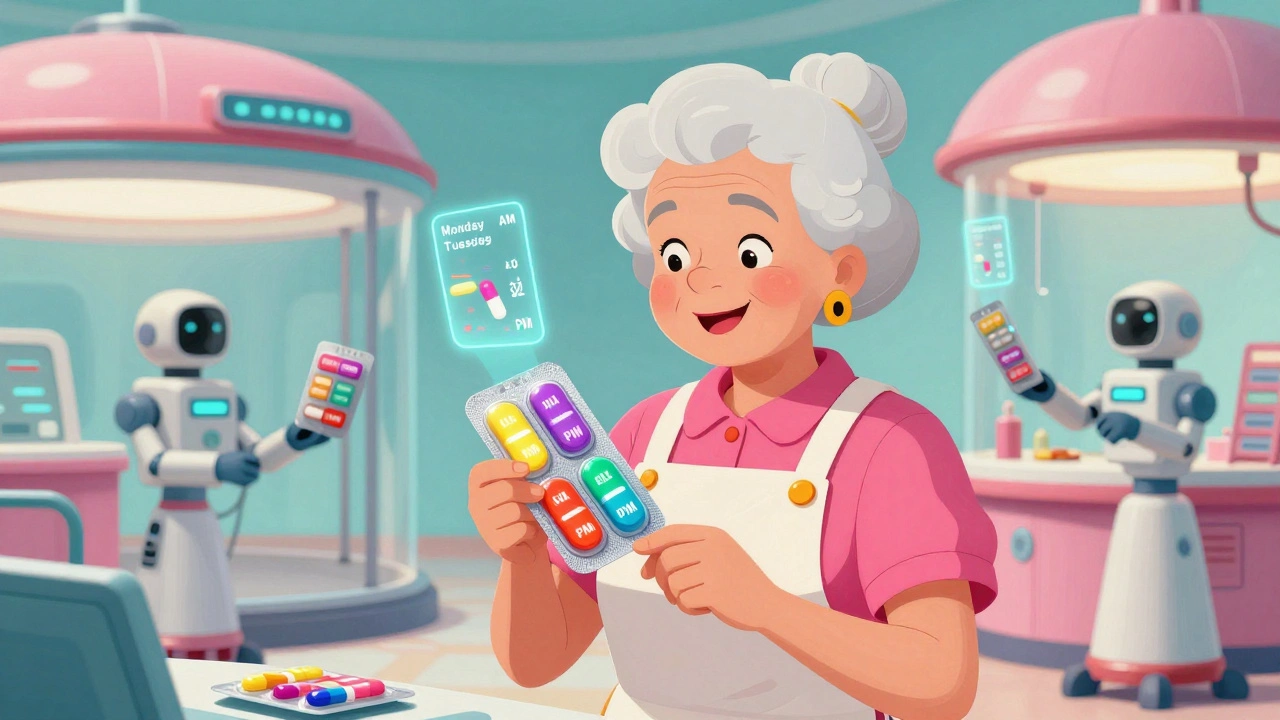
Blister packs are pre-filled, sealed plastic cards with individual compartments for each dose. Each bubble holds one pill, clearly labeled with the day and time-Monday morning, Tuesday evening, Thursday bedtime. They’re made by pharmacies, not bought off the shelf. You send your full medication list to a specialty pharmacy, and they sort everything into a custom pack for you. These aren’t the same as the blister packs you see in drugstores for single medications. These are multi-dose systems designed for complex regimens. Each card typically covers 7 to 14 days. Some go up to 30 days. The packaging is tamper-evident, so you know if someone else has opened it. And unlike pill bottles, you can’t accidentally pour out two pills at once. A 2022 study found that patients using blister packs took their meds correctly 87% of the time-compared to just 64% with regular bottles. That’s a 23-point jump in adherence. For someone with heart failure or diabetes, that difference can mean the difference between staying out of the hospital and ending up in one.How Pill Organizers Work
Pill organizers are simpler. You buy them at a pharmacy or online. They come in weekly, monthly, or multi-time versions. The most common is the 7-day box with four compartments per day: morning, noon, evening, bedtime. You fill them yourself, usually once a week. They’re cheap-$4 to $13 on Amazon-and easy to use. But they have a big flaw: you have to fill them. And that’s where mistakes creep in. If you’re tired, have shaky hands, or forget which pill goes where, you can put the wrong one in the wrong slot. One caregiver on AgingCare.com said her dad with dementia kept taking extra doses because he couldn’t tell if he’d already taken his pill. He’d see an empty slot and think he missed it. Switching to blister packs stopped that entirely. A 2021 study found that even the best pill organizers only improved adherence by 18%. Blister packs? 28%. That’s because blister packs remove the human step of sorting. The pharmacy does it. You just open the bubble and take it.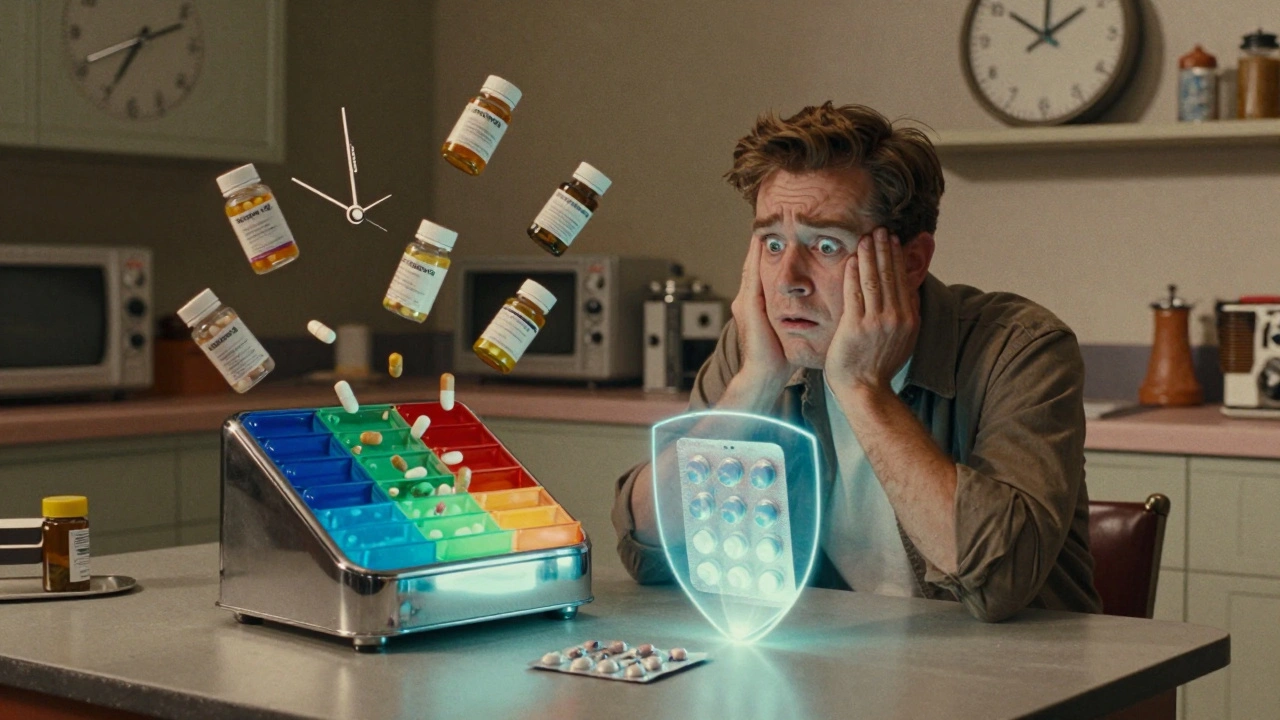
Blister Packs vs. Pill Organizers: Which Is Better?
| Feature | Blister Packs | Pill Organizers | |--------|---------------|-----------------| | Who fills it? | Pharmacy | You or caregiver | | Accuracy | 98% | 70-80% | | Cost per day | $1.50-$3.50 | $0.10-$0.30 | | Best for | 4+ daily meds, complex schedules | Simple routines, stable meds | | Medication changes | Requires repackaging | Easy to adjust | | Visual clarity | Clear day/time labels | Depends on labeling | | Opening difficulty | 23% of users with arthritis struggle | Easy to open | | Tech features | QR codes, sensors available | Rare | | FDA compliance | Yes, tamper-evident | Not regulated | If you’re taking four or more medications daily, or if your schedule changes often (like antibiotics or new prescriptions), blister packs are the clear winner. They’re recommended by the American Society of Health-System Pharmacists for patients on complex regimens. If you’re on a simple routine-say, one pill in the morning and one at night-a weekly pill organizer works fine. But if you’re ever unsure, go with the blister pack. The safety margin is too big to ignore.How to Get Blister Packs
You can’t just walk into a regular pharmacy and ask for one. You need a specialty pharmacy that does multi-dose packaging. Here’s how it works:- Ask your doctor or pharmacist if they work with a blister pack service. Many long-term care facilities and home care agencies already do.
- Provide a complete list of all your medications-including over-the-counter pills, vitamins, and supplements.
- The pharmacy reviews your regimen and creates a custom pack. This takes 3-5 business days.
- You get your first pack delivered, along with clear instructions and sometimes a visual guide.
- Follow-up calls usually happen at 7 and 30 days to make sure everything’s working.
Common Problems and How to Fix Them
Not everything’s perfect. Some people struggle with blister packs. Here’s what comes up-and how to solve it. Difficulty opening the bubbles. About 23% of users, especially those with arthritis, find the seals hard to push through. Solution? Look for “easy-open” blister packs. These have perforated edges or are designed to peel open. Some pharmacies even provide a small tool-a plastic tab you slide under the bubble to pop it out without straining your fingers. Medication changes. If your doctor adds or removes a pill, the whole pack might need to be remade. That’s inconvenient. But newer systems now let pharmacists swap out single doses without repacking the whole card. Ask if your provider uses this updated method. Storage issues. Blister packs can’t hold medications that need refrigeration-like insulin or some antibiotics. If you need cold meds, those will still come in bottles. But you can still use a blister pack for everything else and keep the cold ones separate. Forgetting to refill. Pill organizers require weekly refills. If you or your caregiver forgets, you run out. Blister packs are delivered monthly, so you’re less likely to miss a dose. No refills. No guesswork.
Smart Tech Is Making Blister Packs Even Better
The latest blister packs aren’t just plastic and foil anymore. Some now have tiny sensors inside each bubble. When you open it, the device sends a signal to your phone or your caregiver’s app. If you don’t open the morning dose by 10 a.m., you get a text reminder. If you skip it for two days straight, your family gets a notification. In a 120-person pilot study, these smart packs boosted adherence by 37%. The FDA approved the first QR-code-enabled blister packs in March 2023. Scan the bubble with your phone, and you get a video of your pharmacist explaining why you’re taking that pill, what it does, and what side effects to watch for. AI is coming too. Pharmcare USA announced in October 2023 that their system will soon auto-update blister packs when a doctor changes your meds. No more waiting for a new pack to be mailed-you’ll get a digital alert and a new card within 24 hours.Real Stories, Real Results
One woman in Seattle switched her 82-year-old mother from a weekly pill organizer to a blister pack. Before: 3-4 missed doses a week. After: 1-2 missed doses a month. She said, “Now I can glance at the pack and see exactly what’s been taken. No more guessing.” A survey of 1,247 caregivers found that 89% saw fewer mistakes after switching to blister packs. The top reasons? “Easy to double-check missed doses” (78%), “less chance of taking the wrong pill” (82%), and “huge time saver” (65%). Another caregiver shared that her father with dementia used to end up in the ER every few months from accidental overdoses. After switching to blister packs, he went 18 months without one. “He still has dementia,” she said. “But now he can’t mess up the meds.”What to Do Next
If you’re managing multiple medications-or helping someone who is-don’t wait for a mistake to happen. Take action now.- Make a list of every pill, supplement, and liquid you take, including doses and times.
- Call your pharmacy and ask if they offer blister pack services. If they don’t, ask for a referral to one that does.
- Check with your insurance: Is this covered? What’s the process?
- If you’re using a pill organizer, upgrade to one with color-coded compartments (blue for morning, green for evening, etc.) and refill it on the same day every week.
- Keep a backup list of meds in your wallet or phone. In an emergency, first responders need to know what you’re taking.
Are blister packs covered by insurance?
Yes, many insurance plans cover blister packs, especially Medicare Advantage plans. About 68% of eligible Medicare Advantage beneficiaries have coverage. Medicaid and private insurers often cover them too, particularly if you take four or more daily medications. Always ask your pharmacy or insurer for details-coverage varies by plan.
Can I use blister packs if I have arthritis or limited hand strength?
Yes. Many pharmacies now offer easy-open blister packs with perforated edges or peel-back designs. Some also provide a small plastic tool to help pop open the bubbles without straining your fingers. If you’re having trouble, ask your pharmacy for these versions-they’re designed specifically for people with dexterity issues.
How often do I need to get new blister packs?
Most blister packs are filled for 7, 14, or 30 days, depending on your regimen. You’ll typically receive a new pack weekly or monthly. If your medications change, the pharmacy will update your next pack. Some newer systems can even send you a new pack within 24 hours if your doctor adjusts your prescription.
Do pill organizers help prevent overdoses?
They can help, but they’re not as reliable as blister packs. Since you fill them yourself, there’s room for error-like putting the wrong pill in the wrong slot or taking an extra dose because you think you missed one. Blister packs eliminate that risk because the pharmacy sorts everything for you. For high-risk patients, blister packs are strongly recommended over organizers.
Can I use blister packs for all my medications?
Almost all, but not quite. Medications that need refrigeration-like insulin, certain antibiotics, or liquid suspensions-can’t be stored in blister packs. These will still come in bottles. But you can use a blister pack for everything else and keep the cold meds in a separate, clearly labeled container. Your pharmacy will help you organize this.
Vivian Amadi
December 11, 2025 AT 00:36Taylor Dressler
December 12, 2025 AT 13:24Courtney Blake
December 12, 2025 AT 20:04Sylvia Frenzel
December 13, 2025 AT 22:45Lisa Stringfellow
December 15, 2025 AT 14:09Eddie Bennett
December 16, 2025 AT 03:55john damon
December 17, 2025 AT 04:46Monica Evan
December 19, 2025 AT 02:23Aidan Stacey
December 19, 2025 AT 18:24Katherine Liu-Bevan
December 19, 2025 AT 19:25