
How to Prevent Overdose with Patch, Liquid, and Extended-Release Medications
 Jan, 24 2026
Overdose isn’t just about street drugs. Many people don’t realize that prescription medications - especially patches, liquids, and extended-release pills - can be just as deadly if used incorrectly. These forms are designed to release medicine slowly, safely, and over time. But when they’re misused, the results can be fatal. Fentanyl patches, liquid morphine, and OxyContin are common examples. Each has unique risks. And each needs specific safety steps to prevent tragedy.
Why Patches Are Dangerous When Misused
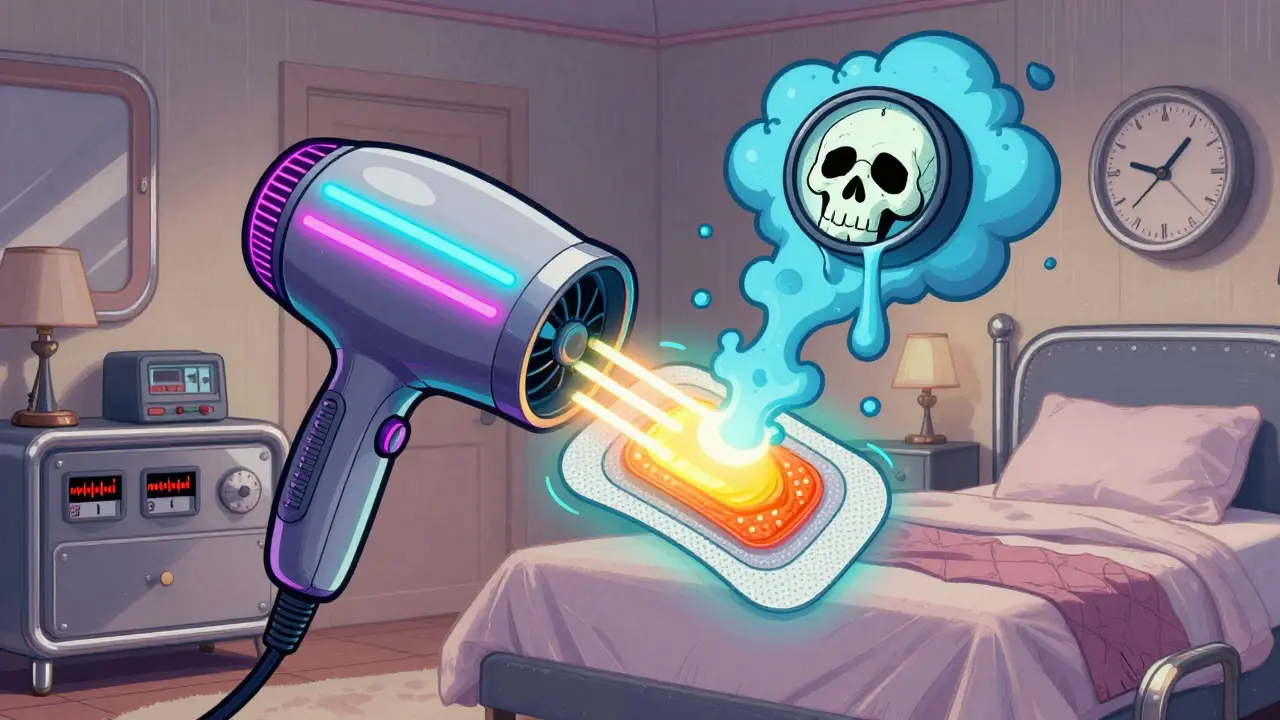
Transdermal patches like fentanyl or buprenorphine are meant to stick to your skin and deliver a steady dose over 72 hours. That’s the whole point: no spikes, no crashes. But people often don’t know what happens when they break that system.Cutting a patch, chewing it, or heating it with a hair dryer or heating pad turns it into a time bomb. Instead of slowly releasing 25 micrograms of fentanyl over three days, you could get the full dose all at once. That’s enough to stop breathing in someone who’s not tolerant.
Even storing patches improperly is risky. Kids have died after finding discarded patches on the floor or in the trash. A single used patch still holds half the original dose. That’s why you must fold the sticky side together before tossing it out - and keep unused patches locked away, out of reach.
Never share patches. Never apply more than prescribed. And never use someone else’s patch, even if they say it’s "just for pain." Fentanyl patches are not interchangeable. Your tolerance is yours alone.
Liquid Medications: Tiny Doses, Big Risks
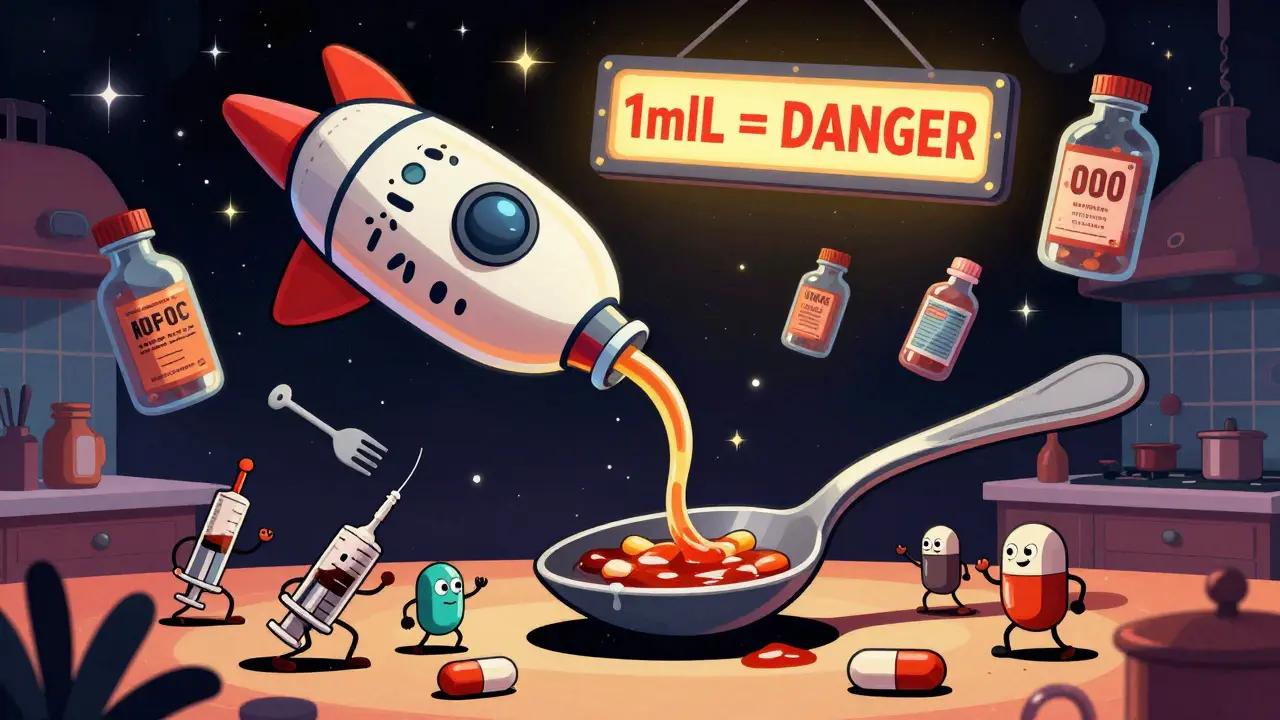
Liquid opioids - like morphine syrup or cough syrups with codeine - are tricky because they’re easy to mismeasure. A teaspoon isn’t the same as a tablespoon. A kitchen spoon isn’t accurate. And if you’re blind, elderly, or distracted, it’s easy to pour too much.One study found that nearly 40% of accidental overdoses from liquid opioids happened because people used household spoons instead of the dosing cup or syringe that came with the medicine. A single extra milliliter can push someone into overdose territory.
Always use the tool provided by the pharmacy. If it’s broken or missing, ask for a new one. Don’t guess. Don’t eyeball. Don’t use a medicine dropper unless it’s marked with measurements. Some liquids look almost identical - like liquid oxycodone and liquid hydrocodone. Keep them labeled and separate. Store them in a locked cabinet, not on the counter.
And never mix liquid opioids with alcohol or benzodiazepines. That combo slows breathing even more. It’s the leading cause of death in people using these medications. Even one drink can turn a safe dose into a lethal one.
Extended-Release Pills: The Silent Killer
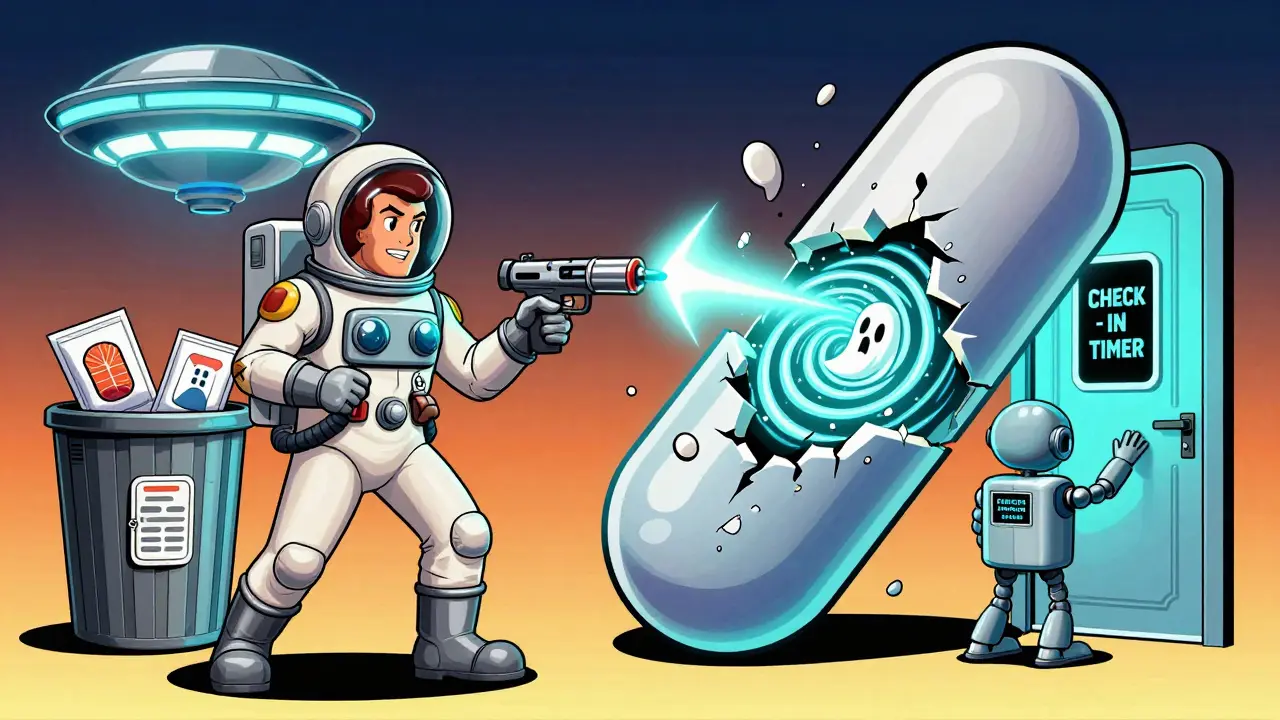
Extended-release tablets like OxyContin, MS Contin, or tramadol ER are built to last. They have special coatings or matrices that control how fast the drug enters your bloodstream. That’s good for managing chronic pain. But dangerous if you crush, chew, or dissolve them.Crushing one of these pills releases the entire dose at once - sometimes 80, 120, or even 160 milligrams of opioid in seconds. That’s like taking 10 regular pills all at once. People do this to get high. Others do it because they think it’ll work faster for pain. Both are deadly mistakes.
Even swallowing the pill wrong can be risky. If you take it with alcohol or grapefruit juice, it can change how your body absorbs the drug. Some people break the pill to make it easier to swallow. That’s not safe. If you can’t swallow pills whole, talk to your doctor. There are liquid or patch alternatives.
Also, never take extended-release pills more often than prescribed. If you miss a dose, don’t double up. If your pain returns before the next dose, call your provider. There are safer ways to adjust treatment than self-dosing.
Naloxone: Your Lifeline - But Not a Cure
Naloxone is the only medication that can reverse an opioid overdose. It works fast - within 2 to 5 minutes. It’s available as a nasal spray (Narcan) or an auto-injector. And it’s free or low-cost in most states.But here’s what most people don’t know: naloxone wears off in 30 to 90 minutes. Extended-release pills, patches, and even some liquids can keep releasing opioids for hours - even days. That means after naloxone wears off, the person can slip back into overdose. This is called "renarcotization." It’s why you must call 911 even after giving naloxone.
Keep naloxone where you can reach it fast. Not in the back of a drawer. Not in your car. Keep it next to your bed, in your wallet, or taped to your fridge. Train your family, friends, and roommates on how to use it. Practice with a trainer kit. You don’t need to be a medic. If someone is unresponsive and not breathing normally, give naloxone. Then call 911. Then keep watching them.
Other Critical Safety Steps
Don’t use alone. This isn’t just advice - it’s life-saving. If you’re using any of these medications, even as prescribed, make sure someone knows what you’re doing and when. Set a text reminder. Ask a neighbor to check in. Use a buddy system. Overdoses often happen when people are alone.
Use fentanyl test strips. Even if you’re taking a prescription, fentanyl can be mixed in by accident. Illicit pills sold as oxycodone often contain fentanyl. Test strips cost less than $1 each. Dip a small piece of the pill in water, then dip the strip. If it shows positive, don’t use it. You can get them free from harm reduction centers.
Know your state’s Good Samaritan law. In most places, you can call 911 during an overdose without fear of arrest - even if you’re using drugs illegally. The law protects you and the person overdosing. Use it. Don’t wait.
Dispose of meds properly. Don’t flush them. Don’t throw them in the trash without folding the patch. Take unused patches, liquids, or pills to a drug take-back location. Pharmacies, hospitals, and police stations often have drop boxes. If none are nearby, mix pills with coffee grounds or cat litter, seal them in a container, and throw them away. That makes them unappealing and hard to reuse.
What to Do If You Suspect an Overdose
Signs of opioid overdose:
- Unresponsive to shaking or shouting
- Slow, shallow, or stopped breathing
- Lips or fingernails turning blue or gray
- Pinpoint pupils
- Gurgling or snoring sounds
Steps to take:
- Call 911 immediately.
- Give naloxone if you have it. One dose. Wait 2-3 minutes.
- If no response, give a second dose.
- Start rescue breathing if they’re not breathing. Tilt head back, pinch nose, give one breath every 5 seconds.
- Stay with them until help arrives. Watch for relapse.
Don’t wait for symptoms to get worse. Act fast. People have survived because someone acted before they thought it was "serious enough."
Final Thought: This Isn’t About Blame
Overdose doesn’t happen because someone is weak or careless. It happens because these medications are powerful, complex, and often misunderstood. Even people following their prescriptions can be at risk - especially if they’re older, have liver or kidney issues, or are taking other sedatives.
The goal isn’t to scare you. It’s to give you control. Know how your meds work. Know the signs. Keep naloxone nearby. Talk to your doctor. Ask questions. If something feels off, it probably is. And you’re not alone in this. Thousands of people use these medications safely every day - because they took the time to learn how.
Can I use a fentanyl patch if I’ve never taken opioids before?
No. Fentanyl patches are only for people already tolerant to opioids. If you’ve never taken opioids, your body isn’t used to them. Even a low-dose patch can stop your breathing. Doctors will never prescribe a fentanyl patch to someone without opioid tolerance. If you’re prescribed one and have never taken opioids, ask your doctor to explain why - and get a second opinion.
Is it safe to cut an extended-release pill in half?
Only if the pill is specifically designed to be split - and most aren’t. Extended-release pills have coatings or layers that control how the drug releases. Cutting them destroys that system. You could get a full dose all at once. Always check the label or ask your pharmacist. If it says "do not crush or split," don’t do it. There are half-dose versions available for most medications - ask your doctor for those instead.
Can I drink alcohol while using liquid opioids?
No. Alcohol and opioids both depress the central nervous system. Together, they can slow your breathing to a dangerous level - even at low doses. Many overdose deaths involve this combination. If you’re taking liquid opioids, avoid alcohol completely. That includes beer, wine, and even cough syrups that contain alcohol.
How long does naloxone last, and why does that matter?
Naloxone works for 30 to 90 minutes. But extended-release pills, patches, and some liquids can keep releasing opioids for 12 to 72 hours. That means after naloxone wears off, the person can go back into overdose. That’s why you must call 911 even after giving naloxone. Medical help needs to monitor them for hours - sometimes overnight - to make sure the opioids don’t return.
Where can I get naloxone for free?
Most pharmacies offer naloxone without a prescription. Many community health centers, harm reduction organizations, and local health departments give it away for free. You can also order free nasal naloxone kits online from government-backed programs like HarmReduction.org or getthemnaloxone.org. No ID or proof of need is required.
What should I do with old or unused patches?
Fold the sticky side of the patch together so it sticks to itself. That keeps the drug from leaking out. Then throw it in the trash. Do not flush it. Do not leave it lying around. If you’re unsure, take it to a drug take-back location - pharmacies, hospitals, or police stations often have drop boxes. If none are nearby, mix the folded patch with coffee grounds or cat litter, seal it in a container, and toss it.
Napoleon Huere
January 24, 2026 AT 17:10It’s wild how we treat medicine like it’s magic when it’s just chemistry. Patches, liquids, pills-they’re not toys, they’re tools. And like any tool, misuse turns them into weapons. We don’t blame people for not knowing, but we also can’t keep pretending ignorance is an excuse when the info’s out there. Maybe the real problem isn’t the drugs-it’s that we’re taught to fear them, not understand them.
Education should start in high school. Not just "don’t do drugs," but "here’s how your body processes this stuff." If we treated prescriptions like we treat cars-mandatory training, safety checks, licenses-maybe fewer people would end up in the ER.
And naloxone? It’s not a Band-Aid. It’s a bridge. A bridge to care. But we treat it like a last resort instead of a first line of defense. We need it in every home, every school, every church basement. Not because we expect overdoses-but because we know they happen.
And yes, people still use kitchen spoons. I’ve seen it. Grandmas. Teens. People with shaky hands. The system fails them every time.
It’s not about blame. It’s about design. Bad design kills. Good design saves lives. We can do better.
And we will. Eventually. Maybe.
Shweta Deshpande
January 25, 2026 AT 05:22Oh my goodness, this post is like a warm hug from a very smart auntie who knows exactly what you need to hear 😊
I’m from India, and here, people think if it’s prescribed, it’s safe-until someone’s dad takes half a pill because his back hurts "a little more today" and ends up in the hospital. We don’t talk about this stuff. We whisper. We hide. We feel ashamed.
But your words? They don’t shame. They teach. And that’s rare.
I showed this to my mom, who’s on liquid morphine for cancer pain. She didn’t know about the dosing cup thing. She was using a teaspoon. I ran to the pharmacy right away and got her a new one. She cried. Not from pain-from relief.
And naloxone? We don’t even have it in our village pharmacy. But I’m going to start a campaign. I’m gonna ask the local doctor to stock it. I’m gonna teach my neighbors. I’m gonna write it in Hindi and share it on WhatsApp.
Thank you for making me feel like I can do something. Not just sit and worry. Thank you.
❤️
P.S. I’m sending this to every group chat I’m in. Let’s save lives, one message at a time.
Aishah Bango
January 26, 2026 AT 04:51People think they’re being responsible because they have a prescription. That’s not responsibility. That’s delusion.
My cousin died from a fentanyl patch. He was 28. He had a torn rotator cuff. He didn’t even know what tolerance meant. The doctor gave him a patch. No warning. No follow-up. Just a script.
And now we’re supposed to feel bad for the system? No. We’re supposed to fix it. And until we stop treating addicts like victims and start treating them like adults who made bad choices, this keeps happening.
Don’t give me the "it’s not their fault" speech. It’s not about blame. It’s about accountability. If you take a powerful drug, you owe it to yourself to learn how it works. Not your doctor. Not your pharmacist. YOU.
And if you can’t? Then don’t take it.
Simple.
Why is that so hard to understand?
Simran Kaur
January 27, 2026 AT 06:18My heart just broke reading this. I’m from Punjab, and I’ve seen so many families lose someone to "medication gone wrong"-and no one ever talks about it. We say "he had a heart attack" or "she got sick suddenly." But we never say opioid overdose. We never say patch. We never say naloxone.
I remember my uncle-he was diabetic, on pain meds after surgery. He didn’t know you couldn’t mix it with alcohol. He had a glass of whiskey after dinner. Just one. He never woke up.
I’ve been working with a local NGO to translate these safety tips into Punjabi, Hindi, and Urdu. We’re printing them on posters and handing them out at clinics. We’re teaching grandmas how to use the dosing syringe. We’re showing them how to fold the patch.
It’s not glamorous. It’s not viral. But it’s real.
And if one person lives because of this? It’s worth it.
Thank you for saying what no one else will.
With love from India.
❤️🫶
Neil Thorogood
January 28, 2026 AT 16:13So let me get this straight-we’re giving out death-in-a-patch like it’s a coupon for free pain relief? 😂
And people are STILL using kitchen spoons?? Bro. You’re not cooking dal. You’re not measuring sugar for your chai. You’re handling a drug that can kill you in 10 minutes. Use the damn syringe.
And don’t even get me started on the "I just wanted to feel better" crowd who crush OxyContin like it’s a vitamin.
Look. I get it. Pain sucks. But so does being dead.
Naloxone isn’t a trophy. It’s a life raft. Keep it next to your damn phone. Not in the glove compartment where it freezes in winter. Not in the bathroom where your cat knocks it over.
And if you’re reading this and you’ve never heard of fentanyl test strips? Go get them. Now. Before you or someone you love becomes a statistic.
And yes, I’m serious. I’m not joking. I’m not being dramatic.
I’ve seen it happen. I’m not gonna let it happen again.
🙏🔥
Jessica Knuteson
January 28, 2026 AT 23:09Robin Van Emous
January 29, 2026 AT 15:15I just want to say thank you for writing this with such care. I’ve been on extended-release pain meds for years. I’ve never crushed a pill. I’ve always used the dosing cup. I’ve always kept naloxone in my nightstand.
But I’ve also been scared to talk about it. Afraid people would think I was addicted. Afraid my doctor would stop prescribing. Afraid my kids would worry.
This post didn’t make me feel judged. It made me feel seen.
And I’m gonna share it with my sister. She’s on liquid oxycodone. She uses a teaspoon. I’m taking her to the pharmacy tomorrow. We’re getting the syringe.
And I’m telling my coworkers about naloxone. I’m gonna ask our HR department to stock it in the break room.
It’s not about fear. It’s about responsibility.
And you just reminded me I can be responsible.
Thank you.
-Robin
Angie Thompson
January 31, 2026 AT 04:24OMG I just read this and I’m literally crying and cheering at the same time 🥹💖
My best friend’s mom died from a fentanyl patch. She was 67. She thought it was like a heating pad. She didn’t know it was a time bomb. No one told her.
So now? I’m the Naloxone Queen of my neighborhood. I’ve given out 12 kits. I’ve taught 3 grandmas how to use the spray. I’ve put up flyers at the laundromat. I’ve even convinced my local Dollar General to stock them.
And guess what? One lady used it on her husband last month. He was blue. She gave him the spray. He woke up. She called 911. He’s fine.
It’s not magic. It’s just… knowledge.
And knowledge? It’s free. It’s powerful. And it’s yours to share.
So go get a kit. Teach someone. Fold your patches. Use the syringe.
You’re not a hero.
You’re just someone who cared enough to act.
And that? That’s everything.
❤️🩹 #NaloxoneForAll
Karen Droege
January 31, 2026 AT 22:41Let’s be brutally honest: if you’re using extended-release opioids, you’re already gambling. The system is designed for chronic pain patients who are monitored, tested, and supported. But most people? They’re self-managing. They’re lonely. They’re in pain. They’re tired of being told to "just exercise more."
So they cut pills. They mix liquids with wine. They reuse patches. And then they die.
And the medical system? It’s complicit. Doctors prescribe like they’re handing out candy. Pharmacists don’t always educate. Insurance won’t cover naloxone unless you’re on a high dose. It’s a death loop.
But here’s the thing: the solution isn’t more rules. It’s more humanity.
We need doctors who sit down and say, "I’m scared for you. Let’s talk."
We need pharmacies that hand you naloxone with a hug, not a receipt.
We need communities that say, "You’re not broken. You’re hurting. Let’s help."
This isn’t about addiction. It’s about care.
And if we don’t fix that? More people will die.
And we’ll keep pretending we didn’t see it coming.
George Rahn
February 1, 2026 AT 17:36Let me be clear: this is not a medical issue. It is a moral failure of Western society.
We have turned pain into a right. We have turned medicine into a commodity. We have turned suffering into a business model.
And now we are surprised when people die?
When I was a boy in the 1980s, we did not have fentanyl patches. We had aspirin. We had rest. We had grit.
Today, we hand out opioids like candy and then blame the victim when they overdose.
This is not a crisis of education. It is a crisis of character.
Stop treating people like children. Stop coddling them with naloxone. Stop enabling them with free kits.
Teach discipline. Teach responsibility. Teach endurance.
Because if you cannot endure pain without a chemical crutch-you are not sick. You are weak.
And weakness should not be rewarded with government-funded safety nets.
It should be corrected with character.
Ashley Karanja
February 2, 2026 AT 23:10Reading this felt like being hugged by a therapist who also happens to be a pharmacologist. 🤗
I’ve been on chronic pain meds for 12 years. I’ve had two overdoses-both near-misses. One was because I took a pill with a glass of wine. I didn’t even realize it was a problem until I couldn’t stand up.
My doctor never told me about renarcotization. I didn’t know naloxone wore off faster than the drug. I thought, "I took it, I’m fine."
That was my wake-up call.
Now I keep two Narcan kits in my purse. One in my car. One taped to my fridge. I’ve trained my roommate. My dog even knows the sound of the spray.
And I tell every person I meet who’s on opioids: "Don’t be like me. Learn now. Don’t wait for the near-death experience."
Because you don’t get a second chance to get it right.
And if you’re reading this and you’re scared to ask your doctor a question? Do it anyway.
Your life is worth more than your fear.
Love you all.
-Ashley 🌿
bella nash
February 3, 2026 AT 07:41SWAPNIL SIDAM
February 4, 2026 AT 18:36Geoff Miskinis
February 5, 2026 AT 00:20How quaint. We’ve reduced a complex pharmacological issue to a BuzzFeed-style checklist. "Fold the patch," "use the syringe," "get naloxone." As if these are the solutions to a societal decay rooted in medical overprescription, pharmaceutical lobbying, and the commodification of human suffering.
And yet, here we are-reducing tragedy to a series of performative safety steps, as if the real problem isn’t the system that turned painkillers into a cultural norm.
It’s not that people don’t know how to use the syringe.
It’s that they were never meant to be the ones holding it.
But by all means, keep folding your patches.
It’s much easier than holding the system accountable.
Sally Dalton
February 5, 2026 AT 21:47Napoleon Huere
February 7, 2026 AT 11:01Just read Ashley’s comment. That’s exactly it. We don’t need more rules. We need more people who’ve been there. People who say, "I messed up too."
That’s the real safety net. Not the naloxone. Not the syringe. The human connection.
Thanks for sharing your story, Ashley. You just saved someone’s life by being honest.
And to Bella-yes, the tone matters. But sometimes, clinical precision kills faster than ignorance. A heart that says "I’ve been there" saves more lives than a textbook that says "follow protocol."
Keep talking. Keep sharing.
Because the next person who reads this? They might be one text away from dying.
And you just gave them a chance.