
How Fatty Foods Boost Absorption of Lipid-Based Medications
 Jan, 4 2026
Medication Fat Requirement Calculator
Select your medication and calculate how much fat you need for proper absorption.
When you take a pill with a fatty meal, you’re not just eating - you’re activating a hidden system in your body that can make your medicine work better. This isn’t folklore. It’s science. And for certain medications, skipping the fat could mean your treatment doesn’t work as well as it should.
Why Fat Matters for Some Medicines
Not all drugs behave the same way in your body. About 70% of new medications being developed today are poorly soluble in water. That means they don’t dissolve easily in your gut, and without dissolving, they can’t be absorbed into your bloodstream. This is where fatty foods come in.
When you eat fat, your body responds by releasing bile and digestive enzymes. These work together to break down the fat into smaller pieces, creating tiny structures called micelles. These micelles act like little taxis for drugs that can’t dissolve in water. They pick up the medication and carry it through the gut lining so it can enter your blood.
This is called the food effect. It’s not random. It’s predictable. And pharmaceutical companies have spent decades learning how to use it.
Lipid-Based Formulations: When Science Meets Diet
Modern medicine doesn’t just rely on your body’s natural response to fat - it builds on it. Lipid-based medications are specially designed to take advantage of this process. These aren’t regular pills. They’re often soft gel capsules filled with oils, surfactants, and co-solvents that mimic what happens when you eat a fatty meal.
Think of them as pre-activated delivery systems. Instead of waiting for your body to create micelles after eating, these formulations already contain the ingredients needed to form them right away. That’s why drugs like cyclosporine (Neoral®), fenofibrate (Tricor®), and itraconazole (Sporanox®) work so much better when taken with food - especially fat.
Studies show these formulations can boost absorption by 20% to over 300% compared to standard tablets. For example, Tricor® delivers 31% more of the active ingredient than older versions, meaning patients often need fewer doses and experience fewer side effects.
What Kind of Fat Works Best?
Not all fats are created equal when it comes to drug absorption. Medium-chain triglycerides (MCTs), found in coconut oil and some pharmaceutical oils, digest faster than long-chain fats like those in butter or steak. MCTs break down in 15-30 minutes, while long-chain fats can take over an hour.
This speed matters. Faster digestion means quicker formation of micelles - and faster drug absorption. That’s why many lipid-based formulations use MCTs as their base. They’re more reliable, especially for patients who don’t always eat consistent meals.
On the flip side, if you’re taking a drug that needs an acidic environment to dissolve - like some bisphosphonates for osteoporosis - fat can actually hurt absorption. That’s because fat slows down how fast your stomach empties, keeping the drug in acid for too long and reducing its effectiveness.

Real Patient Experiences
For people on chronic medications, the difference between a lipid-based formulation and a standard one isn’t just clinical - it’s personal.
One transplant patient on Reddit shared: “Switching from Sandimmune to Neoral eliminated my need to time meals around my dose. I used to stress about eating exactly 2 hours after my pill. Now I just eat with it.”
Another user wrote: “I used to get stomach cramps every time I took my old fenofibrate. The Tricor version? No issues. I take it with breakfast and forget about it.”
These aren’t isolated stories. A 2022 study found that 87% of patients on lipid-based fenofibrate reported fewer gastrointestinal problems than those on older versions. And 72% preferred the new formulation because it simplified their routine.
The Cost Trade-Off
But there’s a catch: these advanced formulations cost more.
A 30-day supply of Sporanox oral solution (lipid-based itraconazole) runs around $1,200. The generic capsule version? About $300. That’s a 4x difference.
For many patients, especially those without good insurance, that price gap makes the choice impossible - even if the better-absorbed version means fewer side effects and better results. Insurance companies often require patients to try the cheaper version first, even if it’s less effective.
And it’s not just about cost. These formulations require special packaging - usually soft gel capsules - because the oils can degrade if exposed to air or moisture. That adds to manufacturing complexity and price.
Who Benefits Most?
Lipid-based delivery doesn’t help everyone. It’s most useful for drugs that fall into BCS Class II or IV - meaning they have low solubility but decent or poor permeability. These include:
- Immunosuppressants like cyclosporine and tacrolimus
- Cholesterol drugs like fenofibrate and atorvastatin (in some formulations)
- Antifungals like itraconazole and posaconazole
- Some cancer drugs and antivirals
If your drug is highly soluble - like aspirin or metformin - adding fat won’t help. In fact, it might slow down absorption without any benefit.
Doctors and pharmacists now routinely check whether a medication has a known food effect. If it does, they’ll tell you whether to take it with food, on an empty stomach, or with a specific type of meal.
What You Should Do
If you’re on a medication that might be affected by food:
- Check the label or ask your pharmacist: “Does this need to be taken with food?”
- If yes, make sure you’re eating at least 10-15 grams of fat with it - think avocado, nuts, cheese, or a spoonful of olive oil.
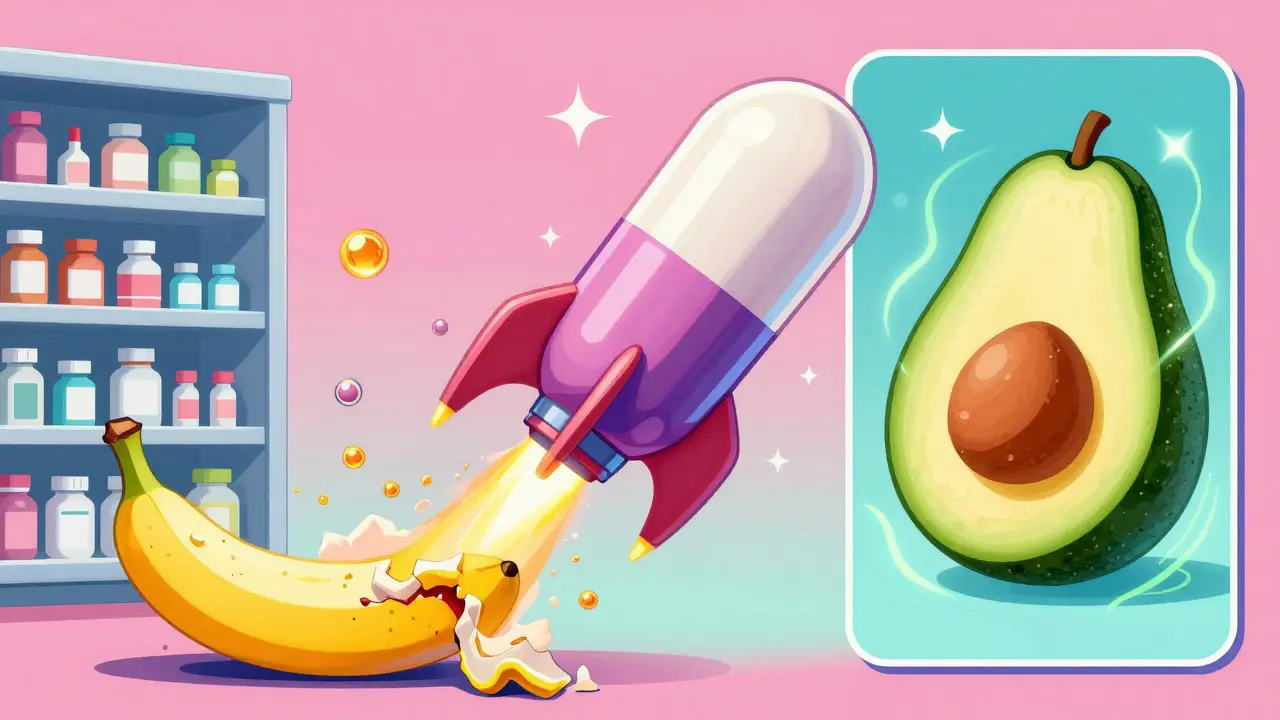
- Don’t assume “with food” means any snack. A banana won’t cut it. You need real fat.
- If you’re on a low-fat diet for medical reasons, talk to your doctor. There may be alternative formulations available.
- If you’re switching from a generic to a brand-name lipid version, give it a few weeks. The difference in side effects or effectiveness might not be immediate.
And if you’re unsure? Don’t guess. A quick call to your pharmacy can save you from underdosing - or overdosing - because your body didn’t absorb the drug properly.
The Future: Personalized Fat Delivery
Researchers are already working on the next step: smart lipid capsules that adjust based on your digestion. MIT scientists recently tested a prototype that monitors stomach pH and enzyme levels in real time, then releases the drug only when conditions are optimal.
Imagine a pill that knows whether you ate a salad or a burger - and responds accordingly. That’s not sci-fi anymore. It’s coming.
For now, the message is simple: if your medicine works better with fat, don’t skip it. Your body already knows how to use it. Science just helped make the delivery system smarter.
Do all medications need to be taken with fatty foods?
No. Only medications with poor water solubility - typically those classified as BCS Class II or IV - benefit from fat. Most common drugs like antibiotics, pain relievers, and blood pressure pills don’t need fat to work. Always check your prescription label or ask your pharmacist.
Can I use any kind of fat with my lipid-based medication?
Not all fats are equally effective. Medium-chain triglycerides (MCTs), like those in coconut oil or specialized pharmaceutical oils, digest faster and create better absorption conditions. But even regular fats like butter, cheese, nuts, or avocado will work. Avoid fat-free meals - a banana or toast won’t cut it. Aim for at least 10-15 grams of fat per dose.
Why does my doctor say to take my pill with food but not specify fat?
Many doctors simplify instructions. If your drug has a food effect, they might just say “take with food” to avoid confusion. But for lipid-based drugs, the fat is the key part. If you’re unsure, ask: “Is this because of fat, or just to avoid stomach upset?”
Are lipid-based medications safer than regular ones?
They’re not necessarily safer - but they can be better tolerated. Because they improve absorption, you often need lower doses, which reduces side effects like nausea, diarrhea, or stomach pain. For example, patients on Tricor® report fewer GI issues than those on older fenofibrate versions. But they’re not risk-free - especially if you have gallbladder or pancreatic issues.
Why are lipid-based drugs so expensive?
They’re more complex to make. The oils, surfactants, and special capsules cost more to produce and stabilize. Manufacturing requires precise control and specialized equipment. Plus, they’re often branded drugs with patents. Generic versions of the same drug without lipid tech are cheaper, but may not work as well. Insurance often requires you to try the cheaper version first.
Can I take my lipid-based medication with a high-fat meal every day?
Yes - and many patients do. Unlike some drugs that need fasting, lipid-based formulations are designed to work with food. In fact, taking them consistently with fat helps maintain steady absorption. Just make sure you’re not overdoing saturated fats if you have heart disease. A balanced approach - like avocado, olive oil, or fatty fish - works best.
What if I forget to take my medication with fat?
If you miss the fat, the drug may still work - but less effectively. For critical medications like cyclosporine or antifungals, this can mean lower blood levels and reduced treatment success. If you realize you forgot, don’t double up. Just take your next dose with fat as scheduled. Talk to your doctor if this happens often - they might switch you to a formulation that doesn’t require food.
Joseph Snow
January 5, 2026 AT 21:30So let me get this straight - we’re now telling people to eat more fat so their pills work better? Next they’ll say we need to drink motor oil to absorb antibiotics. This is Big Pharma’s way of turning patients into guinea pigs while charging $1,200 for a pill that should cost $5. They don’t care if you’re healthy - they care if you’re dependent.
melissa cucic
January 6, 2026 AT 19:55It’s fascinating - and deeply humane - how physiology and pharmacology intersect here. The body’s natural response to lipids isn’t just a biological quirk; it’s an elegant, evolved mechanism. When we harness it intentionally, we’re not manipulating biology - we’re collaborating with it. This is medicine at its most respectful: working *with* the system, not against it.
Angie Rehe
January 8, 2026 AT 00:29Let’s cut through the jargon: lipid-based formulations = pharmaceutical-grade fat bombs. The real issue isn’t absorption - it’s corporate greed. They patent a delivery system that’s essentially ‘oil + gelatin’ and jack up the price 400%. Meanwhile, patients with diabetes, heart disease, or fatty liver are being told to eat more fat - while their doctors ignore the metabolic consequences. This isn’t science. It’s a profit loop disguised as innovation.
Enrique González
January 8, 2026 AT 06:46I’ve been on cyclosporine for 8 years. Took it on an empty stomach for the first two - got sick every time. Switched to taking it with avocado toast. My levels stabilized. No more vomiting. No more ER trips. It’s not magic. It’s biology. And if you’re not eating fat with your meds, you’re probably underdosing - even if your blood test says otherwise.
Aaron Mercado
January 8, 2026 AT 11:00WHY IS NO ONE TALKING ABOUT THIS?!? The government knows this works - but they won’t tell you because they’re in bed with the insurance companies who want you to take the cheap junk that doesn’t work! You think this is coincidence? NO! It’s a conspiracy! They want you sick! They want you on MORE drugs! Read the fine print on the label - it says ‘take with food’ - but they never say FAT! That’s deliberate! I’ve been fighting this for YEARS!
josh plum
January 9, 2026 AT 09:31Look, I get it - fat helps. But let’s be real: if your medicine only works if you eat a stick of butter, maybe the medicine is the problem. Why not fix the drug instead of making people change their entire diet? I’ve got high cholesterol. My doctor says ‘eat fat for your pill’ - but then says ‘don’t eat fat for your heart.’ So which is it? This isn’t science. It’s a mess.
John Ross
January 11, 2026 AT 00:43As a pharmacologist trained in Southeast Asia, I’ve seen this in practice: lipid-based delivery isn’t new - it’s ancient. Traditional Ayurvedic and TCM formulations have used ghee and oils for centuries to enhance bioavailability. Modern pharma just branded it with a patent. The science is solid - but the commercialization? Pure capitalism. The real breakthrough is in combining traditional knowledge with modern tech - not in charging $1,200 for a gel cap.
Clint Moser
January 11, 2026 AT 10:28They’re lying. The FDA knows MCTs can trigger autoimmune flares. That’s why they don’t require labeling. My cousin took Tricor with coconut oil and got Guillain-Barré. No one talks about that. The studies? Funded by the same companies selling the pills. You think they’d publish data showing fat + drug = immune collapse? Nah. They’re covering it up. Google ‘lipid delivery autoimmunity’ - they’ll delete your search history.
Ashley Viñas
January 12, 2026 AT 00:32It’s so telling that the people who benefit most from these formulations are the ones who can’t afford them. The irony is almost poetic. We’ve engineered a solution that’s biologically superior - but we’ve built a system where only the wealthy can access it. Meanwhile, low-income patients are told to ‘just take the generic’ - even when it fails. This isn’t healthcare. It’s class-based pharmacology.
Brendan F. Cochran
January 13, 2026 AT 08:40Just take the damn pill with a burger. Stop overthinking it. America’s got the best doctors, the best science, and the best burgers. If your meds need fat, eat fat. Don’t let some fancy-pants pharmacist tell you avocado is ‘better’ - butter works fine. And if you can’t afford the fancy pill? Tough. Life’s not fair. But your medicine still works - if you’re willing to eat like a real American.