
How Clinician Communication Shapes Patient Trust in Generic Medications
 Dec, 1 2025
When your doctor hands you a prescription for a generic drug, you might not think twice-unless they say nothing at all. That silence speaks volumes. In fact, the biggest barrier to patients accepting generic medications isn’t cost, effectiveness, or science. It’s communication. And how a clinician talks about generics can make or break whether a patient sticks with the treatment.
Here’s the hard truth: 53.7% of patients say their doctor never or seldom discusses generic options. Even worse, nearly half of those who get a generic prescription report feeling confused or even suspicious about the switch. They’re not being irrational. They’re responding to the cues they’re given. If a provider says, “Let’s try this generic and see how it goes,” the patient hears: “This might not work as well.” That’s not just a wording issue-it’s a clinical risk.
Why Patients Doubt Generics (Even When They Shouldn’t)
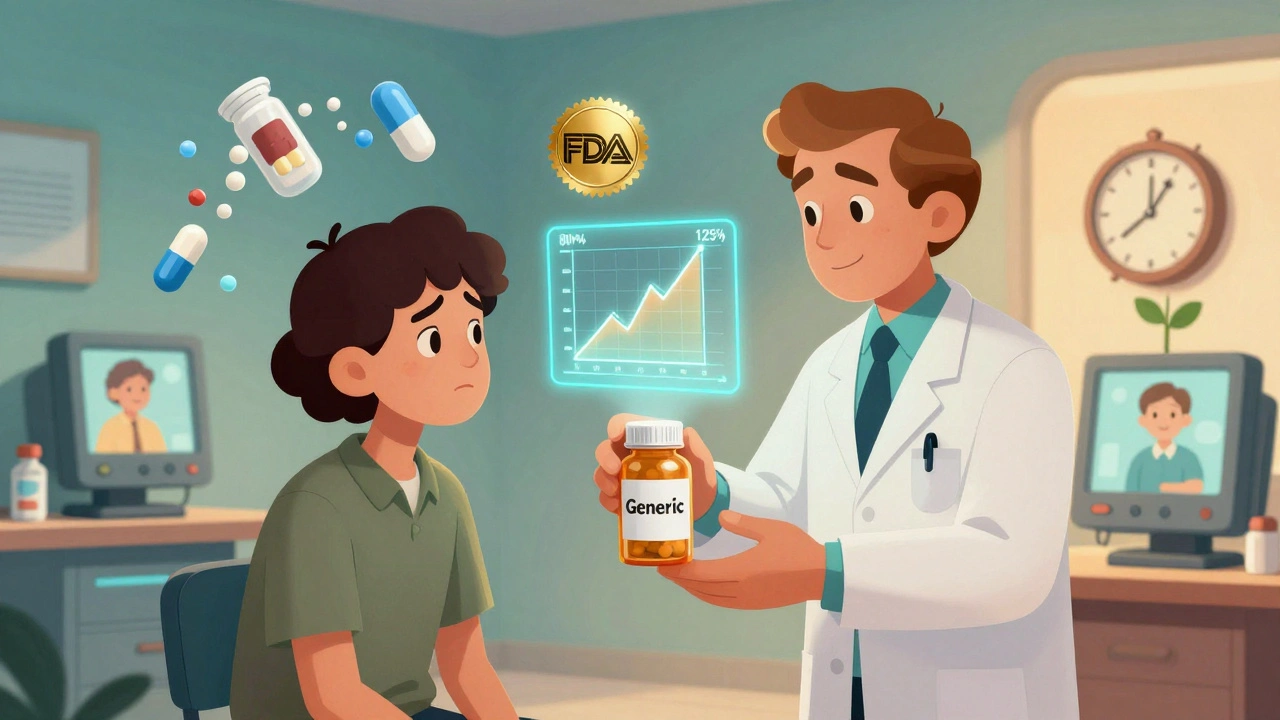
Generic drugs aren’t cheap knockoffs. They’re exact copies of brand-name drugs, down to the active ingredient. The FDA requires them to deliver the same amount of medicine into the bloodstream within a tight range-80% to 125% of the brand-name version. That’s not a guess. It’s science. And it’s been proven in over 10,000 bioequivalence studies.
Yet, 29.9% of patients still believe brand-name drugs are more effective. Why? Because of what they’ve heard-or haven’t heard. A 2015 study found that patients who received no explanation about generics were far more likely to report side effects after switching, even when the drug was identical. That’s not the drug causing the problem. It’s the expectation.
This is called the nocebo effect: when negative beliefs trigger real physical symptoms. In a 2019 JAMA study, patients who were told nothing about their generic substitution reported 28% more headaches, dizziness, and nausea than those who received a clear explanation about FDA standards. The drug didn’t change. Their minds did.
What Effective Communication Actually Sounds Like
It’s not enough to say, “This is cheaper.” That’s just a price tag. Effective communication is a three-part conversation:
- Authority: “The FDA requires generic drugs to meet the same strict standards as brand-name ones. The active ingredient is identical.”
- Confidence: “I prescribe generics every day because they work just as well-and I take them myself.”
- Proactivity: “Some people worry about side effects when switching. If you notice anything unusual, let me know. But most people don’t feel any difference at all.”
That’s not a script. It’s a clinical intervention. A 2022 study in U.S. Pharmacist found that when clinicians used this exact approach, patient acceptance of generics jumped by 24 percentage points. That’s not a small win. That’s life-changing for someone managing high blood pressure, diabetes, or depression.
Who’s Most at Risk-and Why
Not everyone reacts the same way. Research shows that non-Caucasian patients are 1.7 times more likely to distrust generics. Patients earning under $30,000 a year are 2.3 times more likely to insist on brand-name drugs. These aren’t random trends. They’re tied to historical inequities in healthcare access, targeted marketing by drug companies, and cultural narratives around “quality.”
One 2021 study found that culturally tailored communication-using familiar language, trusted examples, and community-relevant analogies-reduced skepticism by 41% in these groups. For example, instead of saying, “The FDA says it’s equivalent,” a provider might say, “This is the same medicine your cousin took for her asthma. It’s just labeled differently because the patent ran out.”
Language matters. So does context. A patient who’s been burned by a bad experience with a brand-name drug may be more open to generics-if they feel heard, not lectured.
The Cost of Silence
When clinicians skip the conversation, the consequences aren’t just personal-they’re financial. In the U.S., generics make up 90% of all prescriptions but only 23% of total drug spending. That’s $37 billion saved every year. But if patients stop taking their meds because they don’t trust them, those savings vanish.
One patient on Reddit shared: “My cardiologist spent 10 minutes showing me the FDA data. He even pulled up a chart comparing the absorption rates. I’ve been on the generic for two years. No issues.”
Another patient on Healthgrades wrote: “My pharmacist just handed me a different pill. When I said I had headaches, he said, ‘Some people react to generics.’ I stopped taking it for three weeks.”
Analysis of over 4,200 patient reviews found that 78% of positive experiences mentioned clinician communication. Eighty-nine percent of negative ones blamed poor or absent explanations.
What’s Working: Real-World Success Stories
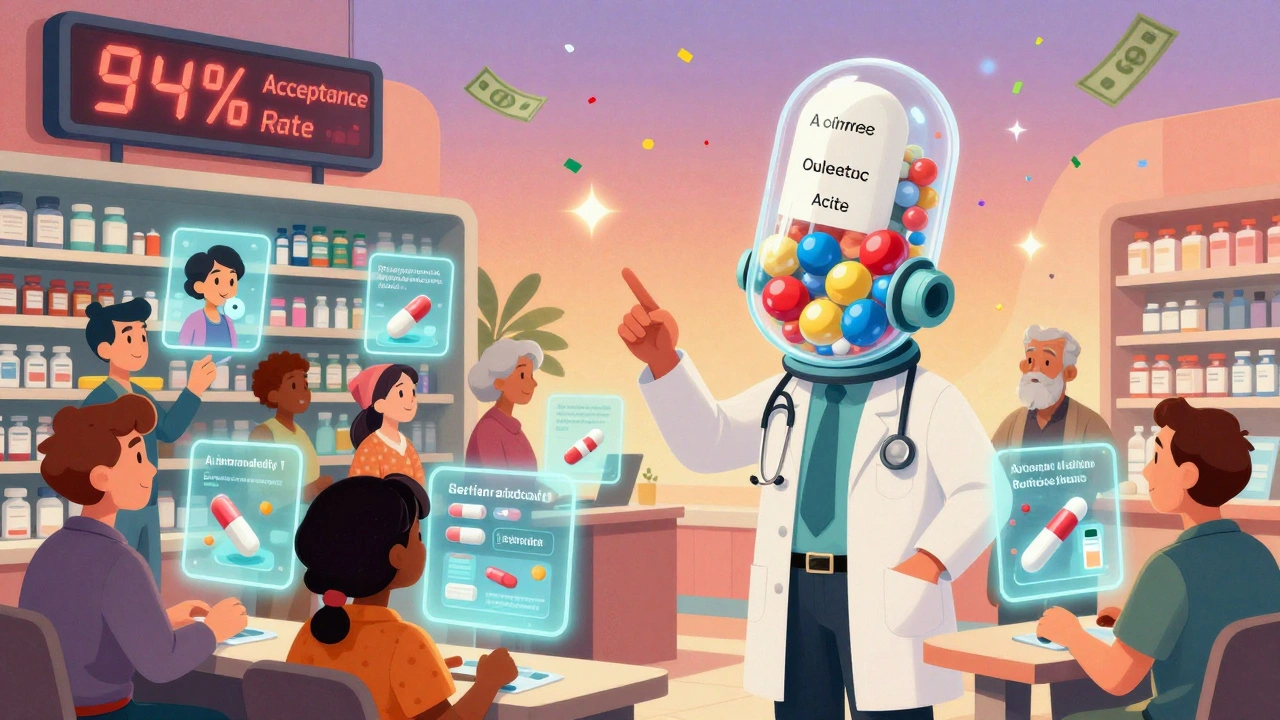
Kaiser Permanente didn’t just hope patients would accept generics. They built a system around it. They trained every provider. They added prompts into their electronic health records. They gave patients printed materials in 12 languages. Within two years, generic use hit 94%. They saved $1.2 billion annually.
Community pharmacies using the American Pharmacists Association’s 15-minute communication toolkit saw patient understanding jump from 42% to 87%. And here’s the kicker: the average time spent explaining generics dropped by 38%. Good communication doesn’t take longer. It takes better.
Now, Epic Systems-the biggest EHR vendor in the U.S.-has launched the “Generic Confidence Score.” It’s a pop-up that appears when a clinician prescribes a generic. It asks: “Did you explain the FDA bioequivalence standard?” “Did you mention cost savings?” “Did you address concerns about side effects?”
This isn’t surveillance. It’s support. It reminds providers that this isn’t a footnote in the prescription-it’s part of the treatment.
The Barriers Are Real (But Not Insurmountable)
Yes, time is tight. The average doctor spends just 1.2 minutes on generic discussions. Only 54% of physicians can correctly explain the 80-125% bioequivalence range. And 39% admit they’re unsure about using generics for conditions like epilepsy or thyroid disease.
But here’s the thing: you don’t need to be a pharmacologist. You just need to be clear. You don’t need to answer every question. You just need to say, “I’ll get you the right info.”
Many clinics now use one-page handouts with simple graphics: a pill with two labels-brand and generic-with arrows pointing to the same active ingredient. Others use QR codes that link to FDA videos in multiple languages. These tools cut confusion, not time.
It’s Not Just About Prescribing. It’s About Trust.
Patients don’t trust generics because they’re cheap. They trust them because their doctor believes in them. When a clinician says, “This is just as good,” and means it, the patient feels safe. When they say, “It’s cheaper, so let’s try it,” the patient feels like a cost-cutting experiment.
That’s why the FDA, AMA, and APhA now all agree: communication about generics isn’t optional. It’s part of standard care. The 2024 AMA guidelines even include generic communication as a metric in physician performance reviews.
And with Medicare Part D set to tie reimbursement to communication effectiveness in 2025, the incentive is no longer just ethical-it’s financial.
Generics aren’t second-best. They’re the standard. But unless clinicians start talking about them like they mean it, patients will keep believing otherwise.
Chelsea Moore
December 1, 2025 AT 23:16Wow. Just... wow. I can't believe this is even a conversation. We're talking about PEOPLE'S LIVES here, and doctors are just handing out pills like they're candy from a vending machine?!? No explanation? No care? No respect?!? I had a relative who stopped taking their blood pressure med because the pill looked different-and then they had a stroke. This isn't just about trust-it's about negligence. And if your doctor can't explain a generic drug in 30 seconds, they shouldn't be prescribing anything. #WakeUpHealthcare
Doug Hawk
December 3, 2025 AT 13:40the bioequivalence range of 80-125 is actually super tight when you think about it like a pharmacokinetic curve. most brand name drugs vary more than that in real world use due to formulation differences. the real issue is the nocebo effect is massively underrecognized in clinical practice. we treat symptoms not expectations. but we dont train for that. it's a cognitive bias loop that's hard to break without explicit framing. also-why are we still using paper handouts in 2024? qr codes with animated pill comparisons would be way more effective.
John Morrow
December 4, 2025 AT 08:35It's fascinating how the entire paradigm of pharmaceutical equivalence is reduced to a rhetorical exercise in patient psychology rather than a rigorous clinical protocol. The FDA's 80-125% bioequivalence window is statistically robust, yes-but it's also a regulatory compromise, not a biological absolute. The fact that clinicians are expected to be pharmacologists, behavioral psychologists, and insurance navigators all at once speaks to the systemic collapse of primary care infrastructure. Moreover, the notion that 'communication' alone can mitigate decades of pharmaceutical marketing and cultural distrust is not just naive-it's dangerously reductionist. The real problem is profit-driven healthcare commodification, not poor phrasing.
Kristen Yates
December 4, 2025 AT 19:00I work in a community clinic. We started using those one-page pill comparison sheets last year. No jargon. Just two pills, same color, same shape, same name on the inside. Patients smile when they see it. One woman said, 'So it's like twins? One wears a fancy coat?' That's all it took. No lectures. No data. Just clarity.
Saurabh Tiwari
December 6, 2025 AT 05:53in india we have generics everywhere and no one cares much unless the medicine doesnt work. but i think the real issue is trust in the system not the drug. if you grow up seeing fake meds in small clinics then even real generics feel suspicious. also doctor time is short everywhere. maybe video explainers in local languages would help? 🤔
Michael Campbell
December 7, 2025 AT 02:56Big Pharma pays doctors to push generics so they can keep charging $2000 for the brand name. They even own the FDA now. Don't be fooled. Your 'equivalent' pill is made in a factory in China with no oversight. I know people who got sick from generics. Don't trust the system.
Victoria Graci
December 8, 2025 AT 21:19There's something deeply human here, isn't there? We don't just take medicine-we take meaning. A pill is not just chemistry. It's a symbol. A brand name feels like legacy, like investment, like care. A generic feels like compromise. Like abandonment. And maybe that's the real tragedy-not that patients misunderstand bioequivalence, but that we've made them feel like they're settling for less when they're not. The doctor's tone becomes the drug's soul. And sometimes, the soul is the only thing that heals.
Saravanan Sathyanandha
December 9, 2025 AT 01:51In many developing countries, generics are the only viable option-and yet, they are often the most trusted because they are accessible. The cultural narrative around 'foreign brands = better' is a colonial hangover. We need to reframe generics not as cheaper alternatives but as democratic medicine. The communication framework outlined here is brilliant-not because it's complex, but because it centers dignity. A simple sentence like 'This is the same medicine your cousin took' carries more weight than any FDA pamphlet.
Fern Marder
December 10, 2025 AT 20:08OMG this is so true. I had my doctor just hand me a generic for my antidepressant and I felt like a lab rat. Then I cried. I didn't even know why. Now I know-it was the silence. 🥺
Carolyn Woodard
December 11, 2025 AT 02:36Interesting that the 2024 AMA guidelines now include communication as a performance metric-but we still have no standardized training modules. The EHR pop-up from Epic is a band-aid. What we need is mandatory continuing education on the nocebo effect, communication psychology, and cultural humility. Without structural change, even the best scripts will fail. And we're still not addressing the racial disparities in trust-those are systemic, not just linguistic.
Allan maniero
December 12, 2025 AT 17:24I've worked in rural clinics for 25 years. The biggest barrier isn't language or education-it's shame. Many patients won't admit they're confused because they think asking questions makes them 'difficult' or 'ungrateful.' We started using silent handouts with icons-pill, checkmark, smiley face-and asking, 'Which part feels unclear?' That small shift changed everything. People felt safe to be confused. And that's where healing begins.
Anthony Breakspear
December 14, 2025 AT 12:47Love this. Seriously. I used to just say 'it's cheaper' and feel guilty. Now I say: 'This is the exact same medicine your body needs-just without the fancy packaging and marketing bill.' I even show them the FDA page on my phone. Last week, a guy with diabetes said, 'Man, I've been paying $500 for this for years.' Now he's saving $45 a month. That’s not just a prescription. That’s freedom.