
GLP-1 Receptor Agonists: Managing Nausea and GI Side Effects
 Jan, 30 2026
GLP-1 Nausea Progress Tracker
Your Nausea Management Guide
This tool predicts your nausea severity timeline based on treatment phase. Track when symptoms typically improve and get personalized management tips.
Your Expected Nausea Progression
Severe nausea likely. Critical advice: Go slow with dose increases
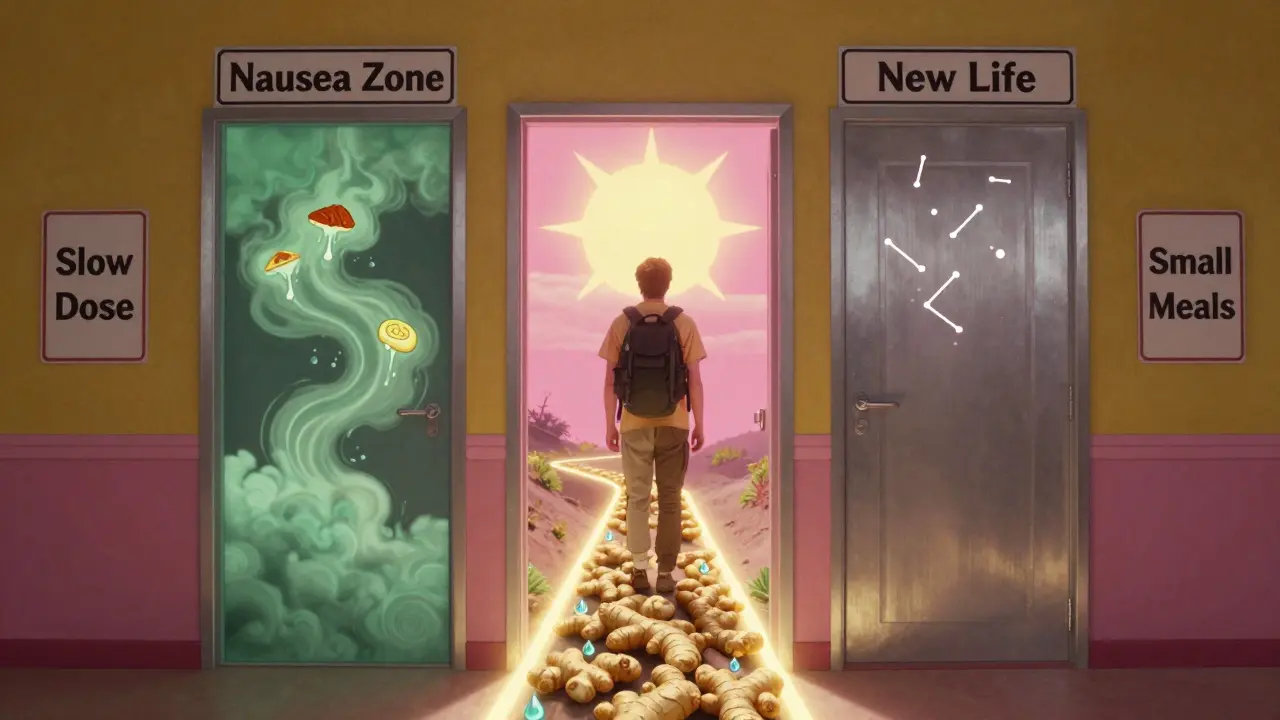
Nausea should improve. Try ginger Sip slowly Small meals
Nausea should be minimal. 80% of users report improvement by now
Your Personalized Tips
When you start taking a GLP-1 receptor agonist like Ozempic or Wegovy, the promise is clear: better blood sugar control and serious weight loss-sometimes 15% or more of your body weight. But for many, the first few weeks feel like a battle with your own stomach. Nausea hits. You feel bloated. You might vomit. Or you just can’t eat like you used to. It’s not just in your head. This isn’t rare. It’s expected.
Why Do GLP-1 Drugs Make You Feel Sick?
These drugs work by mimicking a natural hormone called GLP-1, which tells your brain you’re full and slows down how fast your stomach empties. That’s great for cutting calories and stabilizing blood sugar. But it also means food sits longer in your stomach, which triggers nausea. The same mechanism that helps you lose weight also makes you feel like you’re going to throw up.
It’s not just one drug-it’s the whole class. Whether you’re on semaglutide (Ozempic, Wegovy), liraglutide (Victoza), or tirzepatide (Mounjaro), your gut is going to react. Studies show 40% to 70% of people experience nausea, vomiting, diarrhea, or constipation. Some reports even say up to 85% of users face GI issues during the first few months. And it’s not because you’re doing something wrong. It’s because the drug is doing exactly what it’s supposed to do.
When Does the Nausea Start-and When Does It End?
The worst of it usually hits during the dose-escalation phase. That’s when your doctor slowly increases your dose over 16 to 20 weeks. Most people feel the strongest nausea in the first 2 to 4 weeks after each dose bump. That’s when your stomach is adjusting to the slower emptying.
Here’s the good news: it almost always gets better. By the time you reach your maintenance dose, 70% to 80% of people report that nausea has significantly reduced or disappeared. One study found that after 12 weeks, nausea dropped from 45% to just 12%. Many users on Reddit’s r/Ozempic and r/Wegovy say the worst is over by week 6. The body adapts. Your stomach learns to work with the drug.
What’s the Real Risk Beyond Nausea?
Most GI side effects are mild and temporary. But not all. A 2023 JAMA study looked at over 5,000 people using GLP-1 drugs and found they had a much higher risk of serious complications than those on other weight-loss meds:
- 9 times higher risk of pancreatitis
- 4 times higher risk of bowel obstruction
- 3.7 times higher risk of gastroparesis (stomach paralysis)
These are rare-but they’re real. You need to know the warning signs: severe, lasting abdominal pain; vomiting that won’t stop; inability to pass gas or have a bowel movement; or yellowing of the skin or eyes. If you get any of these, stop the drug and call your doctor immediately. The FDA has a boxed warning about thyroid tumors with these drugs, too, though that risk is mostly seen in animal studies and hasn’t been confirmed in humans.

How to Manage the Nausea (Without Stopping the Drug)
You don’t have to suffer through it. There are proven ways to make it easier:
- Go slow with the dose. Don’t rush the escalation. If your doctor pushes you to increase faster than recommended, ask why. Slower increases mean fewer side effects.
- Eat smaller meals. Large meals overwhelm your slowed stomach. Try 4 to 5 small meals instead of 3 big ones.
- Avoid fatty, fried, or sugary foods. These are the worst offenders. They sit in your stomach longer and make nausea worse.
- Stay hydrated, but sip slowly. Chugging water can trigger vomiting. Take small sips throughout the day.
- Don’t lie down after eating. Wait at least 2 hours. Gravity helps keep food moving.
- Try ginger. Ginger tea, ginger candies, or ginger capsules have helped many people. It’s a natural anti-nausea remedy.
- Take the dose at night. Some users find nausea is less disruptive if they take it before bed. They sleep through the worst of it.
- Ask about OTC options. Medications like dimenhydrinate (Dramamine) or meclizine can help with nausea-but only use them with your doctor’s approval.
What If the Side Effects Don’t Go Away?
For most, symptoms fade. But for about 1 in 5 people, nausea and bloating stick around. If you’ve been on the maintenance dose for 3 months and still feel awful, talk to your doctor. It might be time to switch to a different GLP-1 drug. Semaglutide tends to cause less nausea than liraglutide at the same dose. Or maybe a lower dose is enough to give you results without the misery.
Some people choose to stop. That’s okay. The weight loss and blood sugar control are powerful-but not worth ruining your quality of life. You’re not failing if you can’t tolerate it. These drugs aren’t for everyone.
What About Surgery or Other Medical Procedures?
If you’re scheduled for surgery-any surgery-your doctor will likely tell you to stop your GLP-1 drug at least a week before. Why? Because your stomach empties so slowly that you could still have food in there when you go under anesthesia. That’s dangerous. Always tell every healthcare provider you’re on a GLP-1 agonist. Even your dentist needs to know.
Is It Worth It?
Let’s be honest: the side effects are rough. But so is type 2 diabetes. So is carrying 50 extra pounds. People who stick with these drugs often say their lives change. They move better. They sleep better. Their blood sugar numbers drop into the normal range. Some even get off insulin.
One study showed people on semaglutide lost nearly 15% of their body weight over a year. Placebo group? Just 2.4%. That’s the difference between needing help to climb stairs and walking without pain.
It’s not magic. It’s medicine. And like all medicine, it comes with trade-offs. The nausea is temporary for most. The health benefits? Often lifelong.
What’s Next for These Drugs?
Researchers are working on next-generation versions that work just as well but with less GI upset. Some are combining GLP-1 with other hormones to lower the dose needed. Others are tweaking delivery systems-like oral pills instead of injections-to make absorption gentler on the gut.
For now, the best strategy is patience, smart eating, and communication with your doctor. Don’t quit too soon. But don’t suffer in silence, either. You have options. And you deserve to feel well while you get well.
Bob Cohen
January 31, 2026 AT 00:46Man, I thought I was the only one who felt like a walking zombie for the first month. Took me 6 weeks to get through the nausea without wanting to hug the toilet. But now? I lost 22 lbs, my A1C is normal, and I can actually run without feeling like I’m carrying a toddler. Worth every second of misery. Just don’t rush the dose - my buddy went full turbo and ended up in the ER. Slow and steady wins the race, folks.
Ishmael brown
January 31, 2026 AT 09:56😂💀 GLP-1s are just Big Pharma’s way of making you pay $1,000/month to feel like you swallowed a cactus. They call it ‘weight loss’ - I call it ‘gastrointestinal hostage negotiation.’ My stomach’s been on strike since January. At least the emojis are fun to send while vomiting.
Aditya Gupta
February 1, 2026 AT 03:14bro just take ginger tea and chill. dose slow. eat small. no oil. no sugar. sleep after 2hrs. u good. trust the process. my cousin lost 30kg in 6 months. no drama. just patience. 🙌
Nancy Nino
February 1, 2026 AT 12:00While I appreciate the anecdotal optimism in many of these responses, I must emphasize that the clinical data regarding gastroparesis risk is not merely ‘rare’-it is statistically significant and underreported in patient forums. The FDA’s boxed warning exists for a reason, and dismissing GI distress as ‘temporary’ may inadvertently endanger vulnerable populations with preexisting motility disorders. This is not a lifestyle tweak-it’s a pharmacological intervention with real physiological consequences.
June Richards
February 2, 2026 AT 14:27OMG I took this for 3 weeks and threw up every morning. Like, actual projectile. My cat started avoiding me. I quit. No regrets. Why would anyone suffer like this for a 15% weight loss? I’d rather be chubby and happy than a walking nausea machine. 🤮
Jaden Green
February 3, 2026 AT 04:58It’s fascinating how the entire narrative around GLP-1 agonists has been co-opted by wellness influencers who treat pharmacology like a fitness app. The fact that these drugs induce gastric stasis-essentially paralyzing a vital digestive function-isn’t a ‘side effect’; it’s a feature of their mechanism. And yet, we’re told to ‘push through’ because ‘the results are worth it.’ Meanwhile, the long-term consequences of chronic delayed gastric emptying remain largely unstudied. We’re essentially running a human trial on ourselves while Big Pharma profits. The real tragedy isn’t the nausea-it’s the collective amnesia about what constitutes medical ethics.
Lu Gao
February 4, 2026 AT 02:53Actually, the JAMA study you cited had a very specific cohort-mostly obese adults with T2DM. The risk for bowel obstruction was only elevated in those over 65 or with prior GI surgery. Also, ginger helps, but peppermint oil capsules (enteric-coated) work even better for bloating. Just FYI. 🌿
Angel Fitzpatrick
February 4, 2026 AT 03:03Let’s not ignore the elephant in the room: these drugs were originally developed for diabetes, not weight loss. Now they’re being weaponized by the obesity-industrial complex to turn healthy people into pharmacologically dependent consumers. The FDA approved them under accelerated pathways. The long-term thyroid tumor data? Animal studies. But what if the ‘unconfirmed’ risk is just being buried? Who’s funding the studies? Who profits? And why are we being told to ‘be patient’ while our gut flora is being obliterated? This isn’t medicine-it’s a corporate experiment with a side of serotonin.