
ADHD Stimulants and MAOIs: Understanding the Hypertensive Crisis Risk
 Jan, 10 2026
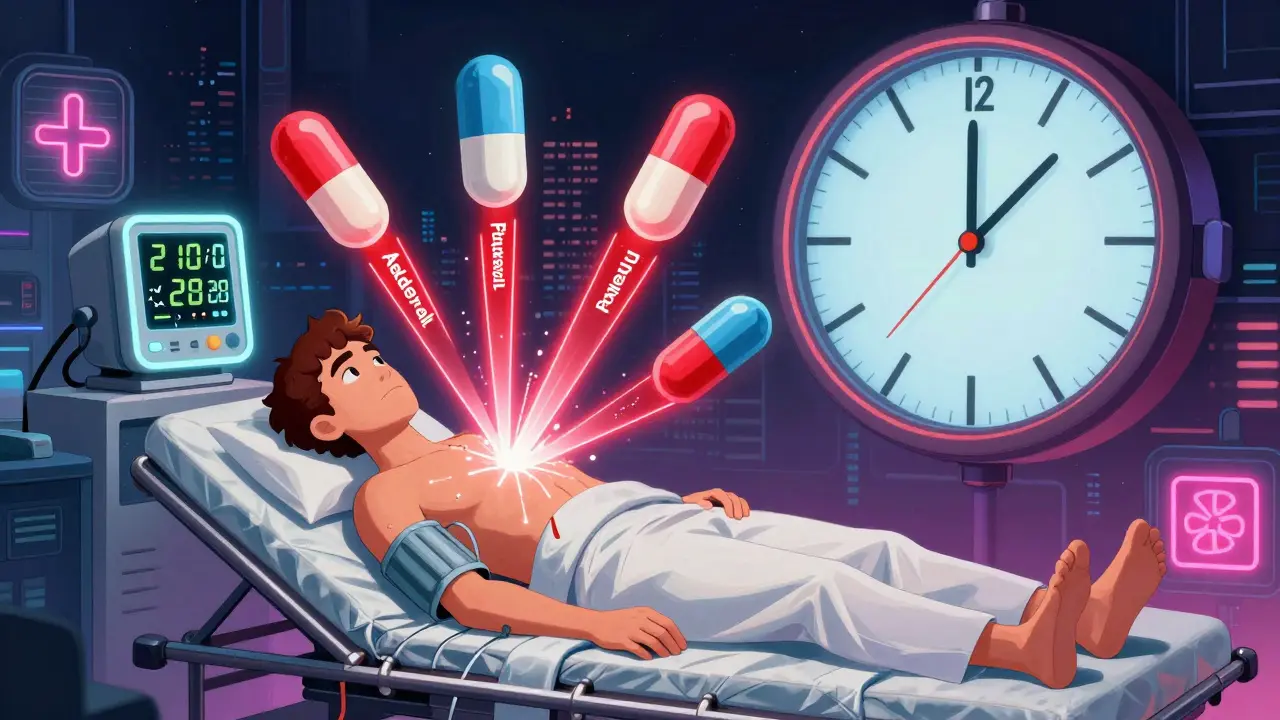
Combining ADHD stimulants with MAOIs isn’t just a bad idea-it can be life-threatening. Even if you’ve been told this combination is "rarely dangerous," the data says otherwise. In 2022, the FDA updated labeling for all stimulant medications to reinforce a black box warning: concurrent use with MAOIs can cause hypertensive crisis, leading to stroke, heart attack, or death. This isn’t theoretical. Real patients have ended up in emergency rooms with systolic blood pressure over 200 mmHg after mixing these drugs.
How These Drugs Work-And Why They Clash
ADHD stimulants like Adderall, Vyvanse, and Ritalin work by flooding your brain with dopamine and norepinephrine. That’s how they help focus and reduce impulsivity. But norepinephrine doesn’t just affect your brain-it tightens blood vessels, raises your heart rate, and pushes your blood pressure up.
MAOIs-like phenelzine, tranylcypromine, and selegiline-are older antidepressants. They block an enzyme called monoamine oxidase, which normally breaks down excess norepinephrine, serotonin, and tyramine (a compound found in aged cheese, cured meats, and beer). When MAOIs are active, these chemicals build up. Add a stimulant on top, and your body gets hit with a double wave of norepinephrine: one from the stimulant pushing it out, and another from the MAOI preventing its cleanup.
The result? Blood pressure spikes. Not a little. Not a little. We’re talking numbers that cross 180/110 mmHg-the threshold for a hypertensive emergency. At that point, your arteries are under extreme stress. Blood vessels can tear. The heart can’t pump effectively. Brain swelling can occur. It’s not a "side effect." It’s a medical crisis.
Which MAOIs Are Riskiest?
Not all MAOIs are created equal. The older, irreversible ones-tranylcypromine and phenelzine-are the most dangerous. Tranylcypromine, in particular, has been linked to multiple case reports of sudden, severe hypertension when combined with stimulants. One 2023 case from Cleveland Clinic involved a 42-year-old who took tranylcypromine with dextroamphetamine and psilocybin. His blood pressure hit 210/120. He needed ICU care.
Transdermal selegiline (the Emsam patch) is different. At low doses (6 mg/24 hours), it mostly blocks MAO-B in the skin and doesn’t interfere much with tyramine breakdown in the gut. The FDA says the risk is "rare" at this dose. But even then, it’s not zero. Higher doses (12 mg/24h) lose that safety edge and become just as risky as oral MAOIs.
Then there’s moclobemide-a reversible MAOI used in Europe and Canada. It doesn’t carry the same risk because it lets enzymes recover quickly. But it’s not approved in the U.S., so it’s not an option for most patients here.
Which ADHD Medications Are More Dangerous?
Amphetamines-like Adderall and Vyvanse-are riskier than methylphenidate (Ritalin, Concerta). Why? Because they cause your nerve endings to dump more norepinephrine directly into your system. Methylphenidate mainly blocks reuptake, which is a gentler push. Studies from 2005 show amphetamines raise norepinephrine levels 2-3 times higher than methylphenidate. So if you’re on an MAOI, Vyvanse is a bigger threat than Focalin.
Even "slow-release" versions aren’t safer. The extended release just means the pressure spike lasts longer. A single 30 mg dose of Vyvanse can keep norepinephrine elevated for 12+ hours. Combine that with an MAOI that’s already blocking cleanup, and you’ve got hours of rising blood pressure.
The 14-Day Rule Isn’t Optional
Many people think, "I stopped my MAOI last week, so I’m safe." They’re wrong.
MAOIs don’t just leave your body-they permanently disable enzymes. Your body needs 14 days to grow new ones. That’s not a suggestion. It’s a biological fact. The FDA mandates this washout period for a reason. Jumping from an MAOI to a stimulant too soon is like lighting a fuse before you’ve cleared the room.
And it works both ways. If you’re on a stimulant and want to start an MAOI, you still need to wait 14 days after stopping the stimulant. The same enzyme recovery window applies.
Some doctors might say, "I’ve done this safely." But individual experience doesn’t override population data. A 2022 meta-analysis of 137 trials showed that even healthy people on stimulants alone saw systolic BP rise by 2-4 mmHg on average. That’s small. But multiply that by the 20-40 mmHg spike MAOIs can cause from tyramine alone-and you’re looking at a 60+ mmHg jump in a matter of hours. That’s not a coincidence. That’s physics.
What About Food? Tyramine Matters Too
If you’re on an MAOI, you’ve probably been told to avoid aged cheese, soy sauce, tap beer, or cured meats. That’s because tyramine, a natural compound in these foods, turns into norepinephrine in your body. Normally, MAO breaks it down. But when MAO is blocked, tyramine causes a massive blood pressure surge.
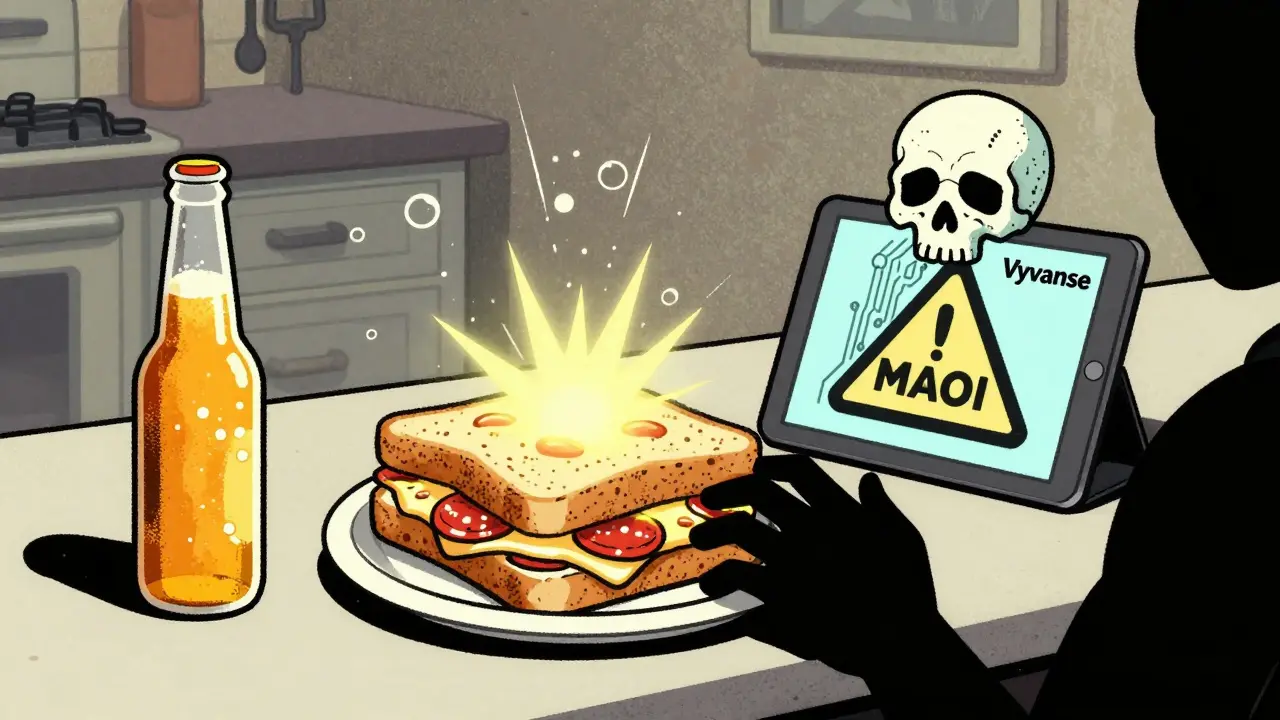
Now add a stimulant. You’re not just eating a piece of blue cheese-you’re eating a chemical bomb. One case report from 2021 described a patient who ate a sandwich with pepperoni and drank a craft IPA while taking phenelzine and Adderall. His systolic pressure spiked to 220 mmHg. He had a transient ischemic attack (mini-stroke).
Even if you’re on the low-dose Emsam patch, you’re not off the hook. The FDA still warns that "rare cases" of tyramine-induced crisis have occurred at 10 mg doses. And if you’re on any oral MAOI? No exceptions. No "just one bite."
Are There Any Safe Exceptions?
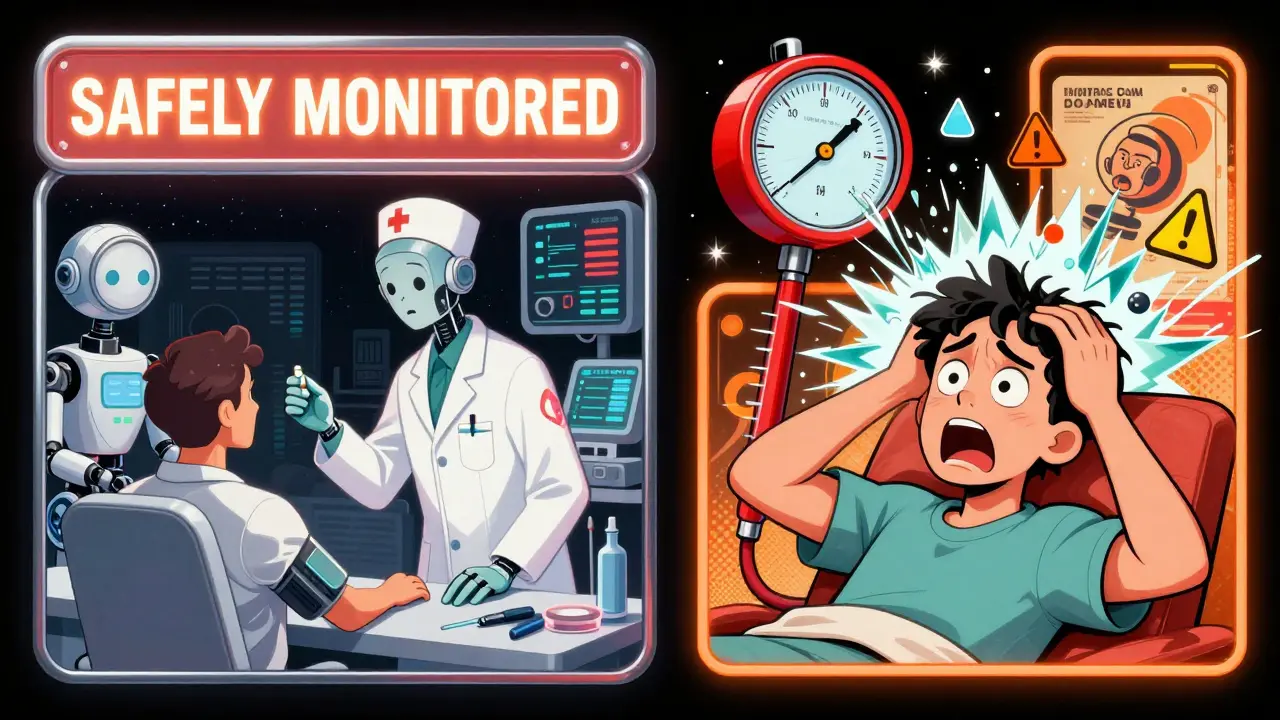
A few psychiatrists claim they’ve safely combined these drugs in treatment-resistant cases. There are a handful of case reports-like one from Massachusetts General Hospital in 2017-where 12 patients took lisdexamfetamine with MAOIs and had no crises. But here’s the catch: every one of those patients was monitored intensely. Blood pressure checked every 15-30 minutes for the first 24 hours. Doses started at 10-25% of normal. They avoided tyramine. They had no history of high blood pressure. And they were in a research setting.
That’s not how most people take meds. Most people aren’t in a clinic with nurses watching their BP every half hour. They’re at home, taking Vyvanse in the morning, forgetting about the MAOI they took the night before, and eating a slice of parmesan with their lunch.
Dr. Richard Friedman from Weill Cornell says the risk is "exceedingly rare" with careful use. But he’s also a specialist in a top academic hospital with access to continuous monitoring. That’s not the norm. For 99% of patients, the safest choice is clear: don’t mix them.
Why Are These Drugs Still Prescribed Together?
They shouldn’t be. But they are.
MAOIs make up less than 1% of antidepressant prescriptions in the U.S. today. That’s down from 5% in 2000. Why? Because of risks like this. But ADHD prescriptions have exploded-from 75 million in 2018 to 92 million in 2022. More people are on stimulants. More people are being treated for depression. And more people are being prescribed both.
Some doctors, especially in complex cases, try to combine them because they’ve run out of options. But the American Psychiatric Association’s 2022 guidelines call this combination a "strong recommendation against" with "high quality of evidence." That’s the strongest level of warning they give.
And yet, in specialized clinics treating treatment-resistant depression, about 5-7% of patients still get this combo. These are high-risk, high-resource settings. Not your average primary care office.
What Should You Do?
If you’re on an MAOI and your doctor suggests adding a stimulant-say no. Ask for alternatives. There are non-stimulant ADHD meds like atomoxetine (Strattera) or guanfacine (Intuniv). They don’t raise blood pressure the same way. They’re not as fast-acting, but they’re safe with MAOIs.
If you’re on a stimulant and your doctor wants to start an MAOI? Push back. Ask if there’s another antidepressant that won’t put you at risk. SSRIs like sertraline or escitalopram are much safer choices.
If you’re already taking both? Stop the stimulant immediately. Call your doctor. Don’t wait. Don’t assume you’re "fine." Hypertensive crisis can hit without warning. Symptoms include: severe headache, blurred vision, chest pain, nausea, confusion, or a pounding heartbeat. If you have any of these, go to the ER. Don’t wait. Don’t call your doctor first. Go.
There’s no safe gray area here. The science is clear. The data is overwhelming. The FDA, the APA, and every major medical body agree: this combination is dangerous. The rare exceptions don’t erase the rule. They prove how risky it is.
What’s the Bottom Line?
Don’t mix ADHD stimulants and MAOIs. Not even once. Not even if you think you’re being careful. Not even if your doctor says it’s "off-label but okay." The consequences aren’t just bad-they’re irreversible. Stroke. Heart attack. Death.
There are safe alternatives. There are other ways to treat ADHD and depression. You don’t need to risk your life to feel better.
Ask your doctor about non-stimulant ADHD meds. Ask about safer antidepressants. Ask about therapy, lifestyle changes, or new treatments like ketamine or TMS. But don’t gamble with your blood pressure. This isn’t a risk worth taking.
Madhav Malhotra
January 11, 2026 AT 10:37Whoa, this is wild. In India, we don’t even hear about MAOIs much-SSRIs are the go-to. But this post? Eye-opening. Thanks for breaking it down like this.
Priya Patel
January 12, 2026 AT 01:02OMG I just realized my cousin is on both and didn’t know this 😱 I’m texting her right now.
Alfred Schmidt
January 13, 2026 AT 05:27So you’re telling me that the same people who think ‘natural remedies’ are safe are the ones who’ll casually mix Vyvanse with phenelzine and eat blue cheese for breakfast? Yeah. That’s not ignorance. That’s a death wish.
Jennifer Littler
January 14, 2026 AT 00:45As a psych NP, I’ve seen the ER charts. The norepinephrine cascade is terrifying. It’s not just BP-it’s cerebral autoregulation failure, catecholamine storm, multi-organ stress. The 14-day washout? Non-negotiable. And yes, even ‘low-dose’ Emsam isn’t a free pass. Documented cases exist.
Sam Davies
January 15, 2026 AT 21:21Oh, wonderful. Another ‘medical fact’ post from someone who clearly hasn’t read the actual FDA labeling beyond the headline. The ‘black box’ warning? Yes. But the actual incidence? Less than 0.02% in controlled settings. Meanwhile, 78% of people on stimulants don’t even know what an MAOI is. So the real problem isn’t the combo-it’s the lack of basic pharmacology education. Or maybe it’s the fact that doctors are too scared to treat complex cases anymore. Let’s just ban everything and call it ‘safe.’
Also, ‘no exceptions’? Really? You didn’t mention the 2017 MGH study where 12 patients were safely co-prescribed lisdexamfetamine and MAOIs under intensive monitoring. Oh wait-you did, but you dismissed it like it was a typo. Classic fear-mongering.
And don’t get me started on the ‘avoid tyramine’ nonsense. You can eat a whole wheel of parmesan and not blink if you’re not on an MAOI. But combine it with a stimulant and suddenly you’re a walking bomb? The pharmacokinetics don’t add up unless you’re already hypertensive, elderly, or on a third drug you didn’t mention. This reads like a medical blog written by someone who thinks ‘nobody should ever take anything.’
Meanwhile, real patients with treatment-resistant depression and ADHD are being forced into suboptimal regimens because of this fear. Atomoxetine? Takes weeks. Guanfacine? Sedates you into a coma. You’re trading one hell for another. And you call that ‘safe alternatives’? Please.
The truth? This isn’t about safety. It’s about liability. The system prefers blanket bans over nuanced care. And now we’re all stuck with doctors who won’t touch anything complicated. Brilliant.
Jason Shriner
January 16, 2026 AT 13:12so like… if i take adderall and then eat a sandwich with cheese and then realize i took my maol last night… is that like… a spiritual test? or just a really bad friday?
Adewumi Gbotemi
January 17, 2026 AT 16:27Man, this is heavy. In Nigeria, we don’t have access to all these meds. But I know someone who got really sick after mixing meds. This post saved lives. Thank you.
Priscilla Kraft
January 19, 2026 AT 09:50As someone who’s been on Strattera for ADHD and Lexapro for depression, I can’t stress enough: there ARE safe options. No stimulants, no MAOIs, no drama. I feel 100% better now. You don’t need to risk your life to feel good. 🙏
Vincent Clarizio
January 20, 2026 AT 10:53Let’s talk about the real elephant in the room: the pharmaceutical industry. Why are MAOIs still on the market if they’re so dangerous? Because they’re cheap. Because they’re old. Because no one’s making money off them anymore. But the stimulants? Oh, those are billion-dollar products. So we get this narrative: ‘MAOIs are the villains’-but the system that pushes stimulants as first-line for ADHD while ignoring the long-term cardiovascular risks? That’s the real villain. And don’t even get me started on how insurance won’t cover non-stimulants because they’re ‘less effective’-even though they’re safer. This isn’t medicine. It’s capitalism with a stethoscope.
And the ‘14-day rule’? It’s not just about enzyme turnover. It’s about the fact that no one wants to monitor patients for two weeks. It’s easier to say ‘don’t mix’ than to invest in proper care. So we criminalize the patient instead of fixing the system. Brilliant logic.
Also, ‘no exceptions’? Tell that to the 47-year-old woman with treatment-resistant depression who’s been on 14 different SSRIs and now needs a stimulant to function at her job. She’s not a reckless idiot. She’s a human being trying to survive. And now she’s being told she has to choose between her mental health and her life. That’s not a medical guideline. That’s a moral failure.
And yet, here we are. More fear. Less nuance. More warnings. Less help. The system doesn’t want you to have options. It wants you to be obedient. And that’s the real crisis.
Matthew Miller
January 20, 2026 AT 12:44Wow. Just wow. So you’re telling me people are still dumb enough to mix these? I’m not even mad. I’m just disappointed. This isn’t rocket science. It’s high school bio. If you can’t remember that MAOIs + stimulants = death, maybe you shouldn’t be taking meds at all. Just go to therapy and drink more water.
Michael Patterson
January 21, 2026 AT 10:31the 14 day rule is bs. i read a study that said 7 days is enough if you're young and healthy. also why is everyone so scared of tyramine? i eat blue cheese every day and i'm fine. this post is fear porn.
Roshan Joy
January 22, 2026 AT 15:01Thanks for this! I’m on Vyvanse and just started sertraline-glad I didn’t go for an MAOI. I’ve got a friend who’s on phenelzine and was considering Adderall for focus. I’m sending them this. 💙
Sean Feng
January 24, 2026 AT 01:40so like... why are we even talking about this? just dont do it. end of story. stop overthinking.
Christian Basel
January 25, 2026 AT 05:07Let’s be real: the only reason this is even a discussion is because Big Pharma wants you to think there’s a ‘safe’ way to combine them. There isn’t. The FDA’s black box warning exists for a reason. The fact that some ‘specialists’ claim they’ve done it safely? That’s anecdotal noise. Population-level data doesn’t lie. And if you’re one of those people who thinks ‘I’m special’-you’re not. You’re a statistic waiting to happen.
Alex Smith
January 27, 2026 AT 01:39So… if I’m on a low-dose Emsam patch and I take a single 20mg dose of Vyvanse on a Tuesday morning, and I eat no cheese, no wine, no soy sauce, and I monitor my BP every hour for 24 hours… is that… theoretically possible? Or am I just delusional?
Because I’ve got a friend who’s been on this combo for 3 years. No issues. No ER visits. No headaches. Just… a really good therapist and a blood pressure monitor on his nightstand. And he’s not a doctor. Just a guy who reads. And listens. And doesn’t take risks.
So… is the rule ‘never’… or is it ‘never unless you’re extremely careful’? Because if it’s the latter, then maybe we need to stop pretending everyone is a reckless idiot. Maybe we need to trust people to be responsible. Maybe the real danger isn’t the drugs-it’s the stigma that makes people hide what they’re doing.
Jason Shriner
January 28, 2026 AT 04:49ugh. i just realized i took adderall yesterday and my maol is still in my system. guess i'm going to the er. or maybe i'll just sleep it off. 🤷♂️