
Who Actually Makes Authorized Generics? The Truth Behind the Label
 Jun, 26 2026
Have you ever picked up a prescription that looked like a generic pill but carried the same active ingredients as the brand-name drug you used to take? You might have been holding an authorized generic, which is a prescription drug produced by the original New Drug Application (NDA) holder and marketed under a private label at generic prices. It’s a confusing corner of the pharmaceutical world. On one hand, it looks like a cheap alternative. On the other, it comes from the same company that made the expensive brand-name version. So, who actually makes these drugs? Is it the big pharma giant in their main factory, or some third-party contractor trying to cut corners?
The short answer is: usually, it’s the exact same people who make the brand-name drug. But the path to getting those pills into your local pharmacy varies wildly depending on how the company structures its business. To understand who is behind the bottle, we need to look at the regulatory playbook established by the Hatch-Waxman Act, which is the 1984 legislation that created the framework for generic drug approval and authorized generics. This law didn’t just open the door for cheap copies; it gave brand companies a way to compete with themselves.
The Two Paths to Making an Authorized Generic
When a brand-name manufacturer decides to launch an authorized generic (AG), they aren’t filing for a new drug approval. They are leveraging their existing New Drug Application, often abbreviated as NDA, which is the FDA-approved dossier containing all data on safety, efficacy, and manufacturing for a specific drug. However, there are two distinct ways this happens, and knowing the difference tells you exactly where your medicine was made.
Pathway 1: The In-House Rebrand
In the most common scenario, the NDA holder manufactures the AG in the exact same facility as the brand-name product. The formulation, the mixing process, and the quality control tests are identical. The only thing that changes is the sticker on the bottle. Instead of the fancy logo, you get a plain label with a different trade name or no brand name at all. According to Premier Consulting’s 2023 analysis, this pathway requires the manufacturer to file an annual report with the Food and Drug Administration, commonly known as the FDA, which is the U.S. federal agency responsible for protecting public health through regulation of food, drugs, and medical devices. This allows them to start selling immediately once the label is approved. About 52% of all authorized generics follow this route, meaning they come straight from the innovator’s own production lines.
Pathway 2: The Contract Manufacturing Arrangement
Sometimes, the brand company doesn’t want to use its own capacity, or perhaps it has sold the rights to another entity. In this case, they hire a contract manufacturer. Here’s the catch: the NDA holder still holds the legal responsibility. If they bring in a new factory, they must add that site to their NDA. This can be a bureaucratic nightmare. It often requires a Prior Approval Supplement (PAS), which currently takes an average of 22 months for the FDA to review. Or, if the change is minor enough, they might use a Change Being Effected in 30 days (CBE30) submission. Only about 17% of AGs use third-party manufacturers, and even then, the oversight is strict.
Why Do Companies Make Their Own "Generics"?
You might wonder why a company would undercut itself. Why sell a $50 pill for $10 when you could just keep charging $50? The strategy is defensive. When patents expire, traditional generic competitors flood the market, driving prices down to pennies. By launching an authorized generic first, the brand company captures that lower-price segment before anyone else can. It’s a way to maintain cash flow and market presence without losing control over quality.
Dr. Dan Leonard, President of the FDA’s Generic Drug User Fee Amendments (GDUFA) committee, noted in a 2022 advisory meeting that authorized generics represent a sophisticated market strategy. Brand companies compete against traditional generics while keeping their established manufacturing processes intact. This isn’t about charity; it’s about survival in a competitive landscape. As of Q3 2023, the FDA reported 217 active authorized generic products in the U.S., representing roughly 7.3% of all generic entries. These aren’t niche experiments anymore; they are a standard part of the industry.
The Greenstone Model: A Case Study in Control
To see how this works in practice, look at Greenstone LLC, which is a wholly-owned subsidiary of Pfizer Inc. that manufactures authorized generic versions of Pfizer's brand-name medications. Since 1998, Greenstone has been producing over 70 authorized generics. Crucially, these aren’t made in some distant, unknown factory. They are produced using the same manufacturing processes and facilities as the branded counterparts. This model-using a wholly-owned subsidiary-is used by about 31% of authorized generic manufacturers. It gives the parent company total control over quality and supply chain security.
Another notable example is the case of Novartis and its drug Comtan (entacapone). When Novartis launched an authorized generic version in early 2023, they worked with a third-party manufacturer. However, they maintained identical sourcing for the active pharmaceutical ingredient (API) and followed the same manufacturing protocols. The only difference was the packaging. This shows that even when outsourcing occurs, the "authorized" part means the brand company is watching every step of the process.
| Feature | Authorized Generic (AG) | Traditional Generic |
|---|---|---|
| Manufacturer | Brand owner or subsidiary (68% in-house) | Independent third-party companies |
| Regulatory Pathway | Listed under original NDA | Requires Abbreviated New Drug Application (ANDA) |
| Bioequivalence Studies | Not required (uses original data) | Required to prove similarity to brand |
| Facility Compliance Rate | 98.7% cGMP compliance (2022 FDA data) | 96.2% cGMP compliance (2022 FDA data) |
| Primary Goal | Capture generic share while maintaining quality control | Maximize profit through low-cost production |
Quality Concerns: Are They Really the Same?
This is the question that keeps patients and doctors up at night. If an authorized generic is made by the same company, is it truly identical to the brand? The FDA says yes. In their 2023 Transparency Initiative, the agency emphasized that AGs must meet the same quality standards as brand-name products. They contain identical active ingredients, strength, dosage form, and route of administration. The differences are limited to labeling, packaging, and sometimes inactive ingredients (like dyes or binders).
Data supports this high standard. The FDA’s 2022 inspection data showed that facilities producing authorized generics had a 98.7% Current Good Manufacturing Practices (cGMP) compliance rate. Compare that to 96.2% for traditional generic manufacturers. While both rates are high, the slight edge for AGs suggests that brand companies are more careful because their reputation is directly tied to the product. If an AG fails, it reflects poorly on the brand name itself.
However, not everyone is convinced. Dr. Aaron Kesselheim of Harvard Medical School argued in a 2021 JAMA Internal Medicine analysis that authorized generics create "artificial competition." His concern is that by flooding the market with their own cheaper versions, brand companies delay true price drops that would occur if independent generics entered the field earlier. While this is an economic argument rather than a quality one, it highlights the tension between consumer choice and corporate strategy.
What’s Changing in 2025 and Beyond?
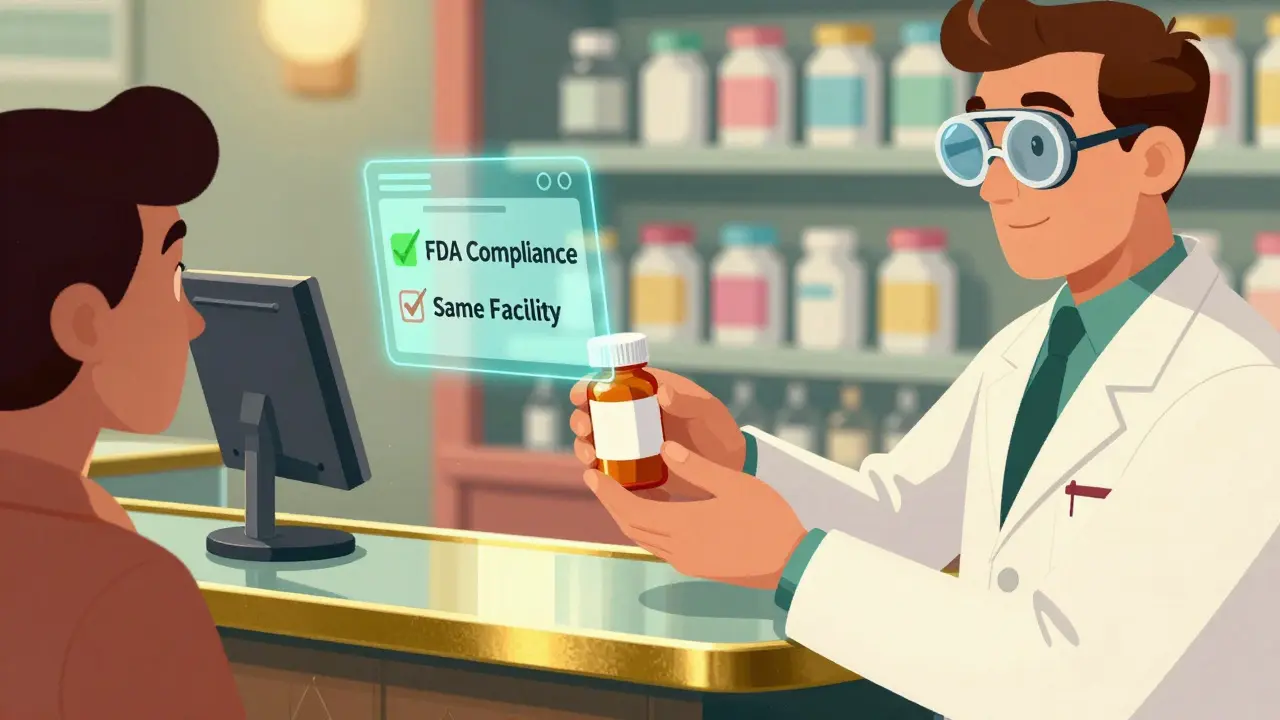
The landscape of authorized generics is shifting. For years, it was hard to tell where an AG came from. That’s changing due to pressure from the Government Accountability Office (GAO), which released a 2022 report raising concerns about pharmaceutical supply chain transparency. In response, the FDA announced a new initiative in July 2023. Starting January 1, 2024, NDA holders must disclose whether their authorized generics are manufactured in the same facility as the brand-name product. This means you will soon be able to look up exactly who made your medication.
Industry analysts at Clarivate predict a 15-20% increase in authorized generic manufacturing through wholly-owned subsidiaries by 2025. Why? Because billions of dollars in patents are expiring. Take Humira, for example. Its patent expired in 2023, but AbbVie had already set up Soliris Generics, which is a subsidiary established by AbbVie to produce authorized generic versions of its blockbuster drugs. This proactive move ensures that even after exclusivity ends, AbbVie remains a major player in the market.
As we move through 2026, the rise of authorized generics isn’t going away. With the FDA streamlining notification processes under GDUFA III, we can expect more brand companies to adopt this strategy. For patients, the key takeaway is simple: an authorized generic is not a mystery product. It is a direct extension of the brand-name drug, made by the same hands, just wearing a different hat.
Is an authorized generic the same as a regular generic?
No, they are different in origin but similar in composition. A regular generic is made by a different company and must prove bioequivalence to the brand. An authorized generic is made by the original brand company (or its subsidiary) and uses the original drug application data. Both contain the same active ingredients, but AGs often have higher manufacturing compliance rates because the brand company controls the process.
Can I tell if my prescription is an authorized generic?
It can be tricky. Often, the label will list the manufacturer as a subsidiary of the brand company (e.g., Greenstone for Pfizer). Under new FDA rules starting in 2024, manufacturers must disclose if the AG is made in the same facility as the brand. You can check the FDA Orange Book or ask your pharmacist to verify the National Drug Code (NDC) to see the manufacturer details.
Are authorized generics safer than traditional generics?
Both types are held to strict safety standards by the FDA. However, statistics show that facilities making authorized generics have slightly higher cGMP compliance rates (98.7%) compared to traditional generic makers (96.2%). This is largely because brand companies protect their reputation closely. There is no evidence suggesting traditional generics are unsafe, but AGs offer an extra layer of brand-backed accountability.
Why do brand companies sell their own drugs at generic prices?
It is a strategic move to capture market share before independent generic competitors enter the scene. By offering a lower-priced version themselves, they retain customers who might otherwise switch to a competitor. It also helps them manage revenue streams during the transition period after patent exclusivity ends.
Do authorized generics require clinical trials?
No, they do not require new clinical trials or bioequivalence studies. Because they are produced under the original New Drug Application (NDA), they rely on the existing safety and efficacy data already approved by the FDA. This saves time and money, allowing them to reach the market faster than traditional generics, which must conduct their own studies.
alexander barrera
June 28, 2026 AT 02:44The FDA is clearly just playing nice with these corporate giants 🙄 They call it 'authorized' but it’s basically a monopoly tactic dressed up as consumer choice. Real generics are made by independent companies who actually care about lowering costs, not these subsidiary shells like Greenstone that exist solely to protect Pfizer’s bottom line. The whole system is rigged to keep us dependent on their pricing structures while pretending there’s competition. Wake up people, this isn’t free market economics, it’s corporate feudalism 😡
Charlotte Stuart
June 29, 2026 AT 11:02It is frankly insulting to suggest that a third-party manufacturer cutting corners is somehow more virtuous than a brand-name company maintaining its own quality control standards. The data presented regarding cGMP compliance rates is unequivocal: authorized generics have a higher safety profile because the original innovator has everything to lose if the product fails. To dismiss this as mere 'corporate strategy' ignores the fundamental pharmaceutical reality that reputation is the most valuable asset a drug company possesses. One must be sophisticated enough to understand that regulatory compliance is not optional; it is existential.
Hema Khimasia
June 30, 2026 AT 07:58The epistemological framework surrounding authorized generics reveals a fascinating tension between economic utility and perceived authenticity. While the active pharmaceutical ingredient remains identical, the sociological impact of branding cannot be ignored. Patients often conflate the inert ingredients with efficacy, creating a placebo effect disparity that is difficult to quantify in clinical trials yet significant in patient adherence metrics. Furthermore, the Hatch-Waxman Act’s provision for AGs creates a unique market equilibrium where the monopolist voluntarily erodes its own price floor to preempt competitive erosion. This is not merely business; it is a strategic manipulation of market psychology.
krystal Live
July 2, 2026 AT 06:05I am so glad someone finally explained this!! My mom was so worried about her new pills looking different and i had no idea what to tell her. Now i can show her this post and explain that it's actually from the same company which is kinda cool right? It feels good to know we aren't getting some sketchy knockoff. Let's spread the word so everyone stops panicking over labels! You guys rock for sharing this info 💪✨
Tucker Brown
July 2, 2026 AT 19:50Don't trust the FDA data. They are paid off by the very companies they regulate. The fact that authorized generics have slightly higher compliance rates is suspicious because those facilities are owned by the same entities lobbying against stricter regulations. Who do you think benefits when the FDA delays approval for independent generic manufacturers? The big pharma shareholders. Keep your eyes open. The transparency initiative is just a PR stunt to cover up the supply chain opacity.
Alyssa Smith
July 3, 2026 AT 04:36This is such an important topic for global health equity too. In many countries, the distinction between brand and generic is less about marketing and more about access. Seeing how the US handles authorized generics gives us insight into how we might improve transparency elsewhere. It’s wonderful to see detailed information like this being shared openly. Knowledge empowers patients everywhere to make better decisions about their healthcare regardless of where they live. Thank you for shedding light on this complex issue!
Frank Polster
July 4, 2026 AT 23:00Ah yes, nothing says 'free market' like a company selling itself out to save face. I suppose we should all be thrilled that Pfizer gets to keep our money instead of some other greedy corporation. Truly inspiring stuff. Can’t wait to see the next article on how they plan to charge extra for the air inside the pill bottle.
ankit agarwal
July 6, 2026 AT 01:09The bioequivalence paradigm shift here is critical. Traditional generics require rigorous pharmacokinetic studies to prove similarity, whereas authorized generics bypass this due to reliance on the original NDA data set. This regulatory arbitrage allows for faster market entry, significantly impacting the therapeutic index window during patent cliff transitions. From a pharmacoeconomic perspective, the cost-benefit analysis favors AGs for payers, provided the supply chain integrity is maintained through vertical integration models like the Greenstone subsidiary structure. It is a sophisticated application of regulatory leverage.
Stephanie Cree
July 6, 2026 AT 14:26You simply MUST read the fine print!!! Do you realize that even though the active ingredient is the same, the inactive binders can cause allergic reactions in sensitive individuals?? It is morally reprehensible that these companies hide behind the term 'generic' without fully disclosing every single excipient used in the formulation process. We demand absolute transparency!!! Why are you all so complacent?? Your health is at stake!!!
Bruno Sarri
July 8, 2026 AT 01:26I appreciate the nuance in this discussion. It’s easy to jump to conclusions about corporate greed, but understanding the regulatory mechanics helps us navigate our options better. For those concerned about specific ingredients, talking to your pharmacist is always a good step. They can check the NDC code and verify exactly what’s in the bottle. It’s about empowering ourselves with knowledge rather than fear. Let’s keep supporting each other in making informed health choices.