
Rheumatoid Arthritis Monitoring: CDAI, DAS28, and Imaging Explained
 Jun, 5 2026
Living with Rheumatoid Arthritis (RA) means your body’s immune system is attacking your joints. It’s not just about feeling pain; it’s about stopping permanent damage before it happens. For years, doctors relied on how bad the pain felt that day. Today, we use precise tools to measure exactly what is happening inside your joints. These tools include clinical scores like the Clinical Disease Activity Index and advanced imaging. Knowing how these work helps you understand why your doctor orders specific tests or changes your medication.
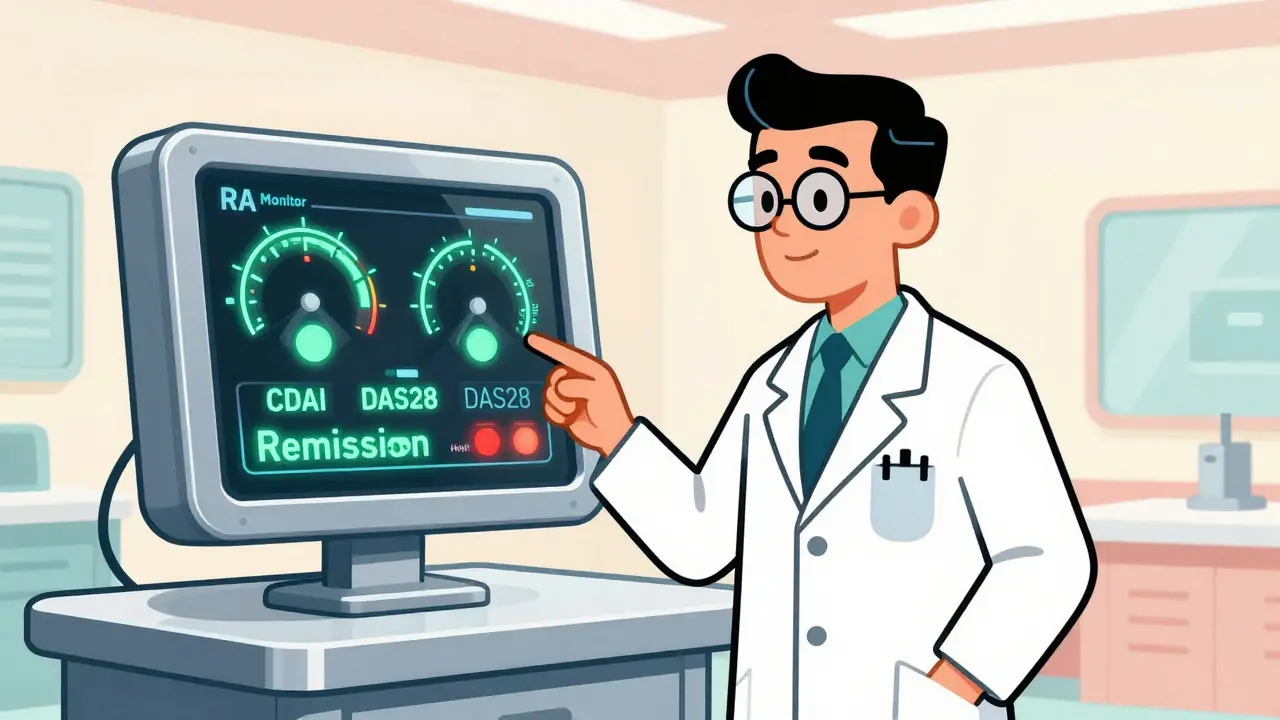
The goal isn’t just to feel better temporarily. It’s to reach a state called remission, where the disease is quiet enough that it won’t destroy your joints over time. This approach is known as treat-to-target. To hit that target, we need a dashboard. That dashboard consists of two main parts: composite clinical scores (CDAI and DAS28) and imaging (X-rays, Ultrasound, MRI). Let’s break down how each piece fits into your care plan.
Understanding Clinical Scores: CDAI vs. DAS28
Clinical scores are formulas that turn your symptoms into a single number. This number tells your rheumatologist if your disease is active, low, or in remission. The two most common scores are the CDAI and the DAS28. They look similar but have key differences that affect your daily life.
The Clinical Disease Activity Index (CDAI is a composite measure that quantifies RA disease activity through tender joint count, swollen joint count, patient global assessment, and physician global assessment) was developed by the American College of Rheumatology (ACR) in 2005. It is popular because it is simple. It does not require blood tests. Your doctor counts how many joints are tender (painful when touched) and how many are swollen. You rate your overall health on a scale of 0 to 10, and your doctor does the same. These four numbers are added together. The result ranges from 0 to 76.
- Remission: Score less than 2.8
- Low Disease Activity: 2.8 to 10
- Moderate Disease Activity: 10 to 22
- High Disease Activity: Greater than 22
The beauty of CDAI is speed. Since no lab results are needed, your doctor can calculate it right there in the exam room. This allows for immediate decisions about your treatment. A large study involving nearly 4,000 patients found that CDAI correlates very strongly with what doctors see clinically. However, because it skips blood tests, it might miss inflammation that isn’t causing obvious swelling yet.
The Disease Activity Score 28 (DAS28 originated in the 1990s through EULAR research and exists in two primary variants: DAS28-ESR and DAS28-CRP) is the other major player. It includes everything in the CDAI but adds a blood test marker for inflammation. You can choose between using Erythrocyte Sedimentation Rate (ESR) or C-Reactive Protein (CRP). The formula is more complex, factoring in your age and how long you’ve had RA.
While DAS28 gives a fuller picture of internal inflammation, it has a practical downside. Blood results often take days to come back. In real-world clinics, this delay means doctors sometimes have to make temporary treatment guesses while waiting for the final score. If you prefer data-driven decisions based on all available evidence, DAS28 is powerful. But if you want quick, point-of-care adjustments, CDAI is often preferred by US practitioners.
| Feature | CDAI | DAS28 |
|---|---|---|
| Blood Test Required? | No | Yes (ESR or CRP) |
| Calculation Time | Immediate (during visit) | Delayed (pending lab results) |
| Best For | Routine quick checks | Research & detailed inflammatory tracking |
| Remission Threshold | < 2.8 | < 2.6 |
The Role of Imaging in RA Monitoring
Scores tell us how you feel and what the doctor sees. Imaging shows us what is actually happening to the bone and tissue underneath the skin. There are three main types of imaging used for RA: X-rays, Ultrasound, and MRI. Each has a specific job.
Conventional Radiography (X-rays are the traditional gold standard for detecting structural damage like erosions and joint space narrowing) has been around since the 1940s. It is cheap, widely available, and great for seeing big problems. Doctors use a scoring system called Sharp/van der Heijde to measure erosion and narrowing across 44 joints in your hands and wrists. The problem? X-rays are slow to change. It can take six to twelve months of active disease before an X-ray shows any new damage. By then, the harm is already done. That’s why X-rays alone aren’t enough for early monitoring.
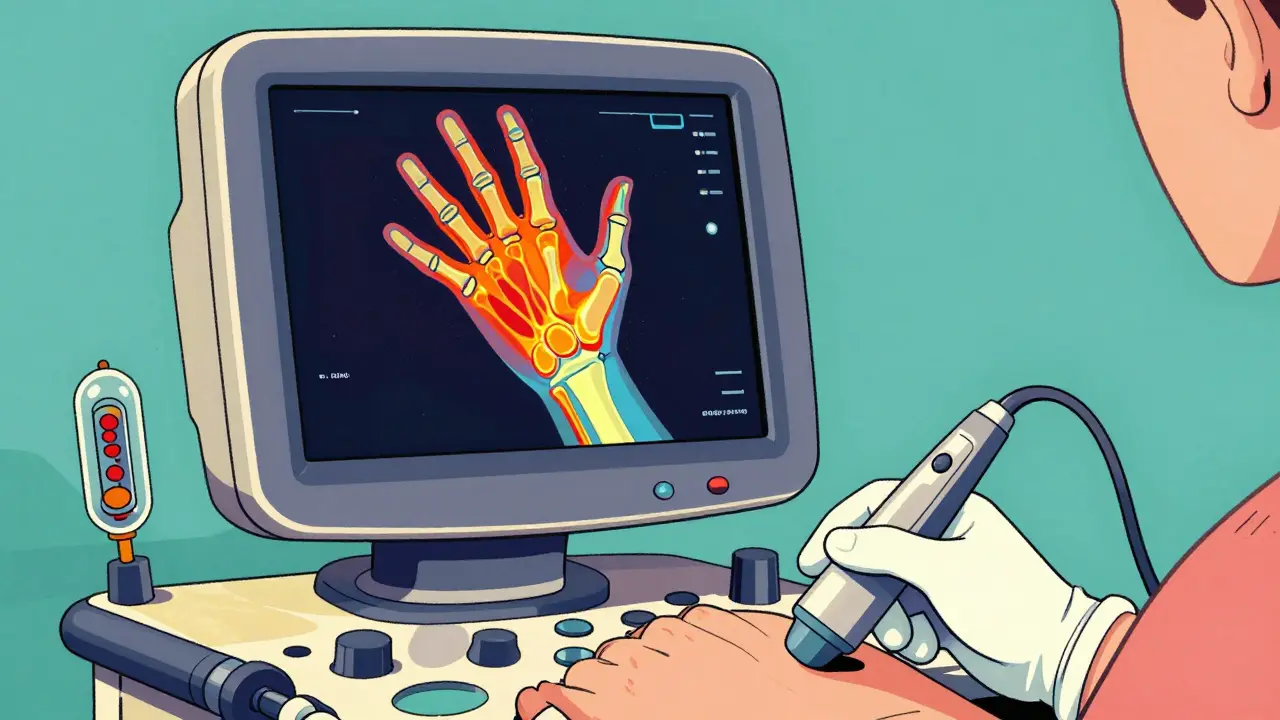
This is where Musculoskeletal Ultrasound (Ultrasound uses sound waves to detect synovitis and blood flow in joints, offering immediate visual feedback) shines. Introduced clinically in the 1990s, ultrasound can see inflammation (synovitis) that you can’t feel and that doesn’t show up on X-rays. It uses "Power Doppler" to detect increased blood flow, which is a sign of active inflammation. It is fast, relatively inexpensive (around $150 per scan), and provides instant results during your appointment. Studies show ultrasound detects synovitis with 85% sensitivity, compared to just 65% for physical exams alone.
Magnetic Resonance Imaging (MRI is the most sensitive tool for detecting pre-erosive changes like bone edema, but it is costly and less accessible) is the high-tech option. It can see "bone edema" (swelling inside the bone) months before an erosion appears. It is incredibly accurate, predicting future erosions with 89% sensitivity. However, an MRI costs significantly more (often over $1,200 in the US) and takes longer to schedule. Because of this, it is usually reserved for difficult cases or specialized centers rather than routine check-ups.
Putting It All Together: The Treat-to-Target Strategy
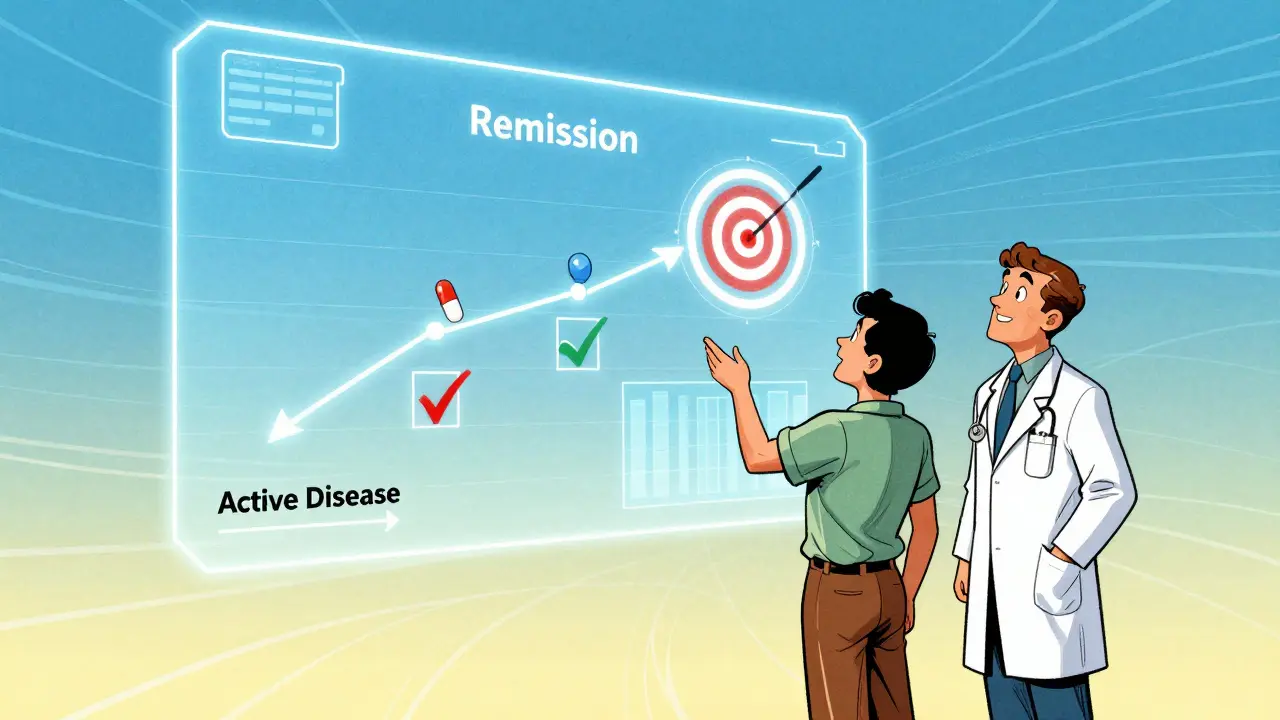
Why do we bother with all these numbers and scans? Because simply treating pain isn’t enough. The current standard of care, endorsed by both the ACR and EULAR, is "Treat-to-Target." This means your doctor sets a goal (usually remission or low disease activity) and adjusts your medication every few weeks or months until you hit that goal.
Here is how the pieces connect: 1. Assessment: Your doctor calculates your CDAI or DAS28 at every visit. 2. Verification: If your score says you are in remission, but you still feel stiff, they might order an ultrasound to check for hidden inflammation. 3. Action: If the score is high, they adjust your drugs. If the score is low but imaging shows damage risk, they might keep you on therapy longer. This systematic approach reduces joint damage progression by 30-50% compared to just watching and waiting. It turns RA management from a guessing game into a science.
Common Challenges and Patient Perspectives
Even with great tools, things don’t always go smoothly. One big issue is the disconnect between what patients feel and what doctors measure. In studies, about one-third of patients report feeling worse than their doctors think they do. This "discordance" can lead to frustration. You might be told you are in remission based on a low CDAI score, but you’re still exhausted and achy. Fatigue, for example, is poorly captured by standard scores but affects your quality of life deeply.
Another challenge is access. While 92% of US rheumatology practices use composite scores, rural areas often lag behind. And while ultrasound is becoming more common, not every clinic has a rheumatologist trained to perform it. Proper interpretation requires significant training-about 150 supervised scans to reach expert-level accuracy. If your doctor isn’t trained, the scan might not add much value.
Finally, there is the anxiety of self-reporting. Many apps now let you track your symptoms digitally. While convenient, some patients worry that reporting high pain levels will trigger aggressive treatments they don’t want. Open communication with your doctor about your goals is key here. Remember, the score is a tool for *you*, not just a metric for them.
Future Directions in RA Monitoring
The field is moving fast. We are seeing AI-powered software that can automatically analyze ultrasound images, reducing human error. Wearable sensors are being tested to track movement and activity continuously, providing data between visits. By 2027, experts predict that half of RA monitoring could involve remote data streams combined with traditional clinic assessments. This means fewer office visits and more personalized care based on your actual daily life.
What is the difference between CDAI and DAS28?
The main difference is that CDAI does not require blood tests, while DAS28 uses either ESR or CRP blood markers to measure inflammation. CDAI can be calculated immediately during a visit, making it faster for routine decisions. DAS28 provides a more comprehensive view of systemic inflammation but depends on lab results, which may cause delays.
How often should I get imaging for Rheumatoid Arthritis?
There is no one-size-fits-all rule. X-rays are typically done annually or biannually to check for structural damage. Ultrasound may be used more frequently if your clinical scores don't match your symptoms. MRI is usually reserved for initial diagnosis or complex cases due to its cost. Your doctor will decide based on your disease activity and risk factors.
What does a CDAI score of 10 mean?
A CDAI score of 10 indicates "low disease activity." This is a good sign, but it is not quite remission (which is below 2.8). At this level, your doctor will likely continue your current treatment to try to push your score lower into the remission range, preventing long-term joint damage.
Can ultrasound replace X-rays?
No, they serve different purposes. Ultrasound is excellent for detecting active inflammation (synovitis) and blood flow early in the disease process. X-rays are better for assessing established structural damage like bone erosions and joint space narrowing. Most comprehensive care plans use both at different stages.
Why do my symptoms not match my DAS28 score?
This discordance is common. Composite scores focus on joint counts and inflammation markers, but they don't fully capture fatigue, stiffness duration, or functional limitations. If you feel worse than your score suggests, talk to your doctor. They may use additional tools like ultrasound or assess other factors like sleep and mental health to get a complete picture.