
Mandatory Substitution Worldwide: Legal Frameworks Compared
 Jun, 19 2026
When you hear the phrase mandatory substitution, what comes to mind? For a banker in London, it might mean swapping collateral in a repo agreement. For a lawyer in Toronto, it could involve appointing a decision-maker for a client with dementia. For a chemical engineer in Frankfurt, it likely means replacing a toxic substance in a product line. The term is the same, but the reality on the ground varies wildly depending on where you are and which law applies.
This isn't just semantic confusion. It’s a fundamental split in how global regulators handle risk, rights, and safety. In some jurisdictions, substitution is a rigid mandate designed to protect systemic stability or public health. In others, it’s a flexible tool-or even a contested concept that violates human rights. Understanding these differences is critical for anyone operating across borders, whether you're managing financial exposures, advocating for patient autonomy, or formulating consumer goods.
The Financial Sector: Risk Transfer vs. Operational Reality
In the world of high finance, mandatory substitution is primarily about risk management. Specifically, it refers to how banks calculate their exposure to large borrowers. Under the European Union’s Capital Requirements Regulation (CRR), specifically Article 403(1), financial institutions are required to substitute exposures to collateral issuers in tri-party repurchase agreements with exposures to the tri-party agent. This rule became mandatory on June 28, 2021.
The logic behind this is straightforward: if a bank holds collateral from a third party, the regulator wants the bank to treat the agent holding that collateral as the primary counterparty for risk calculation purposes. The European Banking Authority (EBA) published guidelines to ensure this happens consistently. However, the industry pushback was immediate and vocal. The Association for Financial Markets in Europe (AFME) argued that this approach is "not prudent from a risk management perspective." They warned that forcing this substitution could encourage institutions to record exposures to clients rather than guarantors, potentially increasing systemic risk.
| Jurisdiction/Body | Approach | Rationale | Industry Impact |
|---|---|---|---|
| European Union (CRR) | Mandatory Substitution | Standardize risk calculation; prevent regulatory arbitrage | High operational costs; IT system overhauls |
| United States (Fed/FDIC/OCC) | Optional/Discretionary | Internal models deemed more accurate for complex risks | Lower compliance burden; reliance on internal data |
| Basel Committee | Optional Substitution | Provide flexibility for different market structures | Global standard with local implementation variance |
The transatlantic divide here is stark. While the EU made it mandatory, US regulators-the Federal Reserve, FDIC, and OCC-maintained an optional approach in their 2018 Large Exposure proposal. They argued that standardized approaches were not adequate replacements for internal models. This divergence creates an "unlevel playing field," as AFME noted. Post-Brexit, we’ve seen real-world consequences: roughly 22% of EU-based financial firms shifted certain tri-party repo operations to London to avoid the stricter EU substitution requirements. For mid-sized banks, implementing the CRR rules cost an average of €1.2 million per firm in IT modifications alone, with timelines stretching from six to nine months.
Mental Health Law: Autonomy vs. Protection
If financial substitution is about numbers, mental health substitution is about identity and rights. Here, "substitute decision-making" refers to appointing someone else to make choices for a person who lacks capacity. This is where the legal frameworks clash most violently with international human rights standards.
The cornerstone of this debate is the Convention on the Rights of Persons with Disabilities (CRPD). Article 12 of the CRPD affirms equal recognition before the law. The CRPD Committee’s General Comment No. 1 (2014) took a hardline stance: traditional substitute decision-making models violate this right. They argue that all forms of substituted consent should be abolished in favor of supported decision-making.
Yet, domestic laws tell a different story. In Ontario, Canada, the Substitute Decisions Act (1992) still operates largely on a substitute model, though it is considered "relatively comprehensive and rights-oriented" compared to peers. When Canada ratified the CRPD in 2010, it added a reservation explicitly stating its understanding that Article 12 allows for both supported and substitute decision-making. Australia followed suit, signing in 2007 and ratifying in 2008 with similar interpretive declarations.
In England and Wales, the Mental Capacity Act (2005) provides a robust framework for substitute decision-makers, prioritizing the "best interests" of the individual. Northern Ireland has its own version under the Mental Capacity Act (Northern Ireland) 2016. Victoria, Australia, recently updated its approach with the Guardianship and Administration Act (2019). Despite the CRPD’s pressure, only 37 out of 182 ratifying countries have fully aligned their mental health legislation with Article 12 requirements. As of 2022, 68% of nations still maintain some form of mandatory substitute decision-making. The tension is palpable: frontline workers in Ontario report a 12% reduction in coercive interventions since shifting toward supported models, yet they struggle with severe cognitive impairments where support isn't enough. The UK’s proposed 2023 reforms aim to cut compulsory interventions by 30%, but full implementation is delayed until 2026, highlighting the slow pace of legal change.

Environmental Regulation: Chemical Safety and Innovation
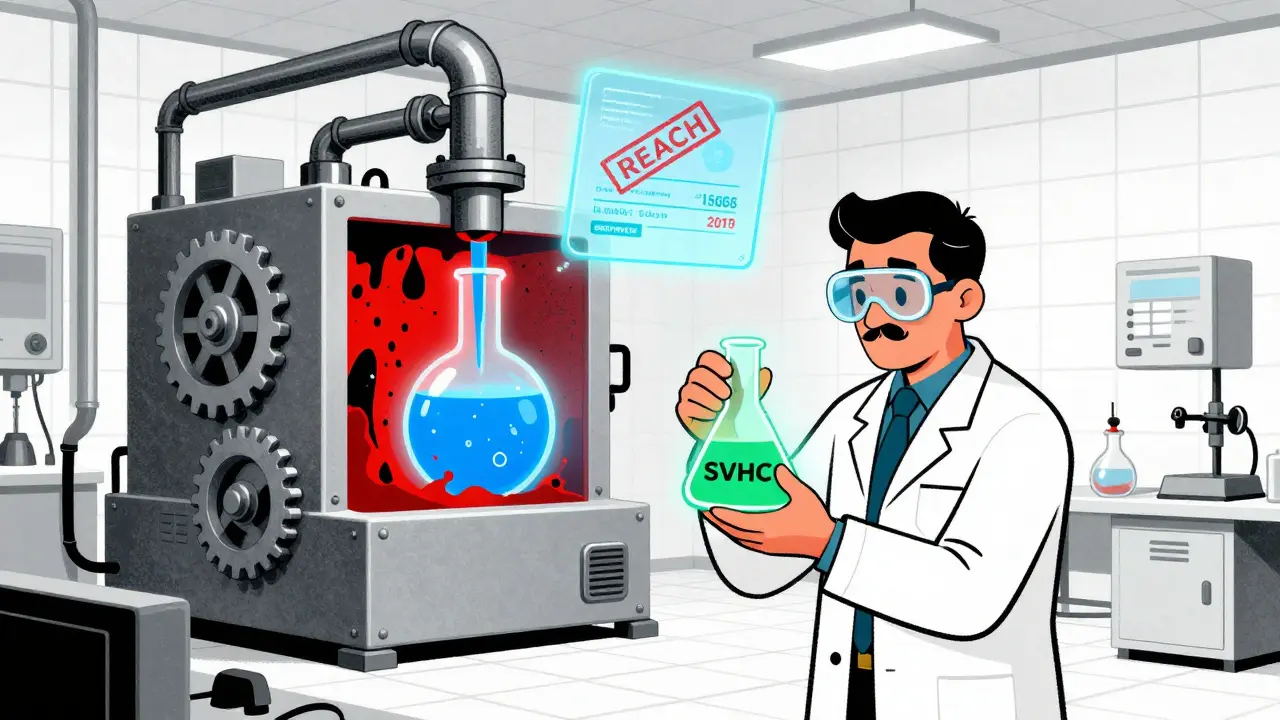
In the environmental sector, mandatory substitution drives innovation through restriction. The EU’s REACH regulation (Registration, Evaluation, Authorization and Restriction of Chemicals) is the gold standard here. It requires companies to identify substances of very high concern (SVHC) and plan for their substitution. This isn't just a suggestion; it's a core part of the authorization procedure. If you want to use a hazardous chemical, you must prove there is no viable alternative or that the socio-economic benefits outweigh the risks.
This framework has forced massive changes in industry. BASF, one of the world's largest chemical manufacturers, documented a 23% reduction in SVHCs in its product formulations between 2016 and 2020. However, the cost of compliance is steep. Small and medium-sized enterprises (SMEs) face average annual compliance costs of €47,000 per authorization application. Furthermore, the European Chemicals Agency (ECHA) reported that 62% of initial authorization applications were rejected due to inadequate alternatives assessments, pushing processing times to an average of 18 months.
While REACH is mandatory, other tools operate voluntarily. Sweden’s PRIO list and ChemSec’s SIN List act as early warning systems, encouraging substitution before regulations force it. The EU’s 2022 Chemicals Strategy for Sustainability aims to expand mandatory substitution planning to all restrictions by 2025. With 27 new substances added to the candidate list in 2023 alone, the pressure is mounting. Globally, the environmental substitution market has grown to $14.3 billion, driven by similar regulations in 42 countries. Yet, experts like Dr. Andrew Watterson question whether current enforcement mechanisms are strong enough to deliver on the promise of safer chemicals without clearer criteria for what constitutes a "suitable alternative."
Implementation Challenges Across Borders
No matter the domain, the gap between policy and practice is wide. In banking, J.P. Morgan’s internal assessment showed a 15-20% increase in operational costs for complying with EBA guidelines. The complexity lies in the "non-exhaustive list of circumstances" that can trigger material concerns, leaving banks guessing. In mental health, England’s Care Quality Commission found that 78% of trusts only achieved full training compliance after mandating 16-hour certification programs. You can’t just write a law; you have to train thousands of professionals to apply it.
For chemical manufacturers, the challenge is technical expertise. ECHA data shows that specialized toxicology knowledge is scarce, leading to high rejection rates. Support resources vary wildly: the EBA established a dedicated Q&A forum with 247 clarifications for CRR, while mental health sectors rely on localized bodies like Ontario’s Capacity Assessment Office, which processed over 14,000 assessments in 2019 with 28-day wait times. These bottlenecks reveal that mandatory substitution is as much about resource allocation as it is about legal text.
Future Outlook: Convergence or Divergence?
Where is this heading? In finance, we’re seeing increased harmonization. 78% of regulatory experts predict greater alignment in financial regulation by 2030, driven by the need for global stability. However, the Basel Committee’s 2023 update preserved optional substitution, keeping the transatlantic gap open. In mental health, the momentum is slowly shifting toward supported decision-making, but entrenched legal traditions resist rapid change. Expect ongoing tensions through 2035 as courts grapple with CRPD interpretations. In environmental law, the trend is clearly toward stricter mandates. The expansion of REACH-like frameworks globally suggests that substitution will become the default expectation for hazardous materials, driving further R&D investment in safer alternatives.
What is the difference between mandatory and optional substitution in banking?
In banking, mandatory substitution (as seen in the EU's CRR) forces institutions to calculate risk based on the tri-party agent holding collateral, regardless of internal models. Optional substitution (used in the US and by the Basel Committee) allows banks to use their own internal risk models if they deem them more accurate, providing flexibility but creating regulatory divergence.
Does the CRPD ban all substitute decision-making?
The CRPD Committee interprets Article 12 as requiring the abolition of substitute decision-making in favor of supported decision-making. However, many countries, including Canada and Australia, ratified the convention with reservations or interpretive declarations that allow for substitute decision-making in specific circumstances, creating a legal gray area.
How does REACH enforce chemical substitution?
REACH enforces substitution through the authorization procedure. Companies using substances of very high concern must apply for authorization and demonstrate that risks are adequately controlled or that socio-economic benefits outweigh harms. If viable alternatives exist, authorization may be denied, effectively forcing substitution.
Why do financial firms move operations to avoid mandatory substitution?
Mandatory substitution increases operational costs and complexity. Firms may shift operations to jurisdictions with optional substitution (like the US or post-Brexit UK) to reduce compliance burdens, utilize more accurate internal risk models, and lower the capital requirements associated with standardized risk calculations.
What are the main challenges in implementing supported decision-making?
Key challenges include the high cost of training professionals, the difficulty of supporting individuals with severe cognitive impairments, and the lack of standardized legal frameworks. Additionally, cultural resistance to moving away from paternalistic "best interest" models slows adoption.